

Print Story
X




With Buner and neighbouring districts witnessing horrifying destruction this week, welfare organisations have rushed to offer help
In the quiet hujra of Pir Baba in Buner district, hundreds of villagers had gathered in silence. Their eyes weary; their clothes soaked in mud; and their hearts heavy with grief. Volunteers entered one after the other, carrying lifeless bodies wrapped in wet sheets. As the faces of the dead were revealed, cries pierced the still air. Screams echoed the sky and shook the walls of the hujra.
“It was the most painful scene I have ever witnessed,” said Ashfaq Ahmad, a volunteer for Al-Khidmat Foundation. His shalwar qamees was drenched in mud and blood. “We have recovered 28 dead bodies in Beshonai village alone,” he whispered; his voice trembling.
That morning, heavy rain and sudden flash floods had torn through Pir Baba and nearby villages. Whole families were wiped out in minutes. Haider Khan Buneri, an eyewitness, recalled a haunting scene.
“Some bodies were found without limbs,” he said. His voice broke as he described the sight of a young mother holding her newborn. “A baby of barely twenty days was still in the mother’s lap. The child never left her embrace. Even as the flood swept them away, her hands did not let go. Both were martyred together, under heavy mud.”
Stories like these echoed across the district. Sadat Khan, a resident of Beshonai, lost 18 family members. “Our land has faced a natural disaster,” he said. “The damage is beyond words. Whole populations were swept away in the blink of an eye.”
Salman, another villager, stood in shock. While he and his nephew had gone out of the house, all 26 members of his family, including his parents, wife, children and siblings, perished.
“It was around 9am in the morning when the cloudburst happened,” said another survivor, tears trickling down his face. “Within seconds, the entire village was under water. I buried 13 members of my family that day. Nine from my brother’s house and four from my uncle’s. I will never forget that scene.”
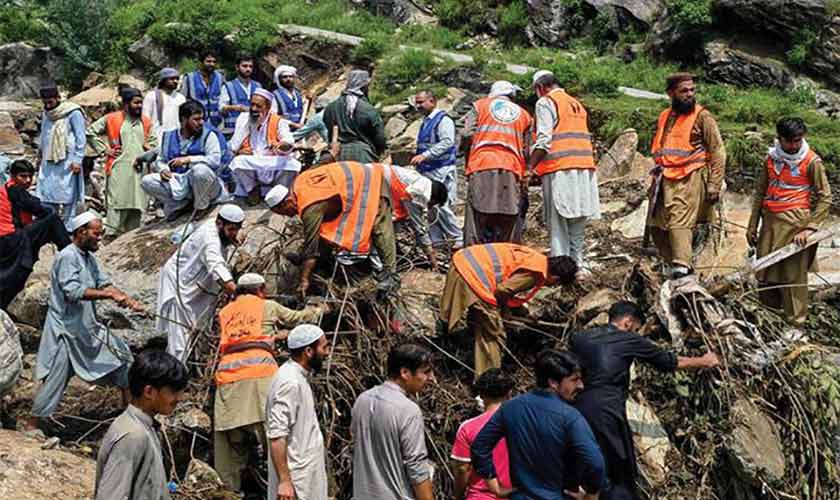
A social worker who had just returned from Beshonai described the grim images. “More than half of the village has been washed away. People are removing stones with their bare hands because their loved ones are buried under them. Without heavy machinery, recovering the bodies is almost impossible.”
The warm weather has made the situation worse.
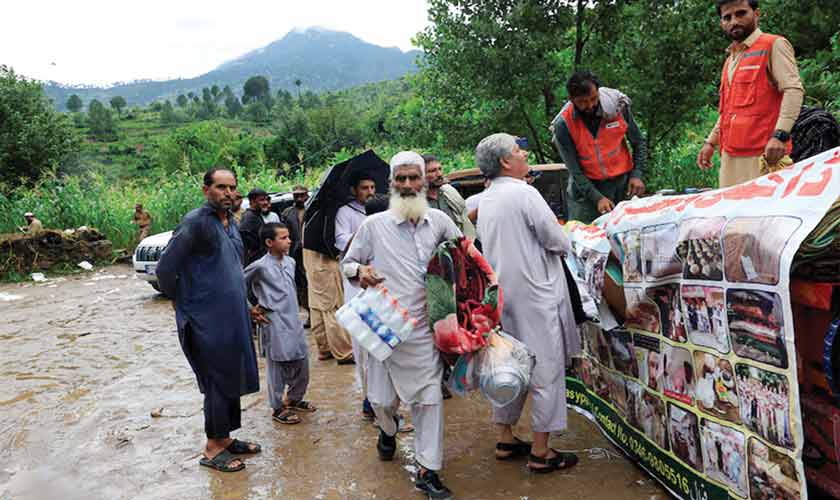
The Al-Khidmat Foundation has deployed a staff of 1,100 in Buner alone. Eleven ambulances and ten medical camps have been set up. Food has also been distributed among survivors.
“The bodies are beginning to rot,” he said. “Still scores of people are missing. The bodies might lie under the heavy rocks.”
The floodwaters not only destroyed homes but also tore apart generations. One survivor recalled seeing a father holding his lifeless son in his lap, kissing his face again and again. “He kept whispering to him, hoping he would breathe once again.”
Another eyewitness spoke about a family of which 41 members had disappeared. “It was like doomsday,” said the younger brother of the medical superintendent of the Headquarters Hospital, Dagar. “For the first time, I saw entire villages being buried under stones. I found a father and his three-year-old child... but it was too late.”
These stories, repeated across Buner and neighbouring districts, reveal not just the destruction of houses but also the perishing of people and communities.
Despite the overwhelming destruction, local and national relief groups have rushed to the area. The Al-Khidmat Foundation has been one of the most active. Akbar Khan, the foundation’s district president, shares details of their work.
“Two village councils have been destroyed 70 percent,” he says. “Over 200 bodies have been recovered so far; 30 of those were recovered by our volunteers with their bare hands.”
The foundation has deployed a staff of 1,100 in Buner alone. Eleven ambulances and ten medical camps have been set up. Food has been distributed among survivors. “We have prepared 70 mass graves for the martyrs,” Akbar Khan adds. “We urgently need more food, shelter and medicines for the people.”
Other welfare organisations, including Shahbaz Welfare Foundation and Maaz Yousafzai Welfare Trust, have also been working alongside the government.
Still, the sheer scale of loss makes every effort seem small.
According to PDMA’s updated report released on August 17, the confirmed death toll included 273 men, 29 women and 21 children. Another 123 men, 23 women and 10 children were injured. Beyond human losses, the floods killed 320 livestock, further damaging livelihoods.
The destruction extended to property and infrastructure: 336 homes, 57 schools and 23 other structures were either damaged or destroyed. Swat alone lost 219 homes, with 42 completely flattened.
In Buner, 209 people were displaced and are now living under the open sky or in temporary shelters. The PDMA had also warned that heavy rains were expected to continue until August 21, raising fears of more floods and landslides. However, locals say there is no alert system to inform people in time. Hence, they rely on their conventional ways to keep themselves safe.
For the survivors, the pain will last long after the water recedes. In the hujra of Pir Baba, families continue to wait for their missing loved ones. Each body that is brought in brings another wave of wails—another reminder of the fragility of life.
“We buried our people together in mass graves,” said one villager quietly. “We had no other choice. There are too many of them.”
As relief efforts continue, the needs remain urgent: food, medicine, shelter, but above all, heavy machinery, to clear the debris. Without the latter, many families may never find closure, with their loved ones forever trapped under stones.
In the end, the people of Buner face an uncertain future—their homes now destroyed, but worse yet, their hearts shattered. For them, life is now divided between before the flood and after it.
“It was like qayamat,” said a survivor, with vacant eyes. “The day the sky fell and the water drowned us.”
The writer is a freelance journalist based in Peshawar.