Print Story
X




Ikram Ullah brings history and imagination together in a style that lingers in memory
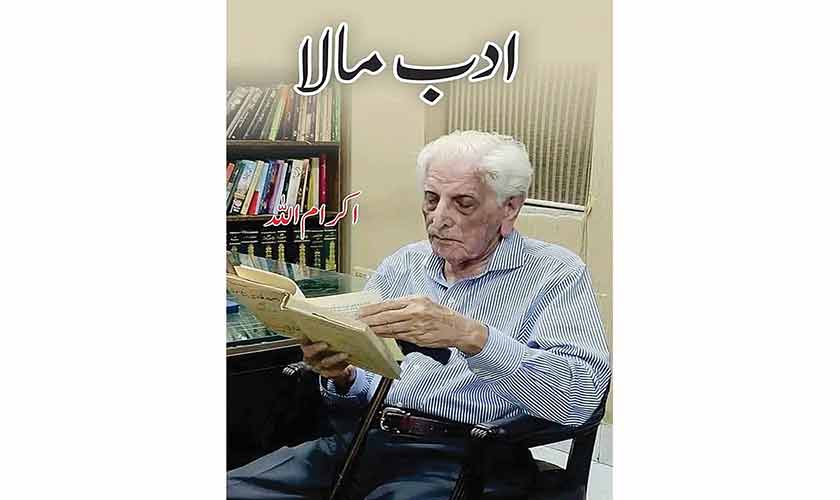
Ikram Ullah is not just a prominent figure in Pakistani Urdu literature but also the gentle glow of its radiant countenance. His work occupies a distinguished place in the literary canon. His vivid prose brings stories to life; endowing them with a persuasive charm. His almost indulgent language stimulates and nourishes thought. His compositions, , stitched seamlessly together, carry the echo of the tale told.
In some of his writings the story emerges at once, like a flicker of light. At other times it unfolds like mist at dawn, so subtly and exquisitely that the reader is not conscious of the moment when their imagination is taken by the hand and led forward. When the story ends, there is a whirlpool of astonishment to confront. It feels as if the reader has been suddenly thrown out of a magical realm back to the mundane world. It will not be an exaggeration or inaccuracy to call it the “fall of imagination.” Even so, the taste of the story lingers in the mind.
There is a profound sense that Ikram Ullah himself is telling the tale. He employs a narrative technique reminiscent of Faulkner and of Hemingway in The Old Man and the Sea. This gently holds the imagination by the hand.
Mario Vargas Llosa, the Peruvian novelist, in Letters to a Young Novelist, calls this “the hidden fact.” Ikram Ullah may be unique in Urdu literature in producing prose that could be called “fragrant.” In recall, it releases cascades of memory’s perfume, parfum du souvenir. His latest work, Adab Mala, has only deepened readers’ delight and longing. Published recently, it is a true “festoon of Urdu literature,” in which almost every prose genre is nestled like a rosary of gleaming pearls.
Two remarkable essays on books reveal Ikram Ullah’s sensitivity as a writer and his attentiveness as a reader. The pen sketches of Syed Muhammad Kazim and Muhammad Khalid Akhtar are written with such grace that their personalities come vividly alive before the reader. Ikram’s prose acquires an almost spoken power, so that when one reads these sketches, the figures of these literary giants unfold layer by layer.
The reader also discovers some new aspects of their lives: what Khalid Akhtar sahib feared or was haunted by; his perspective on writing; how his literary persona was shaped; and how he became the writer we remember today. Likewise, Kazim sahib’s deep fascination with Arabic literature is brought to light. Ikram Ullah also poses a poignant question: why did Kazim sahib’s uncle consider his pursuit of Arabic literary education contemptible? Why were education and livelihoods so tightly bound together?
He highlights the role of British colonial officers who muddled the waters for many by conflating government posts with prestige. This distortion still contributes to the identity crisis facing this nation. The sketch also explores the hidden reasons Kazim sahib abruptly turned away from certain religious ideas and from the Jamaat he had once worked for.
In a similar vein, Ikram Ullah recalls his years at the University Law College and the influence of Sardar Muhammad Iqbal, his law professor. He describes the Law College as a sanctuary of love and learning.
Ikram Ullah has spent much of his adult life in peaceful cities. The experience finds expression throughout his work. He stands with one foot in the bohemian literary world of Lahore, where he was celebrated for his writing and developed close ties with authors, poets, critics and fellow thinkers, and the other in the city beyond. These places shine resplendently in his prose and hold a vital, often prominent, place in his literary imagination.
When a great writer engages with history, it feels as though history itself has been given a voice.
His stories frequently dwell on places, on cities and their evolving social fabric. One might wonder why he is so intimately bound to cities; yet his connection to them is unmistakable. It becomes especially clear when reading his reflective memories of Lahore and Multan. Through these recollections, we see how his lived experience of both cities - after the early years of Partition - shaped his sensibility. They also reveal how poets and writers in Lahore viewed the world differently from historians, offering not only records of fact but also textured portraits of culture and society.
Among the writings in the book, Ikram Ullah’s most arresting, unusual and beautiful short story is Raigan (In Vain). It portrays the shifting relationship between parents and children in contemporary times. The story follows the fragile bond between a mother haunted by schizophrenia and her children, who, once married, gradually pull out of her orbit in an attempt to protect their own lives.
A mother might give up everything for her child. Even when she is afflicted with schizophrenia, the imprint of maternal love remains etched on her heart. Why then does the imprint on the child fade, once it child grows up? The vary child who could not live without his mother, who would weep oceans when separated from her, who would run into her lap at the mere sight of her, clutching her dupatta in his tiny fist; how does he, once grown, drift away from his mother, from her illness, from everything that once bound them?
The story leaves a large question mark: what role does society play in turning a human being into such a creature? Ikram Ullah offers no moral sermon, only a lingering question voiced through the figure of a schizophrenic mother.
His essay on Ghalib and Alf Layla (The Arabian Nights) is equally masterful, exploring their role in expanding the reader’s imagination. It becomes clear how deeply the tales (dastaan) of Alf Layla and other works of Urdu fantasy literature influenced Ikram Ullah and shaped his creativity. The dastaan not only captivates the imagination but also trains readers to think, to cultivate curiosity and to absorb folk wisdom.
For all that, while reading Ikram Ullah’s writings, I often wonder how far a writer’s imagination can extend; how it can become so vast and cosmic. As Ghalib says, “the wilderness of possibilities” is but a single footprint.
After finishing this gripping account, it struck me that the study of history is central to widening the imagination. History allows torrents of thought to travel across centuries in moments, to be drawn from shadowed veins and lifted to the Sidrat al-Muntaha, the farthest edge of imagination. For a great writer, history provides imagination with both strength and elevation.
If we were to strip history from the greatest Urdu novels and stories, their very foundations might collapse. The works of Waris Shah, Abdullah Hussain, Qurat-ul-Ain Hyder, Asad Muhammad Khan, Altaf Fatima and many other literary giants are steeped in history. It is history that gives imagination depth and beauty. It is the ground from which the story emerges.
Ikram Ullah, in particular, is drawn to the history of the world and of humanity. Strikingly, he has written long, comprehensive essays on human history, into which he weaves Ghalib’s verses to heighten their literary richness, a tasteful indulgence that leaves the reader quietly intoxicated. This reveals, resplendently and convincingly, that when a great writer engages with history, it feels as though history itself has been given a voice.
Ikram Ullah is one of the foremost intellectual figures of post-colonial Pakistani Urdu literature; his writings will continue to shape its course. His craft has become part of the canon of Pakistani literature and imagination, comparable in stature to Charles Lamb. A reclusive, yet spellbinding writer, he has left a lasting imprint on the Urdu literary tradition.
Ikram Ullah has also gestured towards the future: how technology has reshaped the inner world of human beings and how it may in turn influence the contours of Urdu literature in the years ahead. This book is immensely alluring and absorbing. Not reading it will amount to cruelty.
The writer teaches in the History Department at GCU Lahore and BNU