

Print Story
X




Ajea Zahid’s 3 Minutes Before Now invites us into a world where colour and time blur quietly
According to a Saudi proverb, to a hungry man, the sun is a flatbread. The same entities are perceived differently by different individuals, groups and societies. Take, for example, a work of art. To its maker, it is the expression of their ideas, a document of their struggle and testimony to its outcome.
For a shipper, however, it is merely a piece of cargo, something to be carefully packed and transported to generate revenue. Upon arrival at a gallery, the work, such as a painting that may have cost only a few thousand rupees to produce and transport, transforms into a more valuable article: handled with white gloves, catalogued and ultimately viewed as a means of earning a percentage in gallery commission once sold.
At a collector’s residence, it becomes an embodiment of taste, affluence and class, if not a tangible form of investment.
There are other ways of approaching art and related materials, beyond predictable routes. Some years ago, I visited an art supplies store in Lahore to buy Chinese bristle brushes, only to be told they were no longer imported. Religious circles, I was informed, had pressured the government into banning the product because it contained hog hair.
For me, the brush was valuable for its fluidity, manoeuvrability and potential to explore the possibilities of paint. For orthodox believers, however, the very same object was profane.
The story of visual art is also a history of religious currents, trade routes and cultural exchanges, far more than just aesthetic considerations. Much of the work that now adorns museums and fills the pages of art history books across continents was originally meant to be religious, decorative or functional.
A closer look at the chronology of colour reveals that not all shades were historically available or easily accessible. Lapis lazuli, extracted primarily from its ancient source in Badakhshan, Afghanistan, was once a rare and highly prized pigment, transported to medieval Europe at great cost.
It wasn’t just materials that travelled. Techniques and imagery were also carried by traders. Rembrandt, for instance, acquired Mughal court paintings as exotic imports brought by Dutch ships to the shores of Amsterdam. He later reinterpreted them with ink and brush.
Around the same period, European diplomats and missionaries introduced Western imagery to the subcontinent, primarily in the form of engravings (the equivalent of today’s photographs). These visual imports influenced the sense of space, introduced atmospheric perspective and encouraged a shift towards naturalism in Indian miniature painting during the reigns of Akbar, Jahangir and Shah Jahan.
Closer to our times, the palettes of impressionist and post-impressionist painters were transformed by Japanese woodblock prints, originally used to wrap delicate Japanese ceramics exported to France. Artists of that era were captivated by the compositions, bold colours and flatness of the imagery created by their Far Eastern counterparts. As a result, the influence of Japanese printmakers, particularly Hokusai and Hiroshige, can be clearly seen in the work of Vincent van Gogh, Paul Gauguin and Henri de Toulouse-Lautrec, among others.
Another factor that reshaped modern art was the invention of the paint tube, which allowed artists to step outside their studios and paint light, colour, water, people and nature while observing them in real time. More recently, the availability of industrial and house paints, in cans and tubs, enabled American abstract painters to expand the scale of their canvases. These vast surfaces were covered in drips, splashes, smudges and generous spreads of paint. Artists such as Jackson Pollock, Willem de Kooning, Franz Kline and others redefined the idea of easel painting with their energy, fluidity and uninhibited approach to materials.
The history of Pakistani art, especially painting, is also shaped by the materials available to artists. Painters from the generation following 1971 had access to a range of colours and brands, including Grumbacher (a foreign-donated brand distributed to artists in the late 1970s and early 1980s by the Pakistan National Council of the Arts), Rembrandt, Maries (a popular and affordable Chinese brand), Winsor & Newton, Daler-Rowney and Golden. Today, these are joined by newer options such as Gamblin and Sennelier.
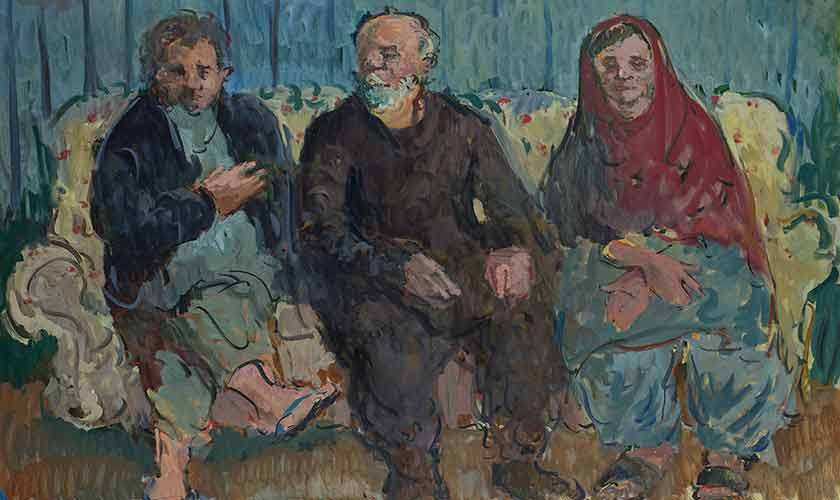
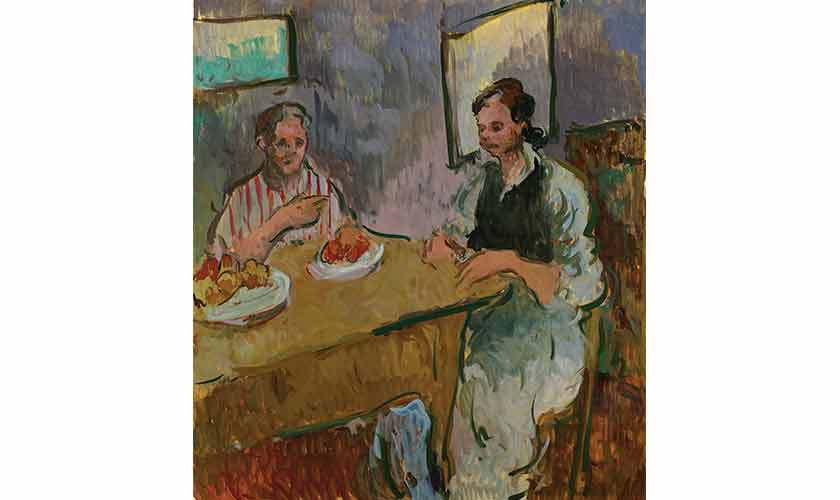
Ajea Zahid’s 3 Minutes Before Now invites us into a world where colour and time blur quietly Figures appear indoors, sitting close to one another, or outdoors in natural surroundings; yet they remain elusive.
Every artist develops an intimate relationship with their materials, a private dialogue marked by disagreement, confusion, struggle, misunderstanding and inquiry. At every stage of their creative practice, materials evolve, sometimes for the better, often simply as one among many. After graduating from the National College of Arts, Zahoor-ul Akhlaq continued working in oil alongside other techniques, but by the mid-1980s, he began transitioning to acrylics, a medium he explored regardless of changes in scale or subject matter.
Painters, particularly recent NCA graduates, continue to push the boundaries of the medium. This trend has been consistently evident at the Fine Art Department’s annual degree shows and was on display again in Ajea Zahid’s 3 Minutes Before Now (August 10-19, NumaishGah, Lahore). Zahid, who graduated in painting from the NCA in 2024, held her second solo exhibition at the same venue this year. She has also taken part in group shows in Pakistan, India and the UK.
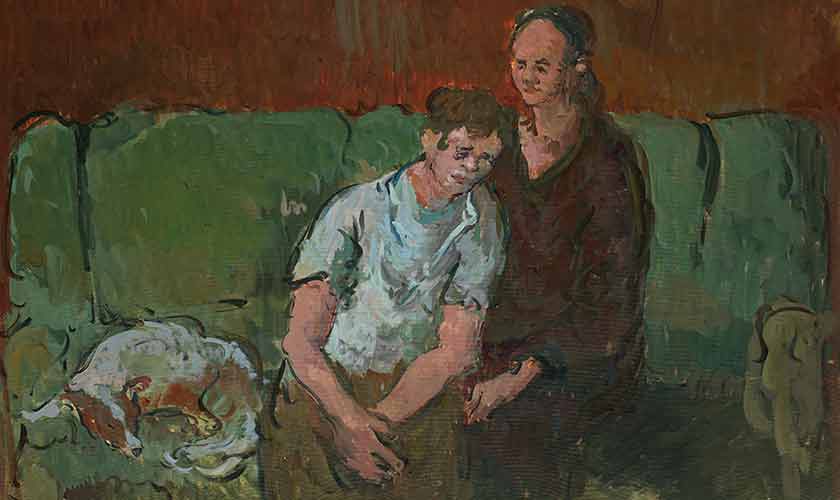
Ajea Zahid has caught viewers’ attention with her distinctive approach to paint application. Rather than filling in outlines or layering tones across the surface, she builds form using loose, liquid and lucid strokes. Though composed in oil paints, Sennelier’s works often resemble quick sketches or shapes moulded in plasticine. Figures appear indoors, sitting close to one another, or outdoors in natural surroundings; yet they remain elusive, intangible, like fleeting emotions, sensory impressions or momentary passions.
This ephemerality is reinforced by the titles of her paintings, which reference time and its passing: 1 Minute Snooze, 5 Minutes Before My Alarm to Work, A Moment in Your Arms, Same Time, Same Place, The Sofa For the Years. The show’s title, 3 Minutes Before Now, echoes this temporal sensitivity, evoking the in-between spaces of thought, memory and presence.
It appears that Zahid operates outside the confines of precise time, yet rather than resisting its fluidity, she embraces it. So do her characters, and so too, it seems, do her viewers. Her ease in capturing contour, spatial relationships, posture, movement, and, most crucially, emotional resonance, feels instinctive. The people who populate her compositions may be drawn from her own circle of family, friends and acquaintances, but to an outsider, they appear as dislocated figures, encased in their solitudes. As Zahid notes in her artist’s statement, her “nomadic upbringing within a naval family, where ideas of home and belonging constantly shifted,” deeply informs this sense of transience.
Even when her subjects are gathered around a round table, reclining on a sofa, walking side by side or seated close together, each retains a distinct identity, mainly defined through layered coats of colour and gestural strokes.
Zahid’s work may be described as paintings saturated with colour, but her palette remains restrained, muted, layered and often semi-transparent, revealing traces of past revisions or abandoned patches. Though her imagery may stem from lived experience or observation, what emerges on canvas is a quietly surreal world: one in which figures and objects dissolve into one another, like the softened butter we spread on our toast each morning, familiar, comforting and momentarily fluid.
The writer is a visual artist, an art critic, a curator and a professor at the School of Visual Arts and Design, Beaconhouse National University, Lahore. He can be contacted at quddusmirza@gmail.com.