

Print Story
X




Youth hailing from religious minorities in Pakistan are determined to carve a destiny for themselves
| C |
ounting on the results of the recent census (2023) and population trends, a conservative estimate of the minority youth in Pakistan (between 15-29 years) is 2.6 million. This includes about 1.2 million Hindu, 1 million Christian and 0.39 million Scheduled Caste youth. 92 percent of this population lives in Sindh and the Punjab. Ahmadi youth are around 42,000. Baha’i and Sikh youths number a few thousand each, and Kailash, Parsi and Buddhists in hundreds. Therefore, they are termed minor-minorities.
This young population spread over Pakistan is differentiable based on their locale, urban-rural divide, economic class, political orientation, educational and employment statuses. To understand the mental outlook and challenges of this large and diverse population, one has to look at the manifestations of their involvement and rely on personal interactions and information.
Varying outlooks and worldviews are identifiable among the youth belonging to various faith groups. For instance, an under-privileged Caste Hindu youth in Sindh feels more confident about opening a shop or starting a business than his Christian counterpart in the Punjab while the latter is a little more confident in expressing their religious identity in formal conversations.
The minority youth in rural and semi-urban areas are lagging behind in literacy (11-20 percent), as compared to national literacy ratios, therefore relying on traditional occupations such as agricultural labour, brick kiln workers, etc. Boys lucky enough to attend school usually study up to matric level. Though the gender gap (7-10 percent) between girls and boys in literacy rate is closing, minority girls are still behind in literacy standards and chances of employment (Punjab Bureau of Statistics, 2017). Minority girls fare better than boys if they get a chance to secure school-education. However, the dropout rate among girls appears to be higher than boys, somewhat consistent with national trends.
Many young Christian boys, especially in the Punjab, join vocational and technical professions owing to the Christian institutions in Sargodha, Gujranwala, Lahore and Karachi. This lot is largely socially and politically inactive, except on social media. Their worldview is mostly practical. It is often characterised by religious and family considerations. The scarcity of job opportunities is keeping this group of minority youth constantly on the move, in and out of the country.
The educated-urban youth often complain about the stress related to career issues. Even when trained in trades, professions and disciplines of market relevance, many are unemployed, underpaid or facing job insecurity, sometimes attributed to their minority status. They live under pressure and are always struggling for better opportunities. Seeking opportunities for education and employment abroad is a common conversation. Technicians, nurses and highly skilled youth are inclined to find greener pastures for employment and immigration.
The educated youth are less inclined to be politically active. The arena is dominated by the older generation and local power brokers. The jalsas of political parties filled by members of religious minorities are a result of the hard work of district office bearers of minority wings, labourers, etc.
Adnan Shahzad, a young graduate and aspiring leader, is of the view that: “The youth were enthusiastic to join politics till 2022; now they have become disenchanted. Subsequent political developments have pushed a large number of the educated youth back into political passivity.” The view was shared by Beesham Lal, a young law graduate from Sukkur, aspiring to begin his legal practice in Lahore.
The News on Sunday asked some minority youth about their idea of nationalism. They contended that the nationalism exhibited at times of war or a cricket match against India, is mostly customary and lacks depth. Beesham Lal, thinks that minority youth are “ready-made for progressive ideas.” The social and institutional discrimination that they face on account of their religious identity makes the minority youth aware of the need for inclusivity and integration and the openness that the society and the state need.
“You will find minority youth in different cadres of political parties, civil society organisations, etc, but the prospects of them joining politics are not encouraging at the moment,” says Beesham Lal.
Generally speaking, the minority youth are displaying optimism and energy. It is no surprise that one finds them in many fields: education, music and fine arts, as well as sports. Some have won gold medals in international competitions, for instance, in power lifting (the Sohail sisters), gymnastic (Maria Rose) and snooker (Babar, Sattar). The Christian and Baha’i youth, in particular, have found a place in the informal music industry. These trends speak of their resilience and dreams of making a meaningful contribution to their own well-being and that of the society at large.
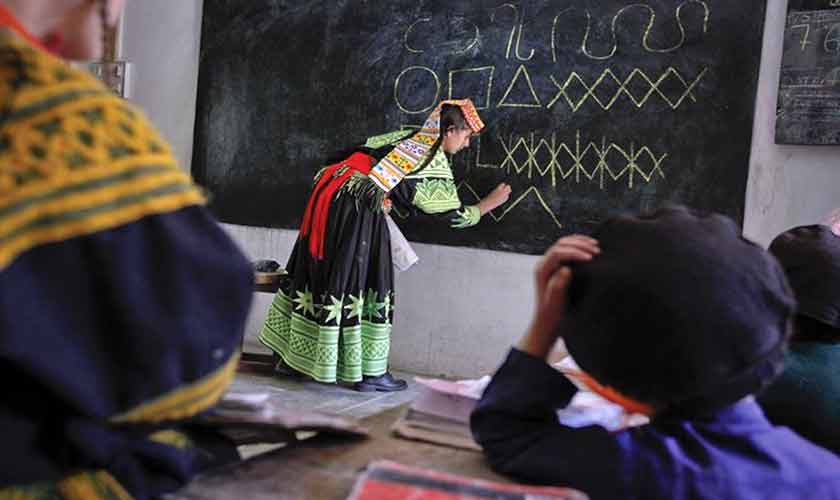
The situation of the Kailash community is an interesting case study of minor-minorities. The Kailash youth appear to be conscious of their existential needs owing to the size of their community (around 4,200 according to Imran Kabir, a leading member of the community). Religious identity is pivotal to dress code and language and yet, they do not feel the need to propagate their religious beliefs. It is encouraging that Kailash youth are seeking education and joining various professions, such as in tourism, science and IT.
Depending on the locale and environment, the minority youth are expressive about their beliefs in multi-faith gatherings. They are active on social media, exercising their freedom of expression to varying degrees.
Given these indicators, it can be inferred that the minority youth predominantly manifest a forward-biased outlook. Irrespective of issues common to Pakistani youth in general, and those specific to religious minorities, they are determined to carve a destiny for themselves that will be brighter than the prospects they were born with. They maintain their religious individuality in a trying environment but are not antagonistic. One wishes this generation the best of luck.
The writer is a researcher, freelance journalist and human rights activist working with the Centre for Social Justice. He can be reached at jacobpete@gmail.com.