

Print Story
X




A look at the bright minds of learning and aspirations in the education sector
| F |
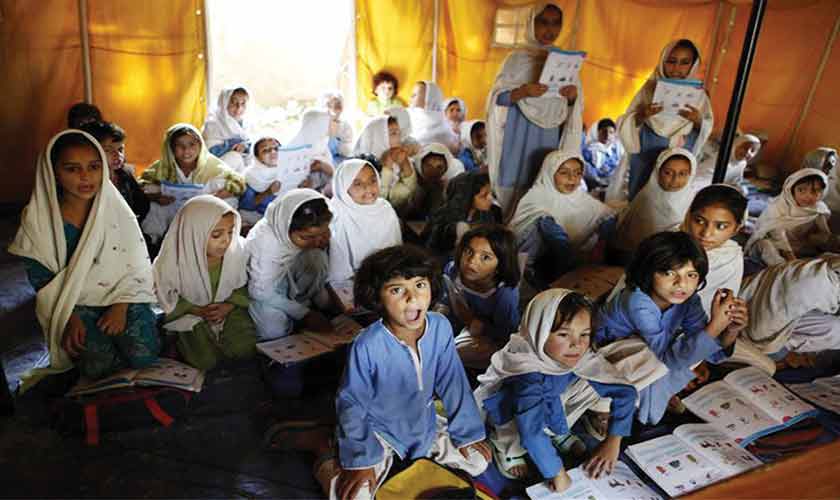
or Sana, who was studying in a government school managed by passionate and capable citizens of the country, her hopes and dreams for life were transformed through enabling education. This meant opportunities to learn holistically: through her head, heart and gut; managing not just academics, but preparation for university interviews and successfully enrolling in the best institution in Pakistan to pursue her professional degree of choice, that too on merit. The days of charity and pity were over. As a daughter of a domestic worker, a single mother, she felt empowered as the first-generation literate reaching the skies to forge ahead, competing with the best. Today, fortunately there are many Sanas supported by such initiatives by design and intention in education, sports and enterprise.
On this Independence Day, why do I feel optimistic and hopeful? What is different in a landscape where we are constantly reminded of 26-28 million out of school children; 77 percent learning poverty; demoralised adolescents/ youth, not in education, employment or training (NEET); runaway population; stunting (40 percent); and climate change episodes? It is not because I am a compulsive ‘half-glass-full’ type person. It is due to trends of hope and agency that are mushrooming across the country. I will begin with champions within the government; I have worked with several of them. Professor Anita Ghulam Ali, Shahid Kardar, ministers, chief secretaries, several secretaries of federal and provincial education and finance departments who have not only adopted, upheld and scaled up innovations and partnerships that work in a system but have also taken bold steps to mobilise and utilise resources in an otherwise abysmally constrained sector. What were they adding to the resource and procurement pipeline and transforming the system for? Better services and opportunities for a broader vision of education, not just the myopia of academics and high stakes board exams.
These courageous frontline state actors began to redefine the purpose of education to life skills, exposure to sports, debates, voice, technology, robotics, arts, heritage and enterprise; opportunities that inevitably entail enabling and decent facilities for learning and local leadership for meaningful encounters. This may be in the form of classrooms that work, libraries, tech/ AI/ robotics labs, playgrounds, tennis/ basketball/ padel courts to skating rinks, sports galas, learning and STEM festivals, arts, financial inclusion and enterprise through devolved leaders and yes, in government-run and government-financed schools/ colleges/ museums and arts councils. Critics may say that these are only in a minority of institutions. But when champions from within the state begin to walk the talk, learn from others and devise at-scale solutions, they influence their colleagues in power who begin to replicate those habits and institutional shifts.
After decades of talk, Islamabad Capital Territory government schools/ colleges (425) boldly moved forward within just 14 months to transform the fragile fabric of their education malaise through a multi-sectoral lens. This meant addressing health, nutrition and upgrading facilities to 21st Century attributes in all subjects as well as sports, technology, libraries and labs, school based and cluster mentors, summer schools; life skills and more spearheaded by the federal secretary, who had attempted similar holistic transformations in the entire Gilgit Baltistan as the chief secretary through vision, will, guts and skills while working within the system. Some of the government financed projects were re-purposed to meet the costs of this transformation. In other instances, philanthropy, partners and innovative procurement was mobilised to open the choked pipelines to education reform.
Ideas for change were sought recently from the best minds in foundational and tech-based learning—even a visit to the famous ‘sobral education experiment in Brazil’ that led to a municipality changing the landscape of one of the nine most populous countries like Pakistan. What is significant is that today there are many champions emerging in the public sector who are seeking ways to set up schools of eminence on similar and expanded patterns, progressively beginning with 150 institutions in all districts of the Punjab. It is not just the facilities but leaders who are speaking about opportunities for children, especially girls, to learn, debate, play, experiment and be heard.
In Sindh, Balochistan and Khyber Pakhtunkhwa, public sector champions for education are speaking, planning and boldly implementing such programmes with bigger funds transferred to SMCs to spend at local-school level. Partnerships are getting bolder too for transforming schools that make children thrive; that practice tech-based learning and early years enrichment. There is a genuine sense of wanting children and our youth to be safer, happier with many more opportunities to learn, creating virtuous cycle of well-being and liberation.
When the government asks civil society to show their mobile libraries and seeks to expand these to 50 in one go—with multiple learning opportunities in deserving schools and communities—we know that there are good ideas and spaces multiplying in Pakistan. When the Civil Services Academy of Pakistan begins to train cohorts of civil servants to become storytellers, inclusive innovators, with appreciation of culture, arts and data for change, there is something good brewing. When a headteacher gets selected from Pishukan for a Chevening scholarship and wants to transform lives of hundreds of young girls through cutting edge critical thinking, climate change activism, arts and STEM for gender and social justice, you just want to salute these brave agents of change. When a curator for a museum (Peshawar, State Bank of Pakistan, Mohatta) wants to mobilise funds from government to bring hundreds of schools to visit living heritage, you know that winds of change are gaining speed with resilience.
The government and its foundations are open to actively collaborating with the TCF, Kiran Foundation, ITA, Akhuwat, Digital Partners, Teach for Pakistan, Taleemabad, Sanjan Nagar Trust, Allahwalay Trust, the AKU IED, the LUMS-SOE, Durbeen, Zindagi Trust, the SRSO, the TRC, HANDs, Alif Laila Book Bus Society, the CERP and many more. Technology, software, innovations and enterprise spaces are expanding with eyes on becoming the unicorn of Pakistan, each time opportunities open up for equity and financing of innovations in social enterprise.
Earlier versions of transformative education initiatives of quality education provision have now upscaled to the preparation and placement of deserving bright students in the best universities in Pakistan and beyond. The first-generation learner thus breaks every glass ceiling from successful outstanding learning, academic excellence to soft skills acquisition of positive mindsets and attitude to completing tertiary professional degrees for career pathways that impact the lives of not just the learner and their family but of thousands of people. Partnerships in education, skills and professional growth are the silver lining in how government is acknowledging and embracing multiple public-private partnership models allowing spaces for ‘good’ to happen. The students who were brilliant, but silent and invisible are being brought to the centre stage by their brilliant teachers in far flung areas, invested in their own growth to transform the lives of many students and cohorts who would have remained quiet and forgotten on the margins. There is change in our land of the possible. Pakistan Zindabad.
The writer is the CEO of Idara-i-Taleem-o-Aagahi, a Pakistan Learning Festival founder and an Education Commission commissioner. She can be reached at baela.jamil@itadec.org.