Print Story
X

| T |
here are political failures, and then there are collapses that feel Shakespearean. Former prime minister Imran Khan’s trajectory lies in the latter category. Khan’s downfall was not simply about losing an election; it was the inevitable collapse of a political experiment built on a myth; a delusion that personal magnetism could substitute for coherent policy, robust institutions and genuine accountability.
From the moment he took office on August 18, 2018, he cast himself as a crusader against corruption, a champion of the dispossessed and the man who would heal Pakistan’s deep divides. The dream found fertile ground among the disillusioned middle classes, Diaspora youth and urban professionals who projected their aspirations onto him, mistaking polished rhetoric and personal austerity for political vision. But charisma, unanchored from competence and reliant on fleeting alliances, proved a dangerously hollow foundation, leaving the country more fragmented and its democratic architecture ever weaker.
Khan’s government did register some popular achievements. The Ehsaas programme digitised cash transfers, scholarships and health stipends, briefly working on extreme poverty. The Sehat Card extended up to Rs 1 million in annual medical coverage to millions of families in the Punjab and Khyber Pakhtunkhwa. His United Nations address on Islamophobia and advocacy for Kashmir earned him applause.
However, each of these victories rested on precarious scaffolding. Ehsaas continued to rely on an outdated social registry, leaving data mismatches unresolved. Provinces not governed by the PTI stalled or watered down the Sehat Card rollout. Foreign policy gestures, while well received initially, masked a lack of a cohesive strategy that could survive changing alliances and economic crises. Good intentions failed to translate into enduring reform.
From the start, Khan positioned himself above the moral rot. His project was personal, not political in the traditional sense. He wasn’t just another leader; he was the alternative. However, this distinction survived only as long as his methods went unexamined. Historian Ayesha Jalal captured this contradiction well, describing Khan as “more of a populist authoritarian than a beacon of light for his democracy-deprived compatriots, leading a party that refuses to talk to political rivals and wants a direct line with the chief of army staff.” This craving for unilateral authority was baked into his politics from the beginning, even as it was cloaked in rhetoric of reform.
Governance
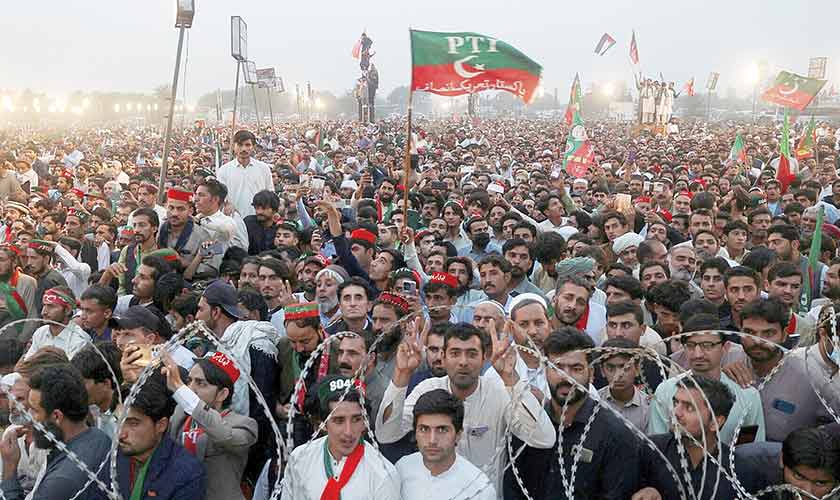
Long before governance began, Khan mastered pageantry. His 2011 Lahore rally was choreographed like a cinematic premiere: drone footage, stirring anthems, epic crowds beneath the banner of Naya Pakistan. Social media subsumed policy debates in high-definition visuals and moral slogans. Once in power, he governed much as he campaigned - for the camera. This obsession with appearances soon shaped key decisions. Loyalty often trumped expertise. The appointment of Usman Buzdar as chief minister exemplified this dynamic. The finance ministry turned over three ministers in as many years, extinguishing any hope of sustained economic planning.
Senator Mustafa Nawaz Khokhar encapsulated the widespread frustration when he argued that Khan’s stubborn refusal to replace Buzdar, despite repeated advice, reflected a callous disregard for effective governance. Khokhar also lamented that it was “a tragedy that a totally inexperienced person was given the responsibility to run the affairs of the province with a population of 120 million.”
Behind the scenes, the establishment’s tacit support had elevated Khan beyond his electoral mandate. He used it to portray critics as “anti-state” and bypass institutional scrutiny.
Khan’s economic narrative began with a defiant rejection of the IMF terms as affront to sovereignty, only to end in a capitulation to even harsher conditions. Economist Atif Mian warned at the time that “foolish policy choices have seriously impacted the productive capacity of the economy… we are witnessing the kind of uncertainty that results in the flight of both capital and humans.” The crisis was not merely cyclical; it was structural and largely self-inflicted. Inflation spiked beyond 12 percent, energy tariffs climbed relentlessly and the rupee tumbled to historic lows. Efforts to broaden the tax base fizzled under political pressure, perpetuating reliance on foreign borrowing.
Optics
Meanwhile, Khan’s vow to end VIP privileges rang hollow as helicopter trips between his private residence and office became routine. Even some of the members of his core team grew disillusioned. Nadeem Afzal Chan, then special assistant to prime minister who later resigned, reflected on this contradiction: “I was impressed by Khan’s anti-corruption platform. We were tired of the status quo. But then I saw that while Khan publicly talked about the poor, privately he surrounded himself with wealthy investors.” This foreshadowed a pattern that eventually came to define his governance: policy U-turns defended as “strategic adaptation” amounted to reactive retreats, exemplifying textbook crisis management rather than visionary stewardship.
Beneath a veneer of moral posturing lay a troubling pattern of institutional encroachment. The national anti-graft watchdog targeted political adversaries while ignoring PTI-linked scandals such as sugar-market manipulations. Similarly, the BRT-Peshawar scandal was quietly buried despite glaring irregularities flagged by auditors. The Federal Investigation Agency wielded cybercrime laws to intimidate journalists and activists, throttling independent reporting.
Choice of methods
Khan’s record in the parliament was poor both as an opposition politician and as prime minister. Parliament watchers had noted low attendance during his years in opposition. The PILDAT found that during his premiership Khan attended just 34 sittings, roughly 11 percent of the 15th National Assembly. These statistics strengthened the argument that he preferred mass rallies to deliberative politics. The parliament, meant to be the crucible of democratic deliberation, became a theater: sessions were skipped, opposition bills were sidelined and executive ordinances were used to push through major legislation without robust debate. A PILDAT’s analysis showed that the 15th National Assembly relied heavily on executive ordinances: 74 were laid across the assembly’s four-year span (72 by the PTI), a 118 percent increase in ordinance-initiated legislation over the 14th Assembly. That dependence on ordinances undercut parliamentary debate and oversight.
Beneath a veneer of moral posturing lay a troubling pattern of institutional encroachment. The national anti-graft watchdog targeted political adversaries while ignoring PTI-linked scandals such as sugar-market manipulation. The BRT-Peshawar scandal, too, was quietly buried despite glaring irregularities flagged by auditors.
In a televised address, Khan praised ‘streamlined’ decision-making unhindered by “too many voices in the room,” signaling that representative institutions existed only to serve the leader, not the public. The message was clear: the system was beneath him.
This contempt for key institutions set the stage for stalling far-reaching reform. With checks and balances hollowed out, attempts to strengthen Pakistan’s foundational systems faltered, leaving systemic weaknesses intact.
Consequences
Khan’s disregard for institutional integrity compounded Pakistan’s long-standing weaknesses. Efforts to modernise the tax regime stalled amid political hesitancy, leaving revenue collection stagnant. Bureaucratic professionalism eroded as frequent transfers and patronage appointments disrupted continuity. In education, the rollout of a Single National Curriculum was hailed as a unifying step. However, its rushed implementation aggravated quality gaps, imposed a one-size-fits-all model and resulted in resistance from provincial governments and minority communities. Sindh, in particular, resisted the curriculum, citing concerns over provincial autonomy, religious homogenisation and inadequate consultation. That resistance was understandable: the curriculum’s defenders, as Nadeem Farooq Paracha argued, failed to address the core charge: that its content was informed by the same myopia that had left Pakistan out of step with the needs of a modern world. The failure to strengthen policy pillars such as tax administration, civil-service capacity and educational quality, Khan’s reforms remained superficial, leaving Pakistan ill-prepared for the challenges of a Twenty-first Century economy.
Moral posture
Khan’s moralising often undercut his reformist image. In a 2019 Al Jazeera interview with Mehdi Hasan, he said, “If a woman is wearing very few clothes, it will have an impact on the men, unless they’re robots.” The statement was widely seen as victim-blaming and condemned. His dismissive reference to grieving Hazara families protesting bomb blasts as “blackmailers” deepened wounds and led to calls for a public apology He denigrated women’s marches as “Western imports” and invoked religious rhetoric whenever political convenience dictated. The selective piety exposed his use of morality to shield his administration, rather than genuinely supporting pluralism or empathy.
Diplomacy
On the world stage, Khan traded consistency for bravado. He rejected US conditions, only to return with an outstretched hand when economic realities bit. His unscheduled visit to Moscow on the eve of Russia’s invasion of Ukraine became emblematic of hasty judgment. His applauding the Afghan Taliban’s takeover of Kabul as a “breaking of shackles” tarnished Pakistan’s standing on human-rights. He also stirred controversy at home when, in a 2020 parliamentary speech, he referred to Osama bin Laden as having been “martyred.” That choice of words drew sharp criticism from opposition leaders as well as foreign commentators. BBC analyst Muhammad Ilyas Khan noted that this characterisation was less about ideological sympathy for the 9/11 mastermind and more a politically convenient stance. After his 2022 ouster, his “cipher” conspiracy theory, alleging a US-engineered coup, crumbled under scrutiny, highlighting his preference for grand narratives over nuanced diplomacy.
Perhaps the most significant legacy of his stint in office is the fiercely loyal following he cultivated. For many of his staunch followers, supporting him became a badge of intellectual superiority. Young professionals, enthralled by his rebel aura, adopted unwavering allegiance as proof of their own insight. Dissent was branded treasonous, critics faced online mobbing and party insiders were rewarded for deference rather than capability. Journalists like Asma Shirazi faced misogynistic abuse for challenging the narrative, reflecting a culture where criticism of policy triggered outrage rather than reflection. This echo-chamber dynamic left Khan unchallenged, accountable only to applause and blind to the very realities he claimed to reform. This echo chamber wasn’t accidental; Ihsan Yilmaz, a professor at Deakin University, noted the party’s rhetoric systematically otherised critics, which helped explain why policy critique was answered with charges of treason rather than engaged with.
As of mid-2025, Imran Khan is entangled in trials, stripped of office and barred from political participation. Journalist Cyril Almeida identified the turning point in Khan’s downfall as the moment when he lost the support of his coalition allies in the parliament and the backing of the establishment outside of it. Khan’s anti-establishment rhetoric rings increasingly hollow as he negotiates behind the scenes with the very power brokers he once vilified. The movement he built on perpetual revolt has fractured into factionalism, with younger activists growing disillusioned and veterans retreating into nostalgia. Khan and his party persist in framing his ouster as a conspiracy orchestrated by the establishment, judiciary and global powers. Reflecting this mindset, writer Mohammed Hanif has described Khan as being on a moral crusade, convinced that anyone opposing him is corrupt and an American puppet, an absolutist worldview that leaves no room for cooperation.
Granted that Pakistan’s power structure is complex and predatory, to claim that Khan was a victim is to deny the decades of opportunity he squandered. He had the following, the momentum, the narrative, and still, he spent more time giving speeches than building systems.
This is not to suggest that Khan’s failures emerged in a vacuum; they were accelerated by systemic rot; a bureaucracy already weakened; a judiciary already politicized; and a media environment already polarised. Yet, even within this compromised landscape, the scale and speed of institutional erosion under his leadership remain uniquely instructive.
Imran Khan’s tenure offers a cautionary lesson. Institutions don’t thrive on a façade of personality; they require patience, expertise and systems. Symbolic wins, untethered from structural reform, collapsed under the weight of economic and political reality. Moralising, used as a shield and deployed selectively to justify failures rather than confront them, goes only so far. A movement built on unprecedented fervour has left Pakistan with a dangerous precedent showing that sentimental loyalty can eclipse critical thought, at the cost of national progress.
This is not an exoneration of other parties and leaders. Pakistan’s dysfunction is systemic. It is shaped by decades of patronage, polarisation and weak institutions. However, few leaders have accelerated that decay like Khan did, fuelling resentment, hollowing out oversight and replacing governance with performativity.
In politics, the test of leadership is not how loudly one can promise change, but how one can build what lasts. Khan promised a revolution and left a shambles and he didn’t just fall, he fell believing that he was ascending.
The writer is a researcher and social critic. Her work explores the intersection of patriarchy, power, resistance and inherited silences across global politics, cultures and systems. She can be reached at anumjmalik@gmail.com