

Print Story
X




Indian court acquits all accused in the 2008 mosque blast case
| I |
remember having seen a French movie based on the life of Robespierre, the much feared hero during the Reign of Terror in post-Revolutionary France. There was a poignant scene in the movie that starkly underlined how often in our fanatic zeal to find justice, we become the people we hate. The story of Hindutva or ‘Saffron terror’ reminds one of the same. Take the latest news on Malegaon blast for instance.
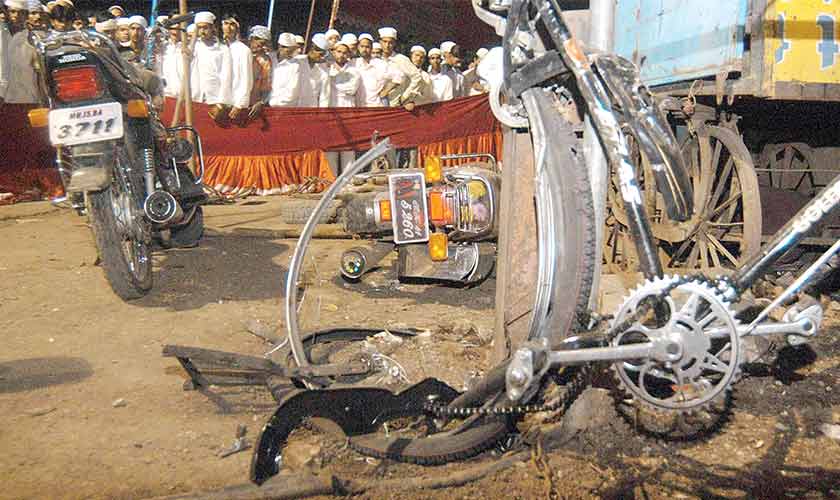
Seventeen years after the 2008 terrorist attack that killed six people and injured 95 during Ramazan. A special court has now acquitted all accused, including Lt Col Prasad Purohit and BJP MP Pragya Singh Thakur. What should have been a landmark case in dismantling homegrown terror has instead ended in a disquieting failure of justice.
The blast was initially investigated by the Maharashtra Anti-Terrorism Squad, then led by the late Hemant Karkare, who was killed soon after arrests began. This was during the fateful 2008 Mumbai attacks, another tragic episode in the history of India. The ATS had unearthed a chilling conspiracy: a retaliatory “blast for a blast” strategy allegedly devised by members of the radical Hindu outfit Abhinav Bharat, apparently inspired by Islamist terror tactics. For a brief moment, it appeared that Indian investigative agencies would break from the communal binaries of terrorism and hold the perpetrators accountable regardless of religion. Muslim youth wrongly arrested in the 2006 Malegaon blasts had only just been acquitted and the ATS was making strides toward credible impartiality.
But political shifts changed the game.
Once the investigation was transferred to the National Investigation Agency n 2011, the trajectory of the case altered dramatically. Despite early alignment with the ATS findings, the NIA eventually dropped charges under the stringent Maharashtra Control of Organised Crime Act in 2016, citing procedural lapses. Evidence began to evaporate: 13 witness statements went missing and as many as 37 witnesses turned hostile during the trial. Former Special Public Prosecutor Rohini Salian alleged that she was instructed to “go soft” on the accused—an allegation she made public before resigning.
In his 1,036-page judgment, Special Judge AK Lahoti acknowledged that “grave suspicion” existed against the accused. But suspicion, however serious, does not meet the threshold of legal conviction. The court rejected key evidence, including electronic transcripts of secret meetings, citing failure to meet legal safeguards. Lt Col Purohit’s defence — that he was infiltrating extremist groups as part of military intelligence — was rejected. Yet, the state’s case was so poorly constructed that he was acquitted anyway.
This acquittal is not an exoneration of Hindutva extremism. It is an indictment of shoddy investigation, prosecutorial failures and the dangerous politicisation of law enforcement. It also signals how majoritarian violence can be reframed not as a crime, but as a form of distorted patriotism.
This acquittal is not an exoneration of Hindutva extremism. It is an indictment of shoddy investigation, prosecutorial failures and the dangerous politicisation of law enforcement. It also signals how majoritarian violence can be reframed not as a crime, but as a form of distorted patriotism.
Pragya Singh Thakur, who was under trial for terrorism, was fielded by the BJP in the 2019 general elections and won from Bhopal. Her campaign, far from distancing itself from the charges, leaned into her alleged victimhood at the hands of ‘anti-Hindu’ forces. Since then, her public glorification of Nathuram Godse — the assassin of Mahatma Gandhi — has only reaffirmed her role as a Hindutva icon.
The consequences of this verdict ripple far beyond Malegaon. There is still no closure in similar cases of alleged right-wing terror: the 2006 Malegaon blasts (37 killed), the 2007 Samjhauta Express blasts (68 killed), the Mecca Masjid bombing in Hyderabad (9 killed), and the Ajmer Dargah blast (3 killed). In each, courts have flagged weak evidence, coerced confessions and prosecution lapses.
Meanwhile, the Supreme Court recently acquitted the accused in the 2006 Mumbai train blasts as well — another example of investigators failing to secure justice after years of delay and rights violations, including torture and forced confessions.
Terrorism has no single religious face in India, or for that matter anywhere. But when institutions falter — when law enforcement is compromised, evidence is mishandled and courts are left with only doubt — the message is chillingly clear: justice is negotiableand the rule of law is only as strong as the political will behind it. It’s interesting to note that the acquittal of Malegaon conspirators came close on the heels of relief for the wrongfully imprisoned and tortured Muslims for the Mumbai blasts. As if by this very logic, alleged Hindutva terrorists could be exonerated on the same ground. However, even such ‘justice’ remains skewed as the acquittal of imprisoned Muslims for Mumbai blasts was almost immediately stayed by the Supreme Court following a request by the Government of India. To paraphrase the old Orwellian adage: some citizens are more equal than others.
It is no wonder that both Pragya Thakur and Home Minister Amit Shah claimed victory for Hindutva in the wake of Malegaon verdict at a time when a whole range of other forms of oppression of minorities have been deployed, ranging from hate speeches, to mob lynching, from bulldozer politics to love jihad and now disenfranchisement through deletion of names from the electoral rolls. In this sense, Saffron terror’s initial tactic of blasts for blasts has come a long way under a regime that has created a larger echo system of mob politics. You don’t have to invest in either technology or resources; you simply convert a bunch of people into mobs, shouting “no Hindu can be a terrorist.”
If the NIA is serious about its mandate, it must appeal this verdict and correct the investigative lapses that enabled it. Otherwise, this is not merely an acquittal— it is a warning. If the courts want to go beyond pointing out ‘grave suspicion,’ they need to do more than leaving something for records.
The author has been in the development sector for more than a decade. He currently works with an international non-governmental organisation based in Delhi. He may be reached at: avinashcold@gmail.com