

Print Story
X




Russia’s recognition of the Taliban regime is a move to counter any US return to the region
| T |
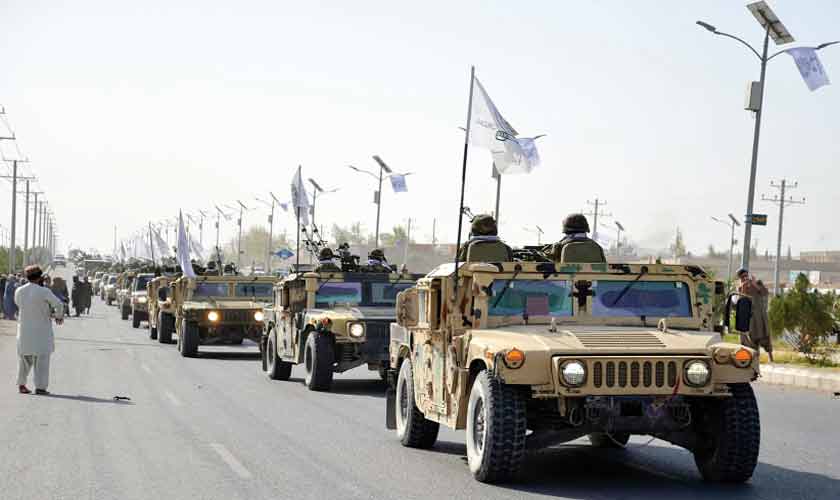
he Russian Federation’s recent decision to extend diplomatic recognition to the Taliban regime of Afghanistan, a welcome development for Kabul, has important consequences for all stakeholders in Afghanistan and their consequent strategies. For Russia, there are a host of reasons to recognise the Taliban regime. For the rest of the world Moscow’s extension of recognition to Afghan Taliban is very significant as it is the first country to do so although Pakistan and China have also been engaged with the Taliban since 2014.
There are a host of reasons for Russia to recognise the Taliban government. These need to be identified and analysed in order to understand Moscow’s foreign policy and to come up with suitable policy adjustments. Although Russia has been pursuing better relations with Afghan Taliban since 2015 there are two basic reasons that triggered Moscow’s recent recognition of the Afghan Taliban regime three and a half years after it seized power. These two reasons are the war between Russia and Ukraine, which started in February 2022, and the recent escalation between Iran on one hand Israel and the United States on the other.
The continuation of the war with Ukraine may not have upset President Vladimir Putin’s calculations. The war has proved a serious strain on Russia’s strategy. Once Ukraine showed that it could hold its own against a Russian onslaught, its European allies too got emboldened. These European allies have been providing increasing assistance in terms of arms, fuel and finances to Ukraine. Despite inflicting heavy devastation on several parts of Ukraine Russia has itself suffered heavy losses. In July, Russia lost its deputy naval chief, Major General Mikhail Gudkov, in an attack by Ukrainian forces in the Kursk region.
Without going into details of the recent conflict between and Israel-US, one can point out that Iran has suffered heavy losses in the fighting. Ironically, Russia was unable to help Iran, largely due to Moscow’s engagement in the Ukraine war. Keeping in view the prevailing and unfolding situation in the region, Afghan Taliban looked like a good ally.
The Taliban regime cannot not be expected to match Iran’s profile but Taliban can likely deny the US strategic space, particularly military bases in Afghanistan. In recent months, Washington has been trying to revive its military base in Bagram. In this connection, former US Ambassador to the United Nations and Afghanistan, Zalmay Khalilzad, has visited Afghanistan. Still a military base for the US in Afghanistan under Taliban is a far-fetched idea. Still, Russia’s recognition of the Afghan Taliban regime is a move to forestall a potential US entry.
In simple terms, Russia’s recognition of the Afghan Taliban regime may have been caused by the former’s apprehensions about the US regaining a foothold in Afghanistan. Such a development would be disastrous for Moscow. Therefore, while the US has not recognised the Taliban regime so far, Russia has capitalised on the situation. A similar recognition by the US and its Western allies is unlikely in the foreseeable future in view of the Taliban’s lack of flexibility on girls’ education, women’s right to work and move towards a broad-based government in Afghanistan, For Moscow, any violations of human rights by the Taliban is an ‘internal’ matter of Afghanistan.
There are a host of reasons for Russia to recognise the Taliban government in Kabul. These need to be identified and analysed to understand Moscow’s foreign policy and to come up with sound policy adjustments.
Another significant reason for Russia to recognise the Taliban regime of Afghanistan is to ensure that Afghanistan has a semblance of stability. Moscow worries that if a strong force like the Taliban, which also has significant, if not extensive, acceptability among Afghans, start losing its grip over the country due to non-recognition by other countries and consequent lack of critical diplomatic, financial and economic support, Afghanistan could become extremely unstable. The consequent political vacuum in Afghanistan will be a grave threat to Russian Federation. In other words, if Afghanistan becomes more unstable the impact on Central Asia, the soft underbelly of Russia, will be grave.
Moscow must also have observed that for the last three and a half years no anti-Taliban Afghan resistance movement has been able to mount a credible challenge. It is better therefore to support the Taliban, who have at least kept a semblance of central authority in Afghanistan. It may be mentioned that when Afghan Taliban first took control of Afghanistan in 1996 they had assumed a very anti-Russia posture. This had forced Moscow to support the then anti-Taliban Afghan Northern Alliance led by Ahmad Shah Masoud. Russia had provided the ANA material support along with Iran to dislodge the Taliban regime in Kabul. However they were unable to achieve that objective.
However, Afghan Taliban later hosted anti-US Al Qaeda of Osama bin Laden as well as anti-Russian Chechen groups. Washington struck soon after the 9/11 terrorist attacks on American mainland, which President George Bush blamed on Al Qaeda. Washington and its NATO allies formed an alliance with Afghan Northern Alliance and Moscow kept silent as it wanted the Taliban regime to be dismantled. However, this time Russia has extended diplomatic support to Afghan Taliban so that there is no threat to Central Asia and Russia.
Ukraine and its Western allies might want to encourage Muslim groups, which have a history of waging liberation movements against Moscow, to revive. Although for the last two decades Muslim separatist movements in Russia have been largely dormant, there is always potential for the challenge to re-emerge. Ukraine has already ‘recognised’ Chechnya, which lost its de facto independence in 2000 to Russia as an ‘independent’ territory. Dagestan, too, has a history of anti-Russian struggle and could become restive anytime.
Chechan and Dagestani groups were hosted and trained by Afghan Taliban in Afghanistan during their first stint in power from 1996-2001. However, Russia started extending diplomatic support to Afghan Taliban when US-NATO forces occupied Afghanistan in 2001 after dislodging Afghan Taliban regime there. Russia then saw Washington and its allies as too close to its strategic backyard, Central Asia. Russia has now extended diplomatic recognition to Afghan Taliban regime in Afghanistan to foreclose any possibility, even a distant one, of Taliban regime’s support for Russian Muslim secessionist groups.
The writer is a political, security, policy and governance analyst and an expert in countering violent extremism and counter terrorism. He holds a doctoral degree in international relations. razamzai@gmail.com|