Print Story
X




Bapsi Sidhwa wrote Lahore and the post-colonial self into English literature
| B |
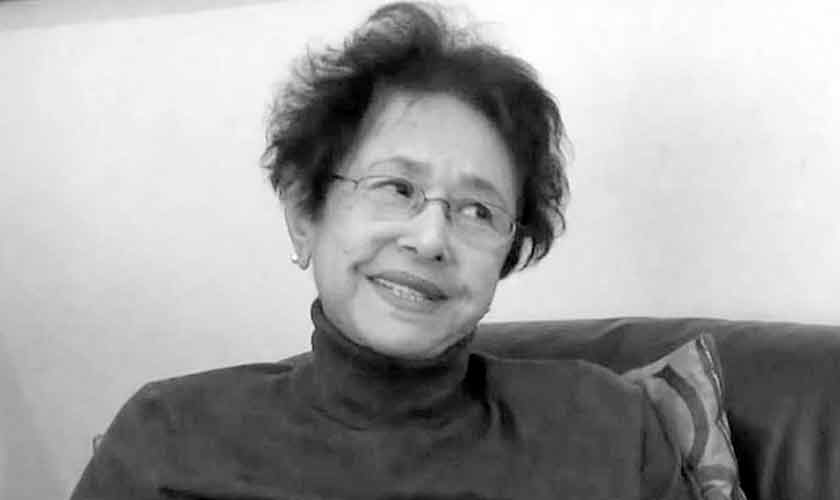
apsi Sidhwa, born on August 11, 1938, in Karachi and died on December 25, 2024, in Houston, Texas. She always wished to be known and recognised as a Pakistani novelist.
In Lahore, she lived in Mozang, Main Market Gulberg and on Munir Road in the Lahore Cantonment. She was a true Lahori through and through.
A distinctive feature of her fiction is its desi-ness. Her characters are deeply rooted in the diverse Punjabi milieu of Lahore. Their speech and behaviour reflect their desi identity, Punjabi vibrancy and communal, localised habits.
“You are what? Only four million or so? Asks Masseur…. You don’t worry our clout!” says Sher Singh offensively… The Angrez calls you a bloody Nuisance! …. Roars the puny Sikh, sounding more and more like the tiger in his name.” Again, “Yousuf is twirling his plume of hair and tugging at it as if he is trying to lift him. I feel a great swell of fear for Hari: and a surge of loathing for his dhoti… worn like a diaper between his stringy legs - just begging to be taken off … his dhoti might come apart partially - perhaps expose a flash of black buttocks to spice the sport - but it happens only rarely.”
Although Sidhwa’s native language was Gujarati and she spoke and wrote English fluently, it was Punjabi idiom and expression that gave her language and characters a distinctive flavour. While it was difficult for her to entirely reject English, the colonial legacy, like many postcolonial writers, she experimented with it, developing a new hybrid form often described as Pakistani desi English.
Her writing is peppered with local vocabulary that anchors it in cultural specificity: “Oye, uloo,” “goondas,” “white kurta,” “Raj karega Khalsa, baki rahi na ko,” “Allah-o-Akbar! Yaaa Ali!” “Pakistan zin-dabad!” “takhti,” “helping a girl cut her kurta and shalwar,” “Baijee? Wake up,” “gathering his lungi above his knees,” and “My mother was from the kotha.”
We also find instances of Babu English in her work, such as: “May God bless you with a child at His early convenience.” Sidhwa was acutely aware that she was writing for a diverse readership, both national and international, with varying linguistic, cultural and social backgrounds. As a result, her sentence structure frequently blends vocabulary from Punjabi, Urdu and English.
As for her characters, there is, to borrow from Dryden, “God’s plenty” in her novels: the Ice-Candy Man, Sher Singh, Imam Din, the butler, Hari, Aya, Col Bharucha, hawkers, cart-drivers, beggars, cooks, cyclists, drug addicts, masseurs, Zaitoon, Nikka Pehlwan, Feroza, Freddy – a host of characters drawn from different communities, each Punjabi to the bone. They embody what might best be described as desi-ness.
Sidhwa challenged the authority of colonial writers like Rudyard Kipling to tell stories of the native experience. Her portrayal of Lahore, in Ice-Candy Man (1988), The American Brat (1994), and The Bride (1983), is more textured and truthful than Kipling’s romanticised version in Kim (1901).
With precision and candidness she describes the historical “Lahore - the ancient whore, the handmaiden of dimly remembered Hindu Kings, the courtesan of Mughal Emperors — bedecked and bejeweled , savaged by marauding Sikh hordes — healed by the caressing hands of her British lovers… Qasim saw her; like an attractive but aging concubine, ready to bestow surprising delights on those who cared to court her —- proudly displaying royal gifts …”
Sidhwa introduced this local desi-ness and its idiom to the wider world, placing Pakistan firmly on the international literary map. Authentic, yet laced with bawdy humour and a touch of farce, her narrative style remains an excellent example of clarity and control.
“Cycle bell ringing, Imam Din and I perambulate through the profusion of bared Lahori bottoms … and the smooth, plump spheres of young women who hide their faces in their veils and bare their bottoms.”
She pioneered a narrative style that seamlessly wove together culture, politics and national history with personal experience. In doing so, she opened a new literary path for writers, showing them how to shape their lived realities into fiction. Novelists like Sara Suleri followed in her footsteps. Suleri’s Meatless Days blends national and personal histories, underscoring the idea that one’s individual story can be just as authentic as the nation’s. Like Sidhwa, Suleri gave form and structure to non-fiction, leaving a lasting impression on readers.
Sidhwa’s The Crow Eaters offers a vivid insight into the life of a Parsi family. Through her characterisation and portrayal of their mannerisms, she employs humour and irony to add a distinctive dimension to her craft: “He has fallen upon his father.” Sidhwa’s narration captures the human condition with a blend of comedy, wit, and a brisk, engaging style: “I cooed to him —- salaam so low I got a crick in my balls —- buttered and marmalade him.” Her Ice-Candy-Man portrays the city of Lahore as seen through the eyes of Lenny, a nine-year-old girl affected by polio, during the harrowing days of Partition. A cluster of roads and familiar spaces forms her world and defines her sense of mobility: “[her] world is compressed, Waris Road, lined with rain gutters, lies between Queen’s Road and Jail Road… [and] moves into the dense bazaars of Mozan Chungi,” at the core of its desi-ness, the novel realistically captures the miserable existence of fallen women; “khut-putlis, puppets, in the hands of fate,” Hamida, Ayah, Mumtaz and others. Above all, Bapsi Sidhwa was a novelist with a strong awareness of the female self and feminist sensibilities. Her work places female characters alongside their male counterparts, highlighting their efforts to survive and their desire for independence.
The writer heads the English Department at Riphah International University, Gulberg Campus, Lahore. He is the author of Amorphous Lahore: Colonial and Postcolonial – A Journey through History and Fiction