

Print Story
X




Nasir Abbas Nayyar’s latest anthology of stories pulls the readers into a world that is both foreign and strangely familiar
Is good art supposed to upset you?
Susan Sontag seemed to think so. In her essay, Against Interpretation, she wrote, “Real art has the capacity to make us nervous.” Our own Manto famously remarked that if people cannot bear his stories, it is because we live in unbearable times.
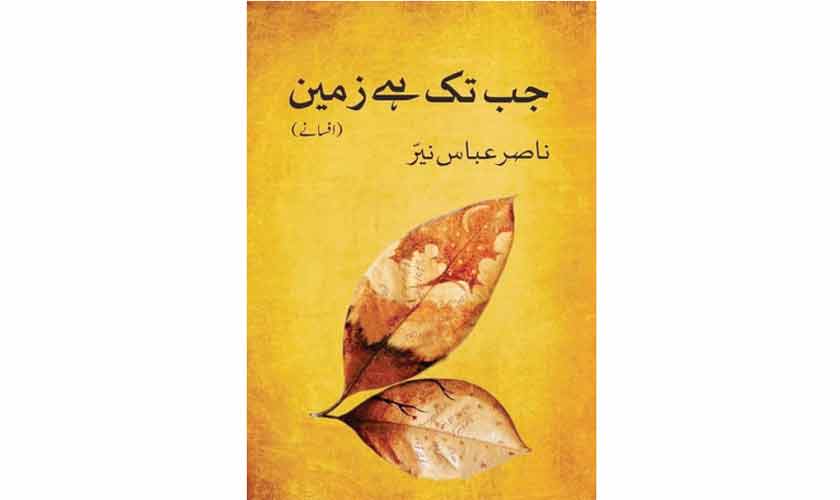
Perhaps, it wouldn’t be unfair to say that Nasir Abbas Nayyar’s latest anthology of short stories, Jab Tak Hai Zameen, does exactly that. It is a raw, otherworldly, mind-bending theatre of the absurd that depicts the strange world we find ourselves in today. This is not a book to read in one sitting; you make time for it. You think, process each line, and then you try to understand why it bothered you so – because it will. Nayyar’s characters shake you, make you question your sanity and can disrupt your long-held beliefs. A lot of what happens in these stories doesn’t make sense, but then, once you take a deeper look, a lot does – not unlike life itself.
If there is one theme that ties all these stories together, it is how love, memory and grief transcend time and space and how, sometimes, even death is not an antidote. Nayyar writes about loneliness, the need to belong and the kind of regret that follows one to their grave. But he also writes about hope. Many of his characters are melancholic storytellers. They move like ghosts, dragging the weight of broken dreams.
The inexplicable twists and turns that largely define human existence, and the beauty and terror of the human mind, are among Nayyar’s central themes. Nothing is unthinkable, nothing too strange.
There are 17 stories in the book. The final seven micro-stories are drawn from the author’s dreams. In the opening story, Warghalaya Hua Aaadmi, a man, wakes up one day with a complete loss of memory and language. He is petrified, unable to utter a word. His helper is convinced that he has been possessed. As the existential dread surrounding his descent into the darkness of his mind became more intense, I was reminded of the song The Sound of Silence by Simon & Garfunkel: “But my words like silent raindrops fell/ And echoed in the wells of silence.”
Apnay Maazi kay Khuda is also about descent into madness, but here it is largely fueled by a nagging guilt and regret that slowly engulfs the protagonist and erodes her sense of self, in true Edgar Allen Poe fashion.
In Panah Mangtaa Hun Main, Shaitan, after following a maulvi for days, finally shows himself to him for some advice to tackle his ‘eternal misfortune.’ His monologue here approaches impeccable craft.
“Aap sab apni zimmedaari say bachtay hein, sab mujh pay daal deytay hein. Mein yeh sab kehnay nahin aaya… Main aaj aap ko behkaanay nahin aaya, sawali ban kay aaya huun.”
This is not a book to read in one sitting. You make time for it. You think, process each line, and then you try to understand why it bothered you so, because it will.
In what is perhaps one of the most mind-boggling stories, Peroshasi, Karofer, Feroshasi, the narrator becomes consumed with finding more about an author whose book was destroyed by the authorities upon publication. This obsession takes him on a magical journey through books, where he encounters other intriguing writers, a letter addressed to an author now living on Venus and a haunting ode to womanhood.
“Tum Maan ko batana chahtay thay keh tum nay itnay taweel safar kay baad jaana hai keh aurat, khayal aur aadmi dono ko janam deyti hai, lekin iss say zyada koi nahin jaanta keh khayal, kabhi aadmi say bara nahin ho sakta.”
In Kherkheshan Namood, the narrator describes a strange new world with an unusual philosophy of crime and punishment, a world built on the premise that it is incomplete but must not remain so, a world where every day is literally a new day with a brand new name.
In Apna Asa aur Apna Azhdaha, a man spirals into near madness after continuously dreaming of his wife’s infidelity. His predicament pushes him into the unforgiving world of intrusive thoughts, but eventually also to the realisation that the power to confront them lies within him.
Awazein aur Saya is about a man who suddenly starts hearing voices and seeing shadows in his ancestral home. It is about how identity can be tied to a place, and how that place often develops a personality of its own.
Many stories change shape just a few paragraphs in. You find yourself in the middle of a story you don’t remember beginning. These sudden changes are intentional. Nayyar doesn’t offer comfort or simple conclusions. His prose is complex but emotionally powerful. Some moments can be hard to understand, often to the point of feeling disconnected. But the writing seems to be asking you to sit with that discomfort instead of avoiding it.
Nasir Abbas Nayyar’s Jab Tak Hai Zameen is a book of many wonders – sublime, mysterious and often unsettling. There are monsters in the closets; unreliable narrators that get you on their side, only to blindside you when you least expect it, leaving you feeling at once disoriented and nervous. These are the kinds of stories that refuse to resolve. They haunt and they provoke. That said, the book urges you to engage with it, completely and devotedly. There is no other way to read it.
“Sab raastay aik jaisay hein, keh woh kahin bhi nahin pohanchatay. In do hafton ki saer ka yeh haasil mamooli nahin hai.”
– Kherkhashan Namood
Jab Tak Hai Zameen
Author: Nasir Abbas Nayyar
Publisher: Sang-e-Meel, 2025
Pages: 155
Price: Rs 900
The reviewer is a staff member