

Print Story
X




Internal strife divides PTI ranks ahead of crucial protest movement
| P |
akistan Tehreek-i-Insaf is at a critical juncture today as it gears up for a do-or-die protest movement. There appears to be much confusion in the party and the claims that it will surprise the government lack credibility. Had Imran Khan’s sons, Qasim and Suleman, arrived to lead the protest rallies, their presence might have revived the party workers’ spirits. However, the PTI founder is understood to have stopped them. It therefore seems that the party has nothing left in its reserves to surprise its opponents.
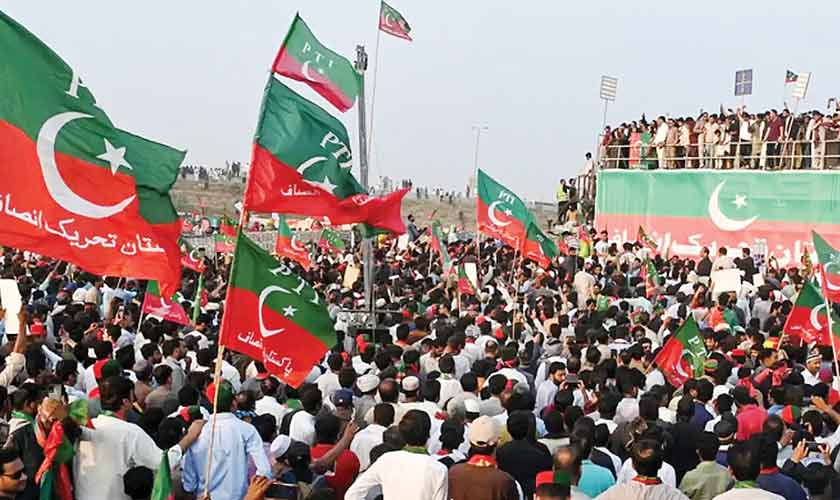
The PTI will mark the second anniversary of Imran Khan’s arrest on August 5. One of the most popular parties in the country, the PTI faces not only intense pressure from the government but also increasing \confusion and division within its ranks. The stakes are enormous—not just for the PTI’s future but also for the opposition politics in Pakistan.
PTI’s leaders have announced a 90-day “do-or-die” campaign across Pakistan with peak activity on August. However, strategic indecision, cracks in the leadership ranks and low morale among supporters have paralysed the party. Most PTI leaders from Khyber Pakhtunkhwa favour a an aggressive approach for the protest movement. However, a majority of leaders from the Punjab think otherwise. Aliya Hamza Malik has publicly questioned the timing and strategy.
Despite his continued incarceration, Imran Khan is trying to control the party himself. He has called for unity and warned those undermining the party unity of strict disciplinary action. However, some of his directions have been largely disregarded by the party.
Advocate Salman Akram Raja’s comment that he was “not protest material” added fuel to the fire. Some PTI workers said this suggested a lack of resolve at the topincluding the party secretary general. Other called the current leaders’ ability to lead the party in tough circumstances.
Tactically, the PTI has two primary options. The first is a direct march on Islamabad, which might result in further trouble for the workers in the form of a massive crackdown. The other, discussed in the recent party meetings, is decentralised protest where each ticket-holder would lead a protest demonstration in their constituency. This might later turn into a massive campaign.
None of these scenarios is free of tough challenges. Most Pakistanis, reeling under economic hardship, are unlikely to rally behind a person-focused campaign in the absence of a concrete policy platform and social justice agenda. It is important that the PTI has failed to expand its anti-government rhetoric to include issues like judicial independence, economic rights and regional representation. This failure has alienated many of the potential activists whose participation could have made the PTI rallies more successful.
PTI leaders have announced a 90-day “do-or-die” campaign across Pakistan with peak activity on August 5. However, strategic indecision, cracks in the leadership ranks and low morale among supporters have paralysed the party.
The fact that the government will have a whole range of options on how to deal with the PTI activity is reassuring for the former. Both federal and Punjab administrations have signaled a zero-tolerance policy for disruptive protests. Both have said that while peaceful assembly within strict bounds is acceptable, a march on Islamabad or a threat to key government installations will be met with pre-emptive force. The state is unlikely to allow another episode of prolonged instability. The recent convictions of PTI leaders under anti-terrorism laws have already suppressed the PTI movement. Whether these will survive appeals before superior judiciary is not clear but they will undeniably raise the cost of protest for the PTI and its supporters.
If the party expands the protest narrative by forgoing Imran’s release as its sole focus and incorporated economic and civil rights issues, it might widen its base. There is a sizable and growing working class constituency in Pakistan. These people are facing the dual brunt of inflation and unemployment. If protests were addressing those issues, there might be a shift in public attitude, leading to greater pressure on the state. Achieving this goal will require message discipline and coalition-building. However, these are the very areas where the PTI has struggled in the past.
For now, even if the scope of the protest is limited, the economic and security impacts will be felt. Similar protests in the past have resulted in violence and chaos. This time, with the government alert and policing bolstered by a new federal paramilitary force, any misstep could lead to an overreaction. There is a risk that provocative elements could initiate violence, leading to injuries, arrests and damage to civil liberties.
Asked about the next ‘surprise’ by his party, a PTI leader, privy to internal affairs, told The News on Sunday, “In the last meeting, the party discussed the idea of showing its strength in an unusual way. The meeting discussed a new way to express solidarity with Khan by hoisting the national flags as well as PTI flags on every PTI supporter’s house along with posters carrying Imran Khan’s image. However, a consensus could not be developed on the suggestion. However, it is still under consideration.”
The PTI can also take the protest to the National Assembly as Speaker Ayaz Sadiq has convened the session on August 4. Some leaders from the ruling coalition have expressed concerns about this following the violent clash between the PTI and the PML-N MPAs in the Punjab Assembly. They fear that the PTI MNAs could create a similar scene in the National Assembly and disrupt the proceedings. They also mention that the speaker has taken special security measures, keeping the PTI’s mood in mind. The PTI parliamentarians can still capitalise on the opportunity the NA session provides.
August 5 will show whether the PTI can still lead a national movement or not. Some fear that the party is increasingly consumed by its internal contradictions. The events of August 5 can shape the political landscape of Pakistan for months, if not years, to come.
Mubasher Bukhari is a senior journalist, teacher of journalism, writer and analyst. He tweets at @BukhariMubasher