

Print Story
X




Mohsin Shafi uses rag-doll figures to explore gender norms, power structures and grief in his show
| B |
efore boarding an aeroplane, you know the pilot is a man and that snacks will be served by female flight attendants. Similarly, when visiting a hospital, you expect your medical examination to be conducted by a male doctor, accompanied by female nursing staff. When booking a cab, you anticipate a male driver, unless, to your surprise, a woman appears behind the wheel.
These assumptions stem from conventional, especially gender-specific, roles. But in today’s world, those roles are increasingly being reversed. Women are flying planes, treating patients and serving in the army and police. Meanwhile, male flight stewards, male nurses and male chefs are now common.
This division of roles extends to the creative realm as well. Traditionally, men were expected to write poetry and women were meant to sing it. Or, as Margaret Atwood once observed, quoting the archaic view of Robert Graves, “Man is the poet, woman is the muse.”
Men were long regarded as the authors of fiction for a broad and mature readership, while women were relegated to telling stories to their children. Today, however, female writers of fiction and poetry fill the shelves of libraries and bookshops around the world, winning numerous prestigious accolades, including the Nobel Prize in Literature.
In the visual arts, gender separation has often translated into genre segregation. Men created paintings and drawings, while women produced embroidery, crochet, stitching, quilts and patchwork. Men sculpted in stone, wood, plaster and bronze; women, by contrast, made dolls using discarded fabric, cotton, thread and straw.
Thus, it wasn’t just the end products or techniques that differed; even the materials were gendered. Hard, coarse, durable substances were associated with men; women were confined to soft, decorative, glittery and perishable materials. Broadly simplified, this division reflected a split between art and craft, between masculinity and femininity.
Mohsin Shafi dismantles these constructs in his latest body of work, created during a period of profound grief following the death of his father and the subsequent family disputes over inheritance. In an email, Shafi confides: “It’s been a challenging year and I’ve been away from any artistic activities for more than one and a half years. I pushed myself into the creative process four months ago.”
He returns with a solo show in Karachi after nearly eight years, exhibiting at Canvas Gallery. The exhibition, The Anatomy of Becoming (22–31 July), could just as easily have been titled The Anatomy of Belonging, for Shafi’s latest work is not only about himself, his past and his memories, but also speaks to a broader experience shared by many in a male-dominated society.
In an interview with Idaho Public Television during the Sun Valley Writers’ Conference, Mohsin Hamid reflected on the feeling of being an outsider, a condition he argued was not limited to race, religion or region, but was, in fact, widespread. As a child raised in both the United States and Pakistan, he once believed he was an odd cultural mix. Over time, he came to realise that “everybody is strange. Everybody is a little bit misplaced. The only daughter in a family of boys is a bit strange; the kid who wants to be a poet in a family of engineers is a bit strange.”
Shafi, using the simple and disarming language of childlike play, challenges binaries and expands the concept of multiplicity.
Being strange, or feeling like an outsider, is often a symptom of the presence and power of hegemony. Through sharing his dreams, fears and inner conflicts, artist Mohsin Shafi prompts us to confront how power, or the majority, expands, exploits and dominates those deemed outsiders, misfits or misplaced. Alongside the supremacy of sameness, there exist socially constructed forms of dominance that must be re-examined, if not dismantled altogether.
In our culture, as in many others, boys are encouraged to play with racing cars, tanks, rifles, fighter planes and toy soldiers, while girls are steered towards dolls, dollhouses and make-up sets. But the compartmentalisation does not stop there. Dolls, too, carry implicit messages and agendas: they are typically female, blonde or brunette, slim, young and able-bodied. Rarely, if ever, do they reflect the full diversity of human experience.
Children are seldom introduced to dolls that vary in skin tone, body type, physical ability or gender identity. One hardly ever encounters an obese doll, a doll with missing limbs, or one in a wheelchair, not in a child’s room, a school play area, or even on the shelves of multinational toy stores.
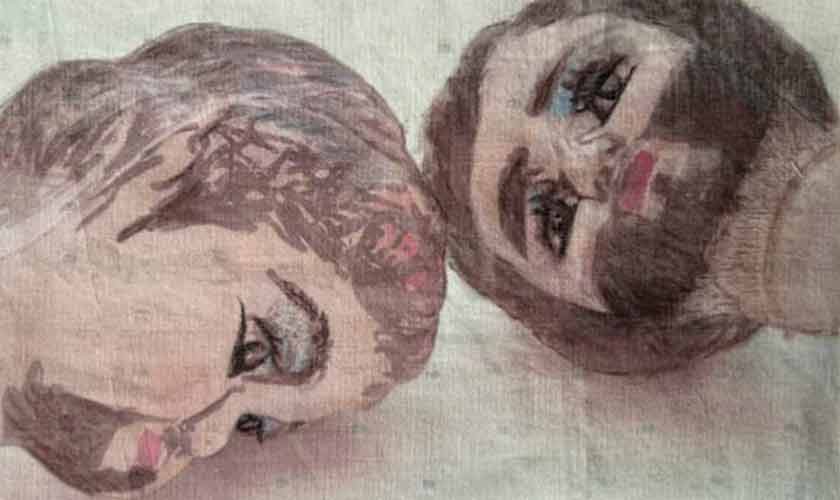
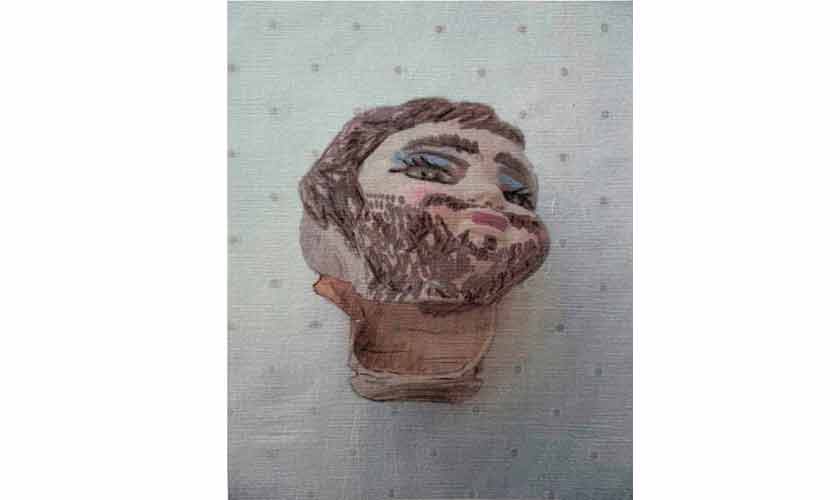
Doll-like forms recur throughout Mohsin Shafi’s new paintings. These are not finely crafted dolls but rag-doll figures, assembled in simplified shapes that nonetheless reveal much about the artist and even more about the communities around him, and us.
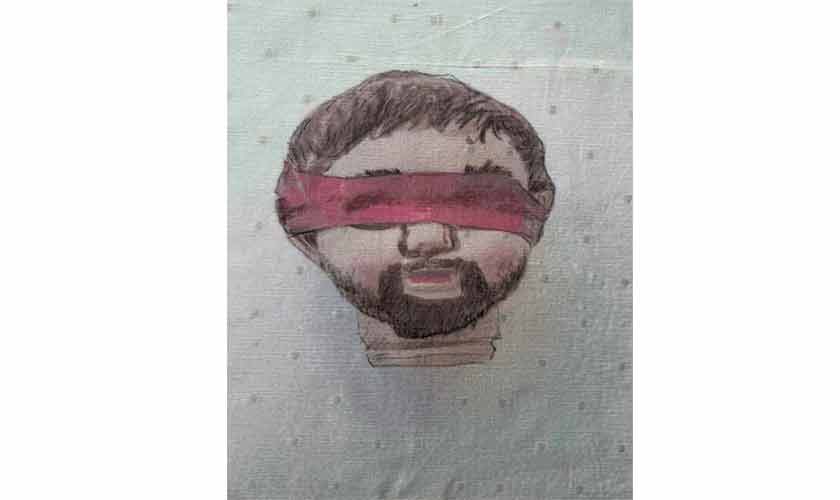
There are unusual, doll-like faces: boys with moustaches, a blindfolded young man and almost-faded portraits of bearded youths marked with lipstick and traces of make-up. The bodies in these works are constructed like dolls, their parts seemingly detachable or interchangeable. In two small paintings, for example, headless figures appear with mismatched limbs, one stubbly, the other hairless, a contrast repeated in the legs.
Traditionally, body hair, moustaches and beards are associated with masculinity, while make-up is linked with femininity. Shafi, using the simple and disarming language of childlike play, challenges these binaries and expands the concept of multiplicity, a notion often misinterpreted as confusion when applied to gender identity.
In a cultural context shaped by conservative family structures and rigid expectations, the act of accepting, expressing or declaring one’s natural physical identity becomes one of bravery. To convey this, Shafi adopts materials and methods that lie on the margins of conventional art practice. He replaces canvas with cloth, substitutes thick impasto with beads and draws not with pencil but with needle and thread. His work incorporates text, lines that echo the lyrical vernacular of truck poetry alongside verses that offer a glimpse into the artist’s private world.
That personal world, in one corner of the exhibition, is captured through small portraits of Mohsin Shafi’s father, mother and himself, stitched with thread and pieces of fabric. These passport-sized artworks convey the intimate bond between a boy and his parents, a relationship rooted in love. This is symbolised in Shafi’s self-portrait, rendered in thread behind an embroidered golden bow, with a steel needle serving as the arrow.
Sigmund Freud once remarked: “No one could be a man unless his father has died,” suggesting that an individual only truly discovers their own identity after the passing of their father. Often, this process begins by opening the metaphorical and literal cabinets, boxes and suitcases left behind.
Shafi’s exhibition includes an installation made up of such objects, collected (or, as he puts it, “picked, stolen, pilfered”) from various sources, including family members. These small, discarded and once-disused items, fragments of memory and material, have not only inspired the artist to open cupboards in his familial home, but also to unlock emotional compartments within himself. The result is an exhibition that turns deeply personal grief into a public act of storytelling and self-revelation, now on view at Canvas Gallery.
The writer is a visual artist, an art critic, a curator and a professor at the School of Visual Arts and Design, Beaconhouse National University, Lahore. He may be contacted at quddusmirza@gmail.com.