Print Story
X




Abdullah Hussein’s fiction continues to confront exile, alienation and the contradictions of modern life
| A |
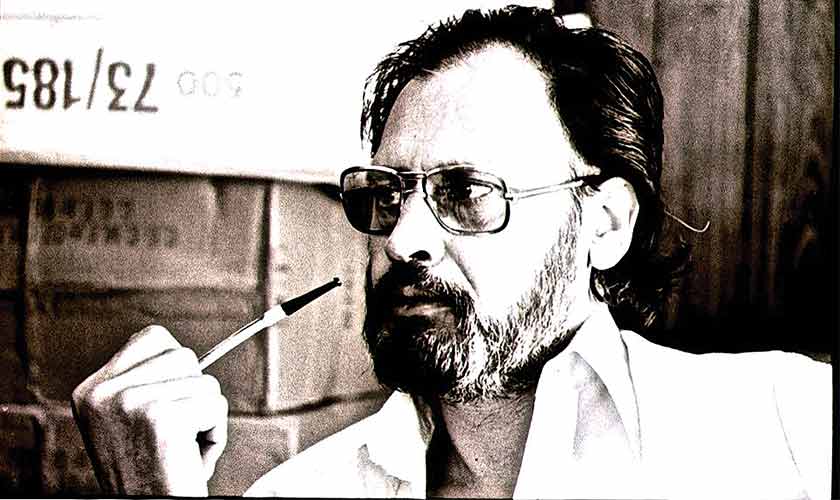
bdullah Hussein, born Muhammad Khan on August 14, 1931, in Rawalpindi, was one of Pakistan’s most influential modern novelists. He completed his matriculation from Islamia High School, Gujrat, in 1946, followed by an FSc in 1949 and a BA from Zamindar College, Gujrat, in 1952.
His professional career began in 1953 as an apprentice chemist at the Dandot Cement Factory. In 1956, he joined the Pakistan Industrial Development Corporation as a chemist at the Maple Leaf Cement Factory. It was here that Muhammad Khan met Tahir Abdullah Hussein, a fellow factory worker from Madras. While writing UdaasNaslein, Khan adopted his colleague’s name as his literary pseudonym: Abdullah Hussein.
In 1959, he was awarded a Colombo Plan fellowship and travelled to Canada for a diploma. He returned to Pakistan in 1960 and resumed work as a senior chemist at the PIDC. In January 1967, he moved to England, where he worked for the North Thames Gas Board in West London until 1975. He returned to Pakistan in 1976.
Hussein’s literary career began with short stories. His first, Naddi, was published in 1962 in the monthly Savera. His debut novel, UdaasNaslein, appeared in 1963 and won him the prestigious Adamjee Literary Award. It was later translated into Hindi, Bengali, Chinese and English. His other notable works include Baagh (1982), Qaid (1989) and Nadar Log (1998).
He presented the first copy of his last short-story collection to then chief minister of the Punjab at the Arts Council Lahore in 2012, saying that his government was free of corruption. The chief minister had not noted that the title of the said collection was indeed Fareb.
Abdullah Hussein died on July 4 2015.
Abdullah Hussein received widespread recognition for his novel UdaasNaslain. His novel Baagh and short story collection Nasheb offer more evidence of his artistic depth and reflective power. One of the most recurring themes in his short stories is exile, not just physical displacement, but emotional and psychological alienation as well.
This idea of exile reflects a different kind of migration, experienced by many Pakistanis in recent decades. While its roots may be cultural, reflective or political, the most dominant driver is economic — the pursuit of prosperity abroad. For some of Pakistan’s educated and skilled upper-middle-class youth, this is not just about employment; it is also driven by the allure of more liberal social environments.
In Hussein’s stories, the emotional fallout of this migration is laid bare. The modern individual is depicted as lonely and disillusioned. His inner world is fractured by uncertainty; his connection to history, belief, and meaning is splintered. Knowledge brings sorrow, and the fast pace of industrial progress seems to benefit society while crushing the individual.
Modern life, Hussein suggests, has turned love and companionship into fleeting illusions. Meaning is displaced by material goals — and success feels hollow. He writes in Naddi:
“In the final analysis, it is found that we cannot do anything for anyone.” (Nasheb, p. 78)
“People worship so that they can find God; I am in search of God so that I can love.” (Nasheb, p. 78)
“Here the individual is destroyed and the society becomes stronger.” (Nasheb, p. 73)
These meditations show Hussein not merely observing society but also probing the loneliness, futility and fragmentation that define the modern self.
Alongside its universal emotional weight, the experience of exile in Abdullah Hussein’s fiction is often compounded by social and racial divisions. In foreign lands, these divisions deepen, particularly through encounters with racial discrimination — perhaps the most painful and complex form of alienation. In Naddi, for example, when Isabella’s mother learns that Sultan is Pakistani, she abruptly cancels her invitation — an act of casual yet cutting exclusion.
Hussein maps a range of displaced individuals, shaped by war, civil unrest and fractured legacies. Some of them are unintended outcomes of desired relationships; others inherit only family names or the remnants of broken homes. Some of his characters find a shared emotional and mental kinship in exile, a quiet solidarity among the uprooted.
His protagonists, described as ‘brave characters’, resist their displacement on two levels. The first is philosophical:
Hussein’s exiled protagonists live at the intersection of ability and limitation, freedom and restriction, nearness and distance.
“After losing initial innocence, the good fortune of human intelligence is only destined for those who seek admiration, not union, who see the beauty of the world and understand that this is the only way to participate in it. All else is loneliness.” (Samandar, Nasheb, p. 128)
The second is more introspective and emotionally demanding — a turn inward toward memory, pain and the subconscious:
“All goodness and all youth and all beauty emerge from here and there, and drown upon seeing — and repeatedly seeing — the faces in our dreams, the beloved ones we’ve lost, the fallen leaves of last year like stories.” (Naddi, p. 43)
In Samandar, he writes:
“This is the brave generation which has lost everything — but has preserved its mind.” (p. 128)
Hussein’s exiled protagonists live at the intersection of ability and limitation, freedom and restriction, nearness and distance. The term “familiar stranger” seems particularly apt to describe their condition:
“He felt a unique mixed sense of estrangement and familiarity — the kind people feel when returning home after a long exile.” (Dhoop, Nasheb, p. 153)
Yet Hussein is clear-eyed about the emotional pull of home, even when one has become disillusioned with it:
“The exile can never be free from the attraction of his tribe, whether or not he has become disappointed with it.” (Jilavatan, Nasheb, p. 27)
While direct references to national politics are rare in Hussein’s short stories, moments of satire do appear. In Muhajireen, for instance, a coachman is arrested during the Second World War after instructing his horse:
“Son, move like Hitler has moved.” (Muhajireen, Jilavatan, p. 178)
In Abdullah Hussein’s work, exile is never a singular condition. It is layered, emotional, intellectual and cultural and bound to both internal longing and external rejection. His characters carry the weight of memory not to escape it, but to understand themselves more clearly in its presence.
Historical and contemporary consciousness speaks through almost every line of Abdullah Hussein’s work, constantly seeking new forms of expression. His characters are shaped by political, moral, and psychological tensions. He writes in Dhoop:
“The conquered is weak, and there is great strength in weakness — he kills the conqueror with a fable and eulogy, the temptation of authority and the gift of ego.” (Dhoop, p. 137)
This layered moral complexity appears elsewhere, too:
“These people are the conscience of the time, who break from their own strength and are erased from human memory.” (Naddi, p. 81)
“At every step, the sound of his swelling, young, sad, wise, deep, emotional, brief, light laughter kept coming.” (Naddi, p. 60)
Abdullah Hussein’s prose is often strong. He demonstrates a command of fictional narration. However, at times, perhaps due to his extended stay abroad, or a conscious desire to appear modern, his Urdu can feel like a translation from English. The following sentence, for instance, reads as though it were conceived in another language:
“He remembered his beloved and benign body from last year with the marble shine, straight as an arrow, lean and lanky but with strong veins, with fluttering, springing and jumping muscles and all-encompassing rotation and a grace like a young boy, which had now become fierce and poisonous.” (Raat, Saat Rang, p. 145)
Astylistic weakness emerges when his characters deliver lengthy monologues. These moments — reminiscent of MaulviNazir Ahmad or Premchand — can feel heavy-handed and overly didactic. For example, in Naddi, one character launches into an extended speech:
“Have you seen? These are the very people who are struggling to see life in its real, basic shape; who have revealed the actual reality of civilisation in order to strip life bare;those who have lost faith in old paths so they can carve out new ones for themselves;those who believe in virtue, love and the simplicity of life, yet whose faith has rendered them hopeless. Because in the world’s most civilised country in the Twentieth Century, a person from one church cannot buy a necessity from the shop of someone from another church. Because one religion teaches hatred for another. These people do not belong to any nation, religion or race. They are simply human, burdened by their own restless minds. They are wrong, but from within all their filth, chaos and confusion, they still strive to create beauty and love. Whether or not they succeed is coincidental. What matters is the courage to search. These people are free and they want freedom. I am one of them. I cannot accept any restriction. I am not interested in anyone. I do not care for anyone. I want only freedom. Freedom.” (Naddi, pp. 61–62)
Despite the unevenness of form at times, this passage reveals one of Hussein’s central obsessions: the search for individual truth and moral clarity in a fractured world. Even in his excesses, his fiction strives to articulate the painful contradictions of being human and free.
Writers such as SaadatHasanManto, Ahmad NadeemQasmi and MustansarHussainTararhave tried to bring the colour of the Punjabi language and sensibility into the narration of the Urdu short story. Abdullah Hussein’s final collection, Fareb (Deceit), achieved a level of success in this regard that is unique.
The text is laced with idiomatic expressions and earthy humour, offering a distinct regional flavour rarely seen in Urdu fiction at this scale. The vivid and often irreverent lines showcase Abdullah Hussein’s skill in bridging the literary with the colloquial, embedding Punjabi-inflected idiom within the broader framework of Urdu fiction. In Fareb, the everyday, the absurd and the profound are allowed to co-exist, raw and unapologetically rooted in the soil from which they emerge.
The writer is a Lahore-based critic, translator and researcher. He is currently translating Abdullah Hussein’s novellaQaidinto English. He may be reached at razanaeem@hotmail.com. He tweets @raza_naeem1979