Print Story
X




11 tightly-crafted tales of ordinary people living through quiet tensions of everyday life
Tarik Malik
| A |
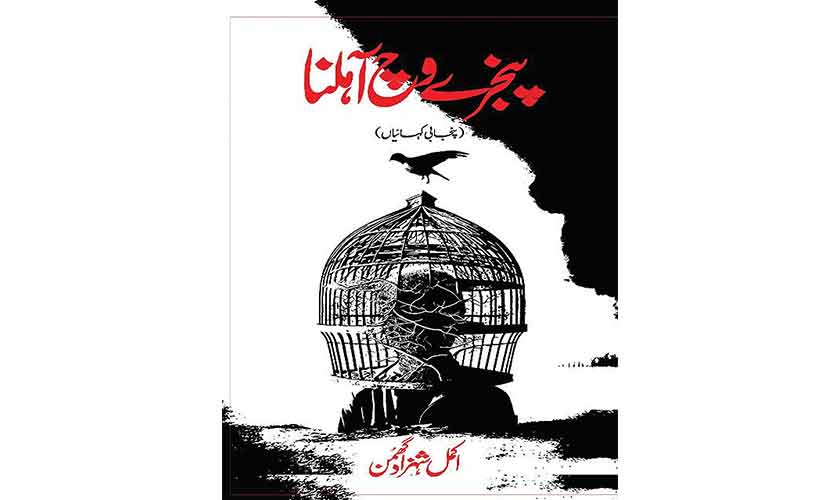
kmalShahzadGhumman’s latest short story collection PinjraywichAahlna is a gift to the readers, and not only in the metaphorical sense. Made available online in PDF format, the book offers welcome access to those who may not have been able to find a physical copy. I read the digital version and promptly shared it with friends I thought had a taste for good literature. Encouraging responses have been coming in from those who’ve read it.
The book is among the rare few that, once I had laid hands on it, I felt like reading in a single sitting. I nearly managed to do that, except for the final story, Musalmaan, which stands apart due to its length. After reading the first ten in one go, I dedicated a second sitting to it. The fact that a book compels the reader to stay with it for such an extended stretch is, in itself, a testament to it being a compelling read.
Following his best-seller Media Mandi, a sociopolitical commentary on the media industry, Ghumman sahib introduces readers to an entirely different facet of his creative identity. This may not come as a surprise to those who have encountered glimpses of his literary flair over the years. Still, it is deeply satisfying to see that he has had the patience and perseverance to channel that creativity into a literary work.
This book has many merits, but the foremost among those is its brevity. With 11 stories of a manageable word count, it aligns well with the ever-shrinking attention span of Generation Z. In an era where relevance is partly measured by economy of form, a writer who cares to remain relevant must write short. This collection succeeds on that front.
As a reader, I found that the author employed several narrative tools that helped keep the stories concise. First, the plots are well-knit, leaving little room for the unnecessary to creep in. Second — and perhaps most impressively — the narrator is kept on a tight leash. The narrator’srole is threefold: to move the plot forward at a steady pace; to fill in contextual gaps that dialogue does not cover; and to gently shepherd the characters so they don’t stray away from the narrative arc.
Third, the characters, perhaps following the narrator’s cue, speak only as much as the situation demands. There is a marked restraint in their speech. This helps ensure the compactness of the storytelling.
Fourth, the writer has avoided Ashfaq-esque monologues often found in Urdu and Punjabi literature. There is no sermonising and no ideology on display. It takes a degree of self-effacement to muffle one’s own opinions and instead (a) allow the characters to grow organically and (b) trust the readers to draw their own conclusions.
The result is a collection of 11 tightly-crafted stories; small gems, each shining on its own.
The brevity of this collection, just 11 stories, invites a compelling comparison with Indian writer BanuMushtaq, who won the International Booker Prize this year for her own 11-story compilation, translated from Kannada into English. The quality of work here stands shoulder to shoulder with hers. I have no doubt that, in time, this collection will be translated.Who knows, Pakistan may yet get its first-ever International Booker, thanks to this author.
The language employed throughout the book is remarkably simple and carries the distinct flavour of everyday life on the street. This, more than anything, makes the reading experience both accessible and authentic.
What struck me most was the absence of melodrama. There is a welcome restraint, no overkill, no unnecessary twists, only the amount needed to hold the reader’s interest. Take, for example, the story Musalmaan. The fate of Danial is delivered with an unusual and unexpected ending. A lesser writer might not have resisted the urge to stage a lynching. The restraint is what elevates the storytelling here.
Literary history reminds us how critics have not always been kind to authors who dare to defy narrative convention. Guy de Maupassant, for instance, faced harsh criticism for letting Mathilde in The Necklace live long enough to discover that the borrowed necklace she had spent years repaying was, in fact, a fake. Her suffering, needless, poignant and irreversible, unsettled many.
In contrast, this collection demonstrates restraint. The writer is economical with misery and melodrama, yet many of the stories are still ripe for adaptation. O Horian is one such example — a story that could be dramatised with minimal effort, and with considerable impact. Others in the collection share this cinematic quality, their visual potential emerging naturally from the writing.
I’ve often wondered why literature, particularly the novel and short story, seems to require a watershed moment in history around which to anchor its plot. Event like world wars, the partition of India and 9/11frequently become the scaffolding for literary exploration. That is not to suggest that this kind of literature is any less worthy; there is no shortage of powerful writing grounded in historical trauma. The Partition alone has inspired countless literary works of enduring value.
Yet what this collection proves is that compelling stories don’t always need dramatic historical backdrops. The quiet tensions of everyday life, told with precision, empathy and insight, are enough to carry a story through, and in this case, they do so with lasting effect.
If literature is indeed a reflection of life, everyday life, then why must it so often rely on grand historical backdrops? Why can’t it be set in ordinary locales, capturing the ordinary struggles of ordinary people? Ordinary times, too, can offer the necessary canvas for literature to explore courage, trauma, loss, survival and resilience.
This is where PinjraywichAahlna truly shines. Its greatest strength lies in how it centres on everyday characters, people from the street, speaking in familiar, colloquial language and confronting life’s challenges in quiet, non-heroic ways.
The authordid not need a major historical event to anchor his writing. Instead, he allowed the strength of his words to do the heavy lifting.
More power to you, sire.
The writer is a freelance reviewer