

Print Story
X




The late Imran Mir’s abstract practice continues to challenge our idea of what it means to make meaning
| P |
ainters and the public often believe that artistic skill, precision and perfection lie in rendering the likeness of a face, a human body, a set of static objects or a specific terrain. Filling flat colours into shapes, lines, circles, triangles or other forms is seen as comparatively easy, achievable — even trivial.
In reality, creating a non-recognisable composition within defined boundaries using flat, even colour presents a greater and two-fold challenge. Applying paint with consistent thickness and texture across areas that may stretch over several feet is a laborious task. Any spillage of pigment, slip of the brush or tremor of the hand can ruin the intended surface, the visual impact — and therefore, the content.
The second, and perhaps greater, challenge is content itself. Naturalistic or stylised imagery is often derived from an existing source — whether a live model in the studio, an arrangement placed in front of the artist, a landscape viewed in the open, a photograph or memory and imagination. By contrast, abstract imagery is not based on a specific source (except earlier or contemporary exercises in art and geometry). It does not refer to identifiable objects or subjects. In visual art, such work is therefore called abstract: “what you see is what you see.”
This dictum by Frank Stella, a prominent exponent of abstract art, is also the title of a monograph on Imran Mir, published in 2014. Mir (1950–2014), another significant practitioner of abstraction, explored and experimented across multiple dimensions of the genre. He worked as a painter, sculptor and designer; yet in each of these conventional roles he stood out due to his distinctive aesthetic. This was confirmed by his posthumous retrospective, Imran Mir: The Alchemist of Line (October 2, 2017 – January 31, 2019), at the Mohatta Palace Museum in Karachi.
Held three years after the artist’s death, the exhibition paid tribute to Mir’s contributions to Pakistani art, while also offering an opportunity to reassess his work from a fresh perspective. Revisiting Mir’s art now, after an interval of 11 years, allows for a more objective and historical analysis of his practice — one traditionally divided by art critics into two categories: his artworks and his design projects.
This separation is rapidly dissolving in contemporary art discourse. For example, in the recently concluded exhibition Manzar — showcasing art and architecture from Pakistan at the National Museum of Qatar, Doha — posters designed by Lala Rukh for the Women’s Action Forum were displayed alongside her artworks. Similarly, the Mohatta Palace Museum retrospective emphasised the coherence in Imran Mir’s vision, demonstrating that his logos and design projects were as creative, original and thought-provoking as his paintings and sculptures.
Perhaps due to his dual engagement — or the private nature of his personality — Imran Mir was never a particularly visible operator in the art world. Unlike artists who frequently move between galleries and exhibitions, Mir belonged to a quieter league of practitioners such as Zahoor-ul Akhlaq, Iqbal Geoffrey and Salahuddin Mian — artists who found greater satisfaction in the act of making than in public display.
A tangible expression of this ethos is seen in the sheer scale of Mir’s canvases — often too large for conventional galleries or private homes. Their mural-like proportions (e.g. 152 cm x 366 cm; 183 cm x 610 cm; 244 cm x 793 cm) reflect his refusal to compromise, either for the demands of the art market or in pursuit of popularity. Regardless of variation in imagery, dimension or form, Mir’s work reflects what Geoff Dyer once wrote about Susan Sontag’s literary criticism: an “unyielding adherence to standards of excellence.”
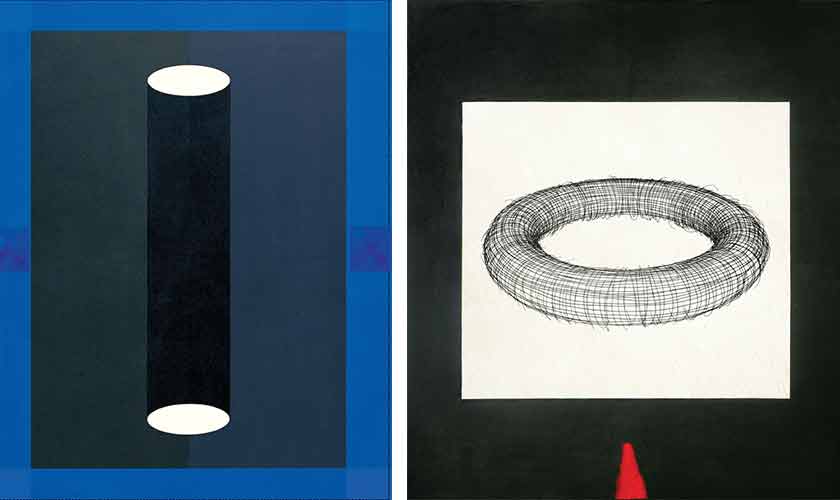
This excellence was achieved through a visual vocabulary not commonly used or understood in societies like Pakistan, where readability often takes precedence over meaning. Yet, meaning cannot be dismissed simply because the language is unfamiliar. One would not deem a line of text meaningless if written in an unknown script — whether Ethiopian, Yiddish, Coptic, Cherokee, Armenian, Amharic or Georgian. Likewise, abstract art cannot be dismissed as senseless merely because the viewer is not fluent in its visual language.
Since ancient times, human beings have assigned meaning to objects — whether man-made or naturally occurring — from a stone nearby to a star in the distance. Everything can become a symbol, a metaphor.
This tendency persists today and is often seen when a visitor confronts an artist at an exhibition, asking: “What does it mean?” regardless of whether the work is an abstract canvas, a group of figures, a cluster of domestic objects or a distant landscape. The image-maker, in turn, is continually attempting to discover meaning in their own creations. With every engagement, they uncover new layers of thought and interpretation.
An artist’s aesthetic journey is long, complex and full of unexpected turns, rarely reducible to a simple explanation for a single work. To view only one piece without considering the full scope of the practice is to miss the broader context from which meaning may emerge.
Imran Mir’s artistic journey, like that of many artists, began with observation — inscribing what he saw, absorbing influences, experimenting with imagery, materials and techniques — until he arrived at a visual language he could call his own. That notion of own is essential: while his paintings and sculptures clearly belong to the lineage of abstract art, they also reflect the distinct personality of the artist behind them.
In the opening essay, My Journey, from his 2014 monograph, Mir writes about three of his close friends: Nusrat Fateh Ali Khan, Zahoor-ul Akhlaq and Ardeshir Cowasjee. He recalls: “Zahoor had a gentle smile and spoke softly; he was the epitome of politeness with all those around him, including servants.” He also shares a line Nusrat Fateh Ali Khan once said to his wife, explaining their friendship: “Bhabi, you know why Imran and I are such close friends? Because we are both men of few words — but in these few words we can say a lot.”
If the qualities attributed to Akhlaq also describe Mir, then Khan’s remark captures the essence of Mir’s art. His visual practice was a quiet yet deeply articulate exploration of abstract form, one that resisted overt subject matter. This is especially evident in his Sixth Papers on Modern Art and Seventh Papers on Modern Art, where he investigates the structure of visual language. Drawing on the Golden Mean and linking modern art to classical Greek and Renaissance formalism, Mir’s compositions evoke the sublime through controlled, deliberate arrangements of lines, shapes and colour.
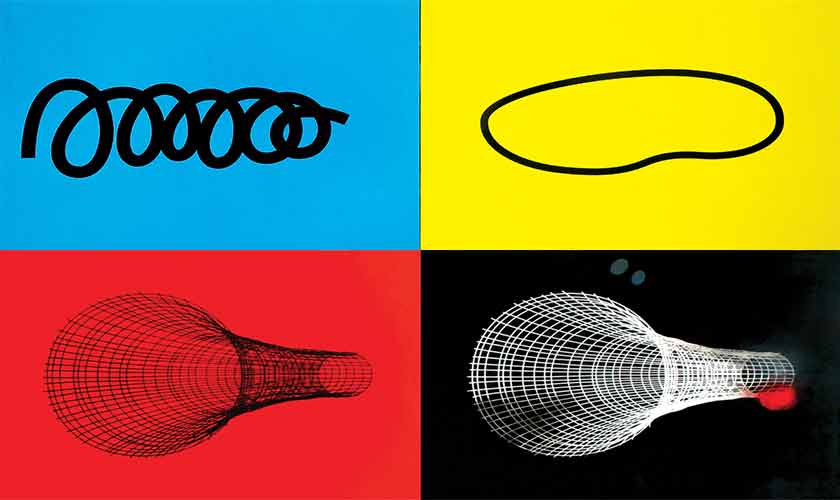
This stillness is particularly visible in his later works, from around 2010, where spiral, circular, oval and spring-like forms float across expanses of luminous colour, outlined with precision and restraint. These canvases, like the characteristics Mir admired in his friends, are quiet, refined expressions of joy. They speak, like his friendships, in “a few words,” “spoken softly,” from an artist remembered as “the epitome of politeness.”
The writer is a visual artist, an art critic, a curator and a professor at the School of Visual Arts and Design, Beaconhouse National University, Lahore. He can be contacted on quddusmirza@gmail.com.