


Print Story
X




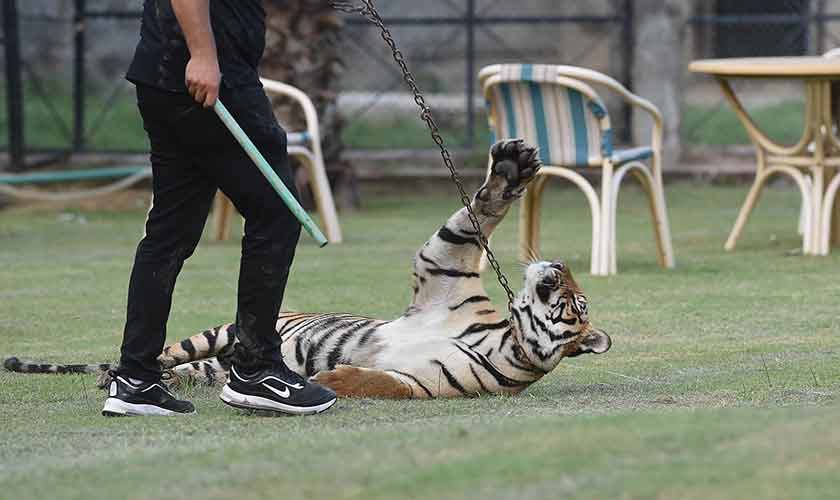
In the wake of the lion’s escape from a house near Shah Di Khooi recently, the government has launched yet another crackdown on unlicensed keepers of big cats
| L |
ast week, the news of a pet African lion escaping a house near Shah Di Khooi, Lahore, broke the Internet. CCTV footage showed the lion jumping over the wall and running off. It later attacked a woman and her two children.
The police arrested the owners who were found to have kept the lion without the requisite licence. They also took the animal to a wildlife park.
This wasn’t the first such incident reported in Lahore. In December last year, an adult lion had escaped from a house in Harbanspura, causing panic among the neighbours. Eventually, a security guard shot it down. Though no human was hurt, the incident alerted the authorities. In January, the Punjab Wildlife (Protection, Preservation, Conservation and Management) (Amendment) Act, 2025 was introduced which seeks to regulate ownership of big cats, among other things.
On February 2, a Jallo Wildlife Park employee was reported to have let a white Bengal tiger out, much to the horror of the visitors. Fortunately, no one was harmed. The animal was tranquilised and returned to its enclosure.
Earlier, a young man who wanted to make a TikTok video near a caged lion, at a breeder’s farm in Sabzazar, was mauled and badly injured by the animal. The Wildlife Department revoked the farm’s licence and launched legal proceedings against the owners.
The Shah Di Khooi incident has prompted another crackdown on unlicensed keepers of big cats. Muhammad Adnan, a spokesperson for Wildlife Rangers, claims that the department has so far captured 18 lions from different parts of the Punjab. Of these, 15 lions have been recovered from Lahore alone.
He says that following the lion’s escape in Harbanspura the Wildlife Department has launched a mobile phone app where pet lovers in the Punjab can register wild animals they are keeping and obtain licences. The app, named Wildlife PASS, offers a 30-day window to pet owners to provide details of their animals.
The Shah Di Khooi incident proves that not everybody took the warning seriously, as the lion was unregistered.
| A |
Altamush Saeed, an interspecies justice advocate and academic, says keeping wild animals in residential areas is a threat not only to public safety but also to the health of the animals.
He says that most homes do not have proper enclosures for wild animals. This makes their escape likelier. Also, they are often kept in poor hygiene conditions. Most private owners cannot always ensure proper care for the lions, Saeed adds.

The government has decided to abolish private ownership of lions, tigers, pumas, cheetahs and jaguars, the main reasons being public safety, risk of disease, poor animal care and unregulated breeding.
Saeed says a crackdown on illegal possession of wild animals was long overdue. It was partly the result of a case filed by his team before the Lahore High Court in June. He says that issuing licences alone cannot solve the problem, because the state lacks the capacity to enforce the laws. His legal team has challenged Section 12 of the Punjab Wildlife Act, 1974, which allows private possession of wild animals. They have also questioned Section 10-A of the Act, which deals with animal welfare and calls for proper housing, temperature control and nutrition for captive animals.
The petition is demanding a complete ban on private ownership of wild animals. They also have reservations regarding the [proposed penalties. Under the law, the punishment for illegally keeping a wild animal is a Rs 250 fine or two months in jail. The penalty is rarely enforced and cannot be an effective deterrent, he says.
Saeed’s team has also sought information from the Wildlife Department on its sterilisation programme. Saeed says proper sterilisation is imperative to prevent the illegal trade in wild animals. He says male and female animals require different treatments so that a blanket sterilisation-for-all programme may be counterproductive.
Muhammad Ramazan, a deputy director of the Wildlife Department, says that the government is working to phase out the private ownership and custody of big cats. He refers to a recent public notice issued during the 22nd meeting of the Punjab Captive Wildlife Management Committee, according to which the government has decided to abolish private ownership of lions, tigers, pumas, cheetahs and jaguars, the main reasons being public safety, risk of disease, poor animal care and unregulated breeding.
Ramazan says that most of the big cats are not native to Pakistan. “The only place for these animals is at zoos and safari parks — where they can contribute to tourism and research,” he adds.
Under the new directive from the Punjab government, only registered breeding farms or wildlife parks that meet the housing standards will be allowed to keep a limited number of big cats. Facilities in residential areas will no longer be allowed to domesticate these animals.
Owners/ keepers have been given a three-month deadline to upgrade their facilities or move their animals to registered parks or safaris. Those failing to do so must hand over their pets voluntarily to the Wildlife Department, or donate them to registered facilities. The wild animals found in violation of the law may be euthanised if their welfare or human safety is at risk.
Ahsan Raza is the editor of Minute Mirror. He can be reached at ahsanbudh@hotmail.com