Print Story
X




A roadside vendor of digests and news dailies in Old Anarkali who wouldn’t give up hope
| D |
isembarking from the Orange Line train at Jain Mandir station, I headed towards one of the oldest marketplaces in Lahore — the Old Anarkali Bazaar.
In the past few years, I have visited this part of Lahore quite frequently. This bazaar always connects me with history through its many relics; its residents, who’ve been based here through generations; and those who’ve been running their businesses for a long time.
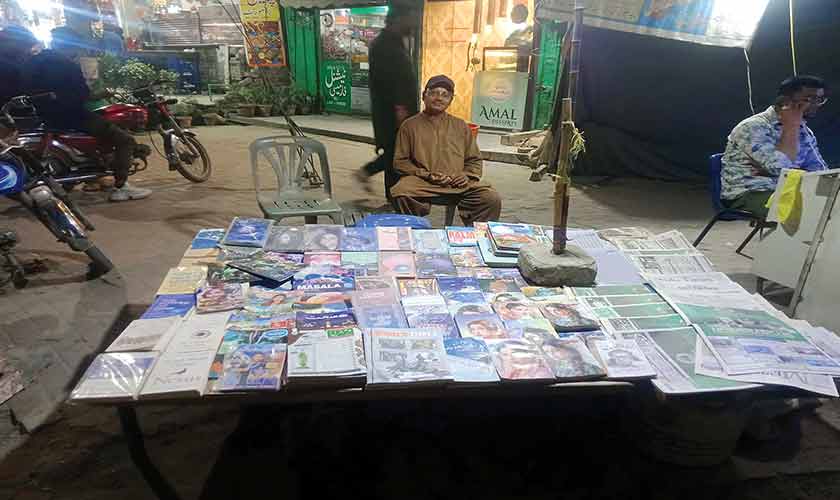
This is also a place where I chance upon people who add richness to its culture. On my previous visit, I noticed a wooden plank beside the entrance to the Old Anarkali Bazaar. A wide variety of digests, magazines, novels, poetry books and newspapers sat on it. Nearby, I spotted a bespectacled man in his late fifties. That was Syed Shamshad Ali, the mild-spoken vendor of old books and papers. At 9pm, he was still at work.
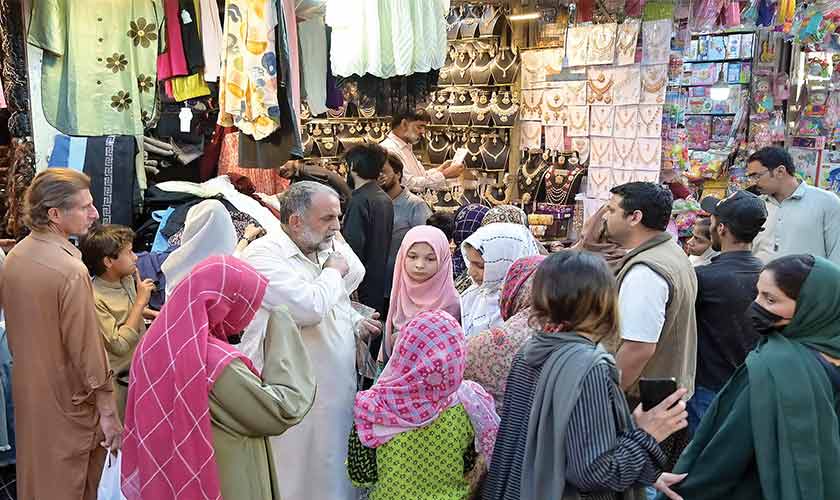
It is common knowledge that Old Lahore comes alive once the sun goes down. Naturally, there was a lot of bustle at that time of the night. Sporting a plain shalwar qamees, with which he wore a sportsman’s cap, Ali looked a bit tired. It was as if it had been a long day.
I greeted him with salaam and, with his permission, sat next to him. I was compelled to ask him as to what difference did he find between the readers of today and those of the 1980s and even earlier. Sounding nostalgic, Ali replied, “The business [of selling old books] was started by my father in 1962. I joined him in ’83. Compared to what I see today, the people were greatly inclined towards reading newspapers back then.”
Ali recalled how he would go from door to door hawking the papers. “Everyone started their day by going through the papers,” he told me. “Sadly, the new generation is not into reading; they are only into their smartphones.”
He recalled how he would go from door to door hawking the papers. “Everyone started their day by going through the papers,” he told me. “Sadly, the new generation is not into reading; they are only into their smartphones.”
I asked him if he liked to read. His eyes glinted. “Of course, I did,” he said, and then went on to recount the authors he had read: Bano Qudsia, Ashfaq Ahmed and Faiz Ahmed Faiz among them. Next, he recited a couplet by Faiz. I was impressed.
Ali told me that he had several loyal customers back in the day. “It was a time when you didn’t see a lot of cars or motorcycles on the roads,” he added. “Mostly, you had tongas and bicycles. Life was simple and, hence, contented.”
I also asked him, “How much feasible is the business of selling old books on a roadside?” His reply was predictable: “Today, I see a lot of food outlets being crowded all the time, but there are very few takers of books or print magazines. It’s really hard [for us] to make both ends meet.”
But he hadn’t lost all hope. He said that he was optimistic about a time in the future when the people would “return to books for solutions to their life’s puzzles and predicaments.”
Usama Malick is a storyteller with an M Phil in English