

Print Story
X




Another voice advocating for peace in the tribal areas has been ruthlessly silenced
| A |
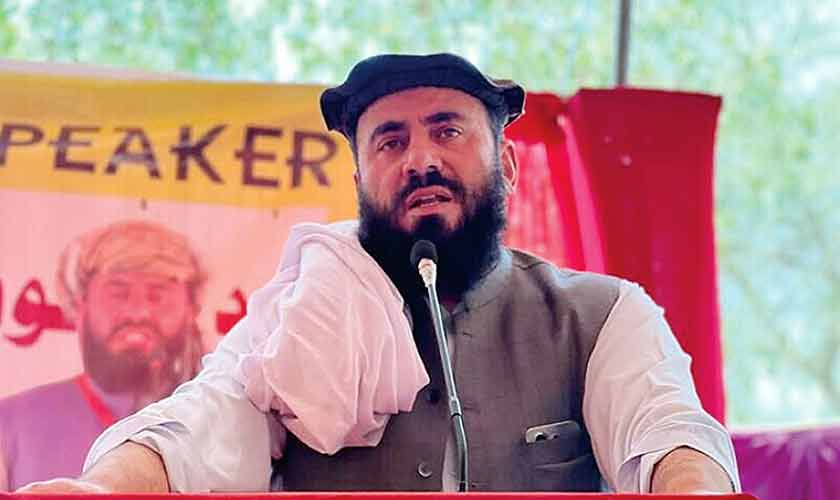
prominent leader of the Awami National Party in Bajaur, Maulana Khan Zeb, was no stranger to danger. He had long been a fearless advocate for peace in a region scarred by conflict and extremism.
He had survived several attempts on his life. In 2019, a rocket attack had targeted his home. Later that year, another strike had left several of his family members with injuries. Yet he never backed down. During Operation Sher Dil, when many fled Bajaur, Maulana Khan Zeb stayed. Rooted in his land, he resisted not only the militant violence but also the fear-induced silence.
However, what began as another day of campaigning for the Bajaur Peace March ended in tragedy. His voice - steady, reasoned and unwavering - was brutally silenced.
As the Maulana wrapped up his day’s activity in Khar Bazaar and headed home, his vehicle slowed near Shandi Morh Chowk, a familiar turn. Suddenly, some men emerged from the shadows and opened fire at it. Maulana Khan Zeb and two of his companions were martyred in the ambush.
This was not an isolated act of violence. Bajaur, still reeling from insurgency, has seen a disturbing resurgence in targeted killings and terrorist attacks in recent months. In defiance of the militants, some tribal elders had launched the Bajaur Peace March. The Maulana was its beating heart.
Though, he had never won an election, his influence in the area ran deep. In the 2024 general elections, he contested the NA-8 seat and secured over 12,000 votes. As Awami National Party’s secretary for the ulema, he was widely respected in both religious and political circles.
The Maulana’s legacy extends far beyond politics. A scholar and author, Maulana Khan Zeb had written a Pashto book on the mineral resources of Khyber Pakhtunkhwa. However, it was his tireless campaigning as a peacemaker that truly defined him.
Last year, when sectarian tensions flared in Kurram, he had led a traditional jirga to the conflict zone. There, amid escalating hostility, he had initiated a dialogue between Sunni and Shia tribes, urging reconciliation and calm in a region often torn apart by sectarian divisions.
Now, that courageous voice for peace has been silenced, not through argument or dissent, but by bullets. His assassination is not just a loss for his family or his party; it is a devastating blow to the fragile hope for peace in one of Pakistan’s most volatile regions.
In recent months, the Maulana had become a familiar presence in universities and colleges, speaking passionately on the Mineral Act. Once the academia was engaged, he took the same message to mosques and seminaries.
Few could match his command over Pashtun geography, history and natural wealth. But for Maulana Khan Zeb, knowledge was never just about information—it was empowerment. He envisioned a future in which Pashtuns were not merely labourers extracting riches for others but rightful stakeholders.
To him, the soil was sacred. The gold and silver hidden beneath mountains meant little if the people living above remained poor and voiceless. For the Maulana, land was not just territory, it was also important to the people’s identity.
He was silenced before the Bajaur Peace March. Thousands poured into the streets of Bajaur to mourn and protest his demise. Tribal elders have since issued a set of demands. Any future military operation, they say, must be launched after public consultation. The people, they say, will not accept another round of displacement. Bajaur’s mineral wealth, they say, belongs to its people; all unauthorised mining must cease. Anyone supporting terrorism will face social and economic boycott. “No more war. No more silence. No more sacrifices for other people’s conflicts,” they say.
Dr Ilam Khan, a close observer of the Pashtun society, remembers Maulana Khan Zeb not only as a religious leader but as a scholar, historian and reformer. “In a short span of time, he earned deep respect not only in Bajaur but across the entire Pashtun belt,” he says.
The Maulana authored two major works, Tareekh-i-Bajaur [A history of Bajaur] and Shtamana Pakhtunkhwa [Prosperous Pakhtunkhwa]. These were no ordinary books, but cultural blueprints, chronicling heritage, resistance and aspirations of a proud people.
The provincial cabinet has approved Rs10 million allocation for the family of Maulana Khan Zeb.
Muhammad Nisar Baaz, the Awami National Party MPA from PK-22 Bajaur and a close friend of the Maulana, says that he was a third generation supporter of the ANP ideology. He had been in active politics since 2017. In 2024, general action he was a strong candidate. However, due to the killing of Rehan Zeb, the election was postponed in the constituency.
“We demand that the government form a joint investigation team to probe the Maulana’s murder. The culprits must be arrested and prosecuted,” Nisar Baaz says.
Nisar Baaz and the Maulana had started Ranra [light], a study circle where they discussed peace and ways to bring prosperity to the region.
“The Maulana’s interest was not limited to history,” Dr Ilam Khan says. “He was one of the few voices who informed people about to the mineral wealth beneath their feet. His message was not just about resources, it was about reclaiming dignity, demanding local ownership and building a future rooted in justice. Through knowledge and activism, the Maulana became a bridge between a wounded past and a hopeful tomorrow.”
The writer is a multimedia producer. He tweets @daudpasaney