

Print Story
X




Surviving climate shocks in a loop of systemic failures and class divide
| I |
n the sun-cracked village of Saifabad in Jhal Magsi, Taimoor Khan gestures toward the roof of his mud house. The clay walls are buckled and heat-ravaged, fractured by a summer that seems to lengthen each year. “We live in a furnace,” he says. “From April to September, the sun crushes us. Children faint, the cattle die and we can’t work in the fields. The heat leaves us no dignity.”
Across Pakistan, climate-induced weather events have aggravated from seasonal hardship to generational threat. They no longer just displace people; they dismantle lives. The invisible frontline of this crisis is formed by communities like Taimoor’s, where poverty meets climate extremes in devastating synchronicity. They are caught in a cycle of rising temperatures, crumbling infrastructure, absent systems and waning hope.
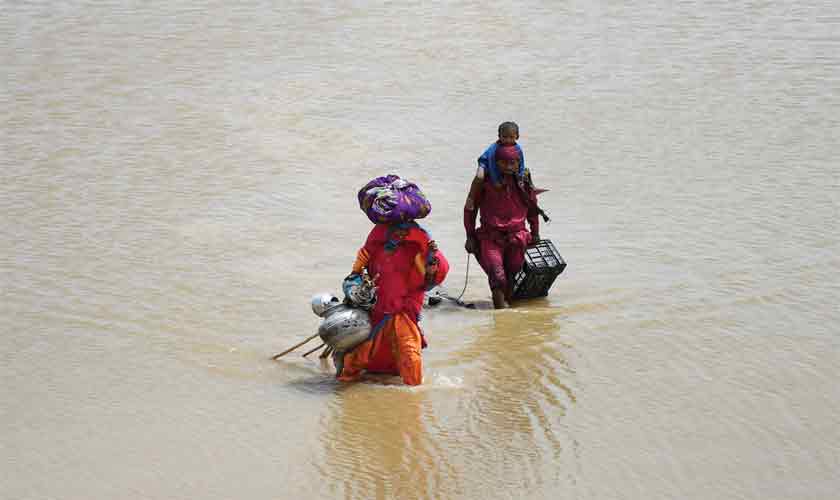
The 2022 floods, among the worst in Pakistan’s recorded history, affected over 33 million people, displacing at least 8 million and killing more than 1,700. But the disaster did not end when the water receded. It continues to date, manifesting in malnutrition, economic devastation and migration without clear maps.
In just twelve days – from June 26 to July 7 – monsoon rains triggered flash floods and landslides that killed 79 people and injured 140, the National Disaster Management Authority reported in its Monsoon 2025 Daily Situation Report, released on July 7. The numbers, though jarring, tell only a part of the story. The deeper crisis is the persistent vulnerability that leaves these communities one storm away from collapse, over and over again.
In Barija village, Yasmeen Baloch recounts how last summer’s heatwave pushed her family past their limit. “We couldn’t cook inside. Our livestock died. My uncle collapsed in the sun. No one provided us support. We were not warned; we were left to survive however we could.”
This is not just neglect but the predictable result of longstanding systemic failures. Pakistan’s disaster impact is amplified by poor planning with infrastructure built near floodplains; an outdated river management system; under-investment in risk reduction and overlapping socioeconomic vulnerabilities. This conclusion is also supported by a World Weather Attribution report, which found that while climate change intensified rainfall, the scale of destruction increased due to high exposure and vulnerability, with social and governance failures playing a major role.
The overlapping risks are most severe for women. Excluded from decision-making, lacking land ownership and bearing the brunt of caregiving during climate shocks, women are not just under-resourced in crises, they are routinely overlooked in planning and response.
Yasmeen explains this quiet exclusion with clarity. “We couldn’t fetch water during the day because it was too hot and unsafe. Inside our homes, too, it was unbearable, but we had no alternatives. Where else could we go? When some people came to assess our needs, only a few families were selected to talk about it. Most of us, especially women, were left out and unheard.”
Children too, face a sharp edge of climate vulnerability. According to UN News, in flood-affected districts in 2022, 1.6 million children were already suffering from acute malnutrition; 6 million were stunted. Add disrupted education, unsafe migration and trauma, and the cost of inaction compounds over generations.
In Dadu, Ali Gohar Malah describes how his family migrates twice a year: first to escape the heat and then the floods. “In June, our fishponds dry up; birds fall from the sky; and we move to Manchar Band to survive. But when the rains come, we move again to the embankments where there is no sanitation or clean water. We live between fire and flood. Still, no one comes [to our rescue].”
These testimonies point to the limits of post-disaster relief and the urgent need for anticipatory action. According to Sahibzada Manzar Hussain, programme manager for the the International Federation of the Red Cross and Red Crescent Societies, climate displacement is not just a logistical issue; it is also a crisis of identity.
“People do not just lose homes. They lose livelihoods, social networks, dignity and their way of life. The response must go beyond infrastructure. It must protect who people are.”
The IFRC, in partnership with the Pakistan Red Crescent Society, has prioritised the strengthening of early warning systems for floods and heatwaves (IFRC Pakistan Plan) as a critical step in reducing loss of life. Hussain notes that for these systems to be truly effective, they must reach the “last mile.” Communities in remote, low-literacy and infrastructure-poor areas that are too often left out of conventional warning mechanisms need to be included.
One promising example of how technology can serve this goal comes from Jazz, Pakistan’s largest telecom provider. “We work with the NDMA to interpret advisories and map at-risk zones through tower-based location data to precisely target users in vulnerable areas,” says Fahad Rehman, head of ESG at Jazz. “When a disaster is forecast, users in those areas receive targeted alerts. It’s a way to reach people directly, quickly. No matter where they are.”
The challenge ahead is not simply to rebuild after each monsoon. It is to rethink how and for whom Pakistan plans its future. Current displacement trends suggest that while disaster-induced migration often results in people returning home, slow-onset climate events like droughts and heatwaves are pushing more families to leave permanently. Unfortunately, national data systems are not yet equipped to track this nuance or the ripple effects on receiving communities, where water, sanitationand public services are already stretched thin.
Preparedness must no longer be measured by response time after the storm but by what is in place before the clouds form. This includes climate-resilient housing, healthcare access, clean water, public education campaigns and the political will to put the most vulnerable first.
One example of such an approach is the Recharge Pakistan project, which takes a long-term view of resilience by working with nature: restoring wetlands, recharging aquifers and managing floods through ecosystems rather than concrete. But beyond the technical design, the project emphasises respect for community knowledge, the lived experiences and ancestral practices that have helped people survive for generations.
“Adaptation is not just a technical fix. It is a long-term commitment to equity,” says Muhammad Fawad Hayat, senior director of Recharge Pakistan, WWF-Pakistan. “We are restoring floodplains and reviving traditional water systems, but resilience is only real when it is locally led and community-owned. Nature can buffer the extremes, but people must define what recovery looks like.”
The next heatwave will arrive, and so will the next flood without asking who owns the land or who holds office. What we do now, where we act, who we listen and whom we protect, will decide whether the same people will keep rebuilding from ruins.
The writer is a communications and advocacy manager at Recharge Pakistan, WWF-Pakistan.