Print Story
X




Nature-based solutions to build resilience of mountain communities in Pakistan
| I |
n the Tissar union council in Shigar district of Gilgit-Baltistan, people live in constant fear. The Basha River that flows next to Tissar causes riverine floods, resulting in the erosion of agricultural land of these communities every year. This not only threatens food security but also the survival of 770 households in the Tissar-I, Tissar-II, Tiston and Thorgo villages.
The situation gets worse in the summer (June to August), when snowmelt raises the water level in Basha River. The water from the nearby Braldu River also adds to the Basha River and increases erosion of farmlands in Tissar. Because of this, prime agricultural land is going to waste.
To make up for the land lost to river erosion, Tissar has been assigned a share in the communal barren land in Gorocho village, which spreads across 716 hectares. Since Gorocho lies between Basha and Braldu Rivers, it lacks irrigation and protective infrastructure.
To build the resilience of mountain communities in Gilgit Baltistan, the World Wide Fund for Nature-Pakistan through the Water Resources Accountability in Pakistan programme, has undertaken several interventions in Tissar. After consultative sessions with communities and field assessments to ensure that the construction of gabion walls along the Braldu River does not cause soil erosion on the riverbank, protective bunds were constructed on Basha and Braldu Rivers. This was followed by the construction of the irrigation channel, using a green-grey nature-based solution approach to help stabilise riverbanks and prevent soil erosion.
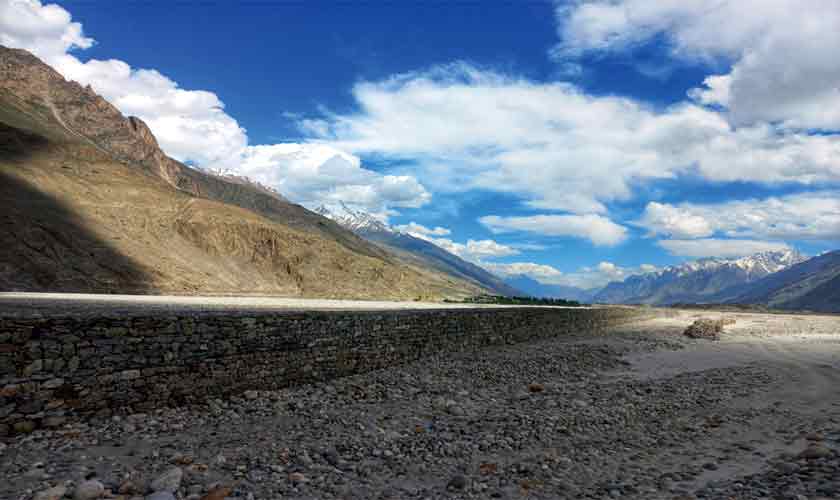
A 1,000 rft gabion wall was constructed along the Braldu River and a 600 rft wall was built along the Basha River to protect the 716 hectares of barren land.
The construction of protective bunds was meant to augment the interventions undertaken by the International Fund for Agriculture Development, as part of the Farm to Market Road initiative of the Economic Transformation Initiative Gilgit Baltistan. The ETI-GB was engaged in developing over 650 hectares of barren land at Ghorocho village through the construction of a 11.4-kilometre irrigation channel, a 4.44-kilometre Farm to Market main road, and a 5-kilometre Farm to Market link road with an investment of Rs 160 million. IFAD’s interventions aim to benefit 770 households.
WWF-Pakistan was requested by the ETI Baltistan office to construct the gabion walls. The construction has significantly helped to protect the channel developed by the ETI. Since the irrigation channel was vulnerable to flooding due to high flows in the Basha and Braldu Rivers, there was a possibility that the protective infrastructure on the right bank of the Braldu River might increase the flood risk on the left bank, potentially affecting the agricultural land in the nearby Hyderabad community. To mitigate this challenge, an additional 500 rft gabion wall was constructed on the left bank.
The construction of gabion walls along the Braldu River under WWF-Pakistan’s WRAP programme has helped protect the communities and the fertile agricultural plains from river erosion.
Dr Farasat Ali, the provincial project lead at the WWF-Pakistan, says that “according to the IUCN NbS guidelines, this case fulfills the NbS criteria by effectively addressing the societal challenge, incorporating risk identification and risk management beyond the intervention site, integrating biodiversity and ecosystem, stakeholders and community engagement as well as resilience-building by ensuring sustainability.”
Zaman Ali, a member of the Tissar Welfare Organisation, says, “The construction of gabion walls has greatly benefitted us. Each of the 770 households have approximately 0.77 hectares (15 kanals) of agricultural land at their disposal. These households are using this land for agriculture and tree plantation. This will improve their livelihoods.”
“At least 50 families practice agriculture on the allocated land. They grow corn and wheat crops. Another 100 families have planted trees. This will give them a steady source of income,” says Ali.
“The construction of gabion walls has also made it easier to travel. Due to higher river flows in summer, access to Gorocho village used to be affected. The high flows no longer erode the land and our movement remains unaffected.”
The soil erosion control interventions have protected over 700 hectares under sustainable land management. The previously barren land has now become arable. These interventions have benefitted a population of 7,800.
Haider Raza, the NbS, WWF-Pakistan director, says that the Tissar intervention is a good example of biodiversity gain, criterion 3 of the IUCN NbS standards. “This also reflects the need for institutional synergies and co-financing as per criterion 4.3. Tissar case could be a model for other stakeholders to adopt NbS interventions.”
The walls also protect the irrigation channel and roads constructed by ETI-GB from flooding. Field assessments have confirmed significant reduction in soil erosion along Basha and Braldu Rivers. WWF-Pakistan’s mitigation measures have proven a replicable cross-project responsibility model with ETI-GB, which will continue to benefit the communities in the long-term.
The writer is a PhD student at George Mason University, US. He is also an international award-winning environmental journalist. His X handle: @SyedMAbubakar. He can be reached at s.m.abubakar@hotmail.com.