

Print Story
X




In Language V, VI and VII, Rana reconfigures familiar images from the Western canon to document the dilemmas of the present moment
| A |
t the moment of our birth, we are bodily tied to our mothers. Likewise, we grow up connected to our mother tongue: a system of sounds we mumble, imitate and gradually develop by recognising words and the meanings associated with those. These allow us to communicate with our parents, family and relatives.
Later, in school, we learn grammar and begin to acquire additional languages: e.g. the national language and the state language. In post-colonial societies, these have often been adopted not as foreign tongues, but as the dominant means of communication between people of different dialects, ethnicities and regions.
Languages introduced by former rulers – such as English, Spanish, Portuguese, French and Dutch – have been so deeply integrated into former colonies that they are now used not only for conversation and official work, but also as medium for producing literature across Asia, Africa, the Caribbean and Latin America.
This natural development has introduced many influential voices to world literature, including Wole Soyinka, Léopold Senghor, Chinua Achebe, Arundhati Roy, VS Naipaul, Maryse Condé, Derek Walcott, Assia Djebar, Nuruddin Farah, Abdulrazak Gurnah and Ng g wa Thiong’o.
The situation sometimes leads to conflicts: writers narrate stories, conversations, situations and sentiments of a community that speaks a language different from the medium used by the author. The recently deceased Ng g wa Thiong’o’s original language was Gikuyu, yet English became a regular medium for his books and essays. After some of his early texts appeared in English, he took a firm stance in favour of returning to his mother tongue. His later publications were written first in Gikuyu, the language of his characters as well, before being translated into English and other languages.
In the realm of visual art, the matter is even more complex. Students of art and design are often taught that visual art is a universal language. Yet with experience, they begin to notice the fissures in this assumption. Images are not simply seen, as through the lens of a camera, they are also interpreted, which requires contextual understanding and awareness of historical, social and economic nuances.
African masks, for example, were inspirations for Cubist painters in France who viewed them as studies in form reduction. But for their makers in Africa, these masks were sacred representations of tribal ancestors. Similarly, Indian art, described as naïve or primitive by British art historians, was in fact a highly sophisticated system for depicting reality, not as illusion, but as a composite vision of the external and internal worlds.
People in a post-colonial culture are caught between two essential languages (and in most cases, three), with an added language for the art practitioner. Languages are not merely collections of words that can be replaced from one dictionary to another; they embody complex structures of life, i.e. beliefs, thoughts, emotions, expressions, physical surroundings, commerce and products. They introduce new concepts into a culture through new terms. ‘Strawberry’ and ‘cherry’ have not been renamed from English to Urdu, just as biryani or mullah have not been converted into English.
Living in a global – or Google – village, most of us use multiple languages simultaneously. This exchange is not confined to the educated (though, paradoxically, a book of literature or philosophy is usually written in a single language), but is common among the general public, academics included. Everyone converses in a blend of two or three languages, in classrooms, business meetings, political talk shows, television dramas, Bollywood films and popular songs.
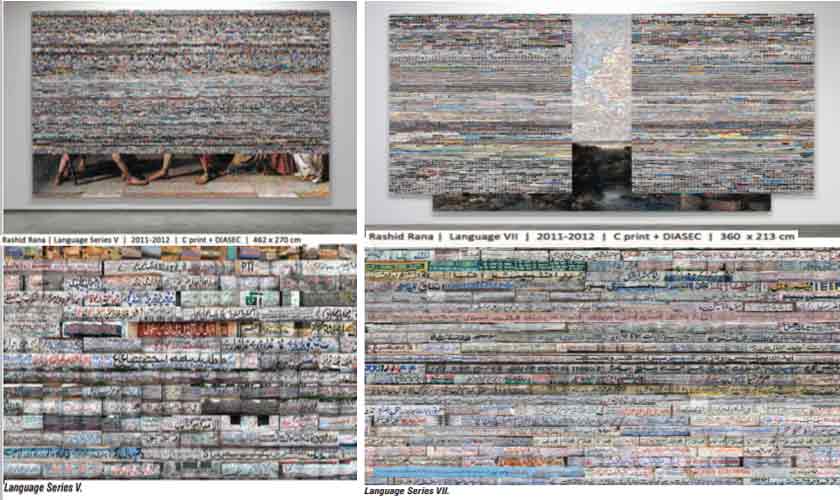
This practice is also visible in our popular visual culture, in cinema posters, advertising hoardings and shop signs from large cities, small towns and modest villages across the country. Rashid Rana has recognised this cultural shift, a natural development unbound by ideological restrictions, in his series titled Language. In Language II and III (2010-2011), what appear at first glance to be abstract paintings are, on closer inspection, compositions of ordinary signboards we pass by daily, often without noticing their multilingual makeup. A living archive of post-colonial communities emerges in the way imported commodities, such as Coca-Cola, motorcycle, camera, etc., are represented in Urdu script and indigenous words such as Sufi, tikka and dulha are written in Roman letters.
In Language V, VI and VII, Rana reconfigures familiar images from the Western canon, disintegrated and reassembled, to narrate and document the social, economic, political and artistic dilemmas of the present moment.
Most available art publications in our context, covering history, theory and criticism, are in English. It is also the medium of instruction in local art institutions. Yet during classroom lectures, seminars, studio discussions and exhibition openings, one frequently encounters a mix of two languages. This is largely due to most artists’ early schooling in Urdu, Sindhi or other national languages before they became familiar with English art discourse.
However, art is not meant for artists alone; it originates from a society and returns to it. (The artist is merely a conduit.) Claes Oldenburg once said that art “takes its form from the lines of life itself, that twists and extends and accumulates and spits and drips and is heavy and coarse and blunt and sweet and stupid as life itself.”
A large segment of the population in our society is not fluent in English and therefore does not feel comfortable engaging with modern and contemporary art. An image that appears to originate from the West can instantly seem alien or un-relatable. Responses to abstract art are prime examples of this phenomenon. Abstraction, often rejected by the general public, is, in its true sense, a product of Western art’s historical evolution. Interestingly, another thread of Western visual culture, figurative painting, whether from the Renaissance or Romantic era, has been more widely accepted here due to its perceived resemblance to locally produced art.
Perhaps recognising this gulf, artists such as Anwar Jalal Shemza, Rasheed Araeen, Rashid Arshed, Jamil Naqsh and Ismail Gulgee explored different routes to create a bridge between the language of abstraction and the script of Urdu and Arabic. Others sought alternative ways to articulate a blended visual language that reflects our time and place.
Earlier exponents of this diction, Bashir Mirza, Zahoor-ul Akhlaq and some of their contemporaries in India, modernised the aesthetics of traditional miniature painting. This concept evolved into a sustained practice among graduates of the Miniature Painting Department at the National College of Arts, Lahore. Many of them, Shahzia Sikander, Imran Qureshi, Nusra Latif Qureshi, Aisha Khalid, Talha Rathore, Tazeen Qayyum, Hasnat Mehmood, Muhammad Zeeshan, Waseem Ahmed, Khadim Ali, have transformed traditional forms and motifs through new imagery, formats, media and techniques. Today, few rely solely on conventional methods or vocabulary; instead, their exhibitions typically include installations, digital prints, tapestry, mixed media and performance-based work.
This shift is highlighted by Rashid Rana in his seminal piece I Love Miniatures (digital print, 2002). In it, a portrait of the Mughal emperor Shah Jahan, borrowed from a historic miniature, is reconstructed using pixels: miniature versions of large billboards advertising a range of consumer products. These are the new compendia of art history we encounter daily on the streets, rather than within the thick volumes published by Thames & Hudson or Phaidon.
Rana’s work captures a new language, one rooted in a glorious past but embodied in contemporary content, a language we now speak with ease and write with frequency.
The writer is a visual artist, an art critic, curator and a professor at the School of Visual Arts and Design, Beaconhouse National University, Lahore. He may be reached at quddusmirza@gmail.com.