

Print Story
X




China is emerging not just as an economic power, but also as a diplomatic and strategic one
| T |
he United States has long positioned itself as the leader of the free world and the guardian of the international law and global stability. But its recent support for Israel in a deepening conflict with Iran may mark the beginning of the end of that era.
In what could be remembered as a pivotal moment in 21st-Century geopolitics, America has chosen sides in a way that many see as a violation of the international norms it had once helped build.
This decision has implications, not only for the Middle East but also for the shape of the world order itself. As the United States clings to an increasingly contested role, China is quietly and steadily rising—offering a new, alternative model for global leadership.
The waning American credibility
From its invasion of Iraq to its silence on human rights abuses by strategic allies, the United States has long been accused of selective morality. Its staunch support for Israel in the face of growing international concern—particularly amid escalating tensions with Iran—may prove the final straw for many in the Arab and Muslim worlds.
This support has further diminished Washington’s credibility as a neutral actor in the Middle East. Once seen as a possible peace broker, Washington is now viewed as a partisan power pursuing its own interests at the expense of regional stability.
A vacuum
As trust in US leadership erodes, many nations—particularly in the Global South—are reassessing their alliances. In this vacuum, China is emerging not just as an economic power, but as a diplomatic and strategic one, too.
Unlike the US, China does not lecture its partners on governance or democracy. It offers infrastructure investment, trade agreements and development loans—no political strings attached. Its Belt and Road Initiative has already embedded it deeply in the Middle East, Africa and Southeast Asia. Increasingly, nations see Beijing not just as an economic partner, but as a reliable counterweight to Western influence.
The United Nations
One of the major casualties of this shift could be the United Nations Created to uphold international law and prevent unilateral action, the UN has been undermined repeatedly—often by the very countries that claim to defend it. US vetoes of resolutions regarding Israel and its selective adherence to international norms have led to growing disillusionment.
What comes next is uncertain. But one thing is clear: the unipolar world order dominated by the United States is ending. A new era - multipolar, contested and shaped by new alliances – is beginning. Whether it will be more just or more dangerous remains to be seen.
As global powers ignore or sidestep the UN to pursue their own agendas, its relevance in resolving international disputes is waning. A world increasingly shaped by power rather than principle may soon operate beyond the UN framework altogether.
New blocs
In the shadow of the US-led world order, a new bloc is forming. Countries like China, Russia and Iran are building economic and military alliances, challenging the dominance of Western institutions like the IMF and the NATO.
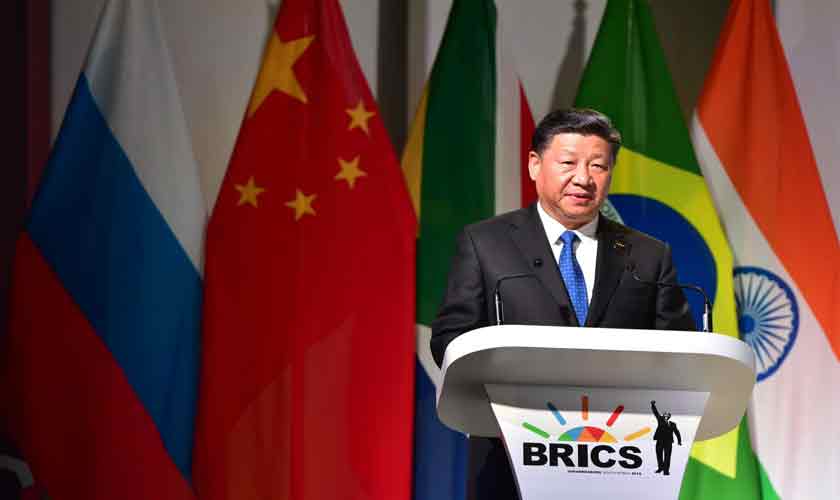
Organisations such as BRICS+ and the Shanghai Cooperation Organisation are gaining momentum. These emerging networks reflect a growing desire among many countries to break free from the post-World War II Western-led order and create a more multipolar global system.
Resource market
For decades, Western powers enjoyed privileged access to global resources—energy, minerals, trade routes—often through coercion or exploitation. That dynamic is changing. Resource-rich nations are diversifying their partnerships and turning to non-Western allies who offer better terms and fewer conditions.
China is at the forefront of this shift, securing long-term deals for energy and rare earth minerals. Western dominance in global markets, once a given, is now being challenged on multiple fronts.
Imperial dominance
No empire lasts forever. While America’s global dominance was rooted in its post-World War II economic and military superiority, its moral authority is now in question. The information age, global media and rising powers have all accelerated the pace of its decline.
In less than 100 years, the United States may go from unparalleled superpower to one of several competing great powers. Its ability to dictate global terms is fading. It will be replaced likely by a complex web of regional alliances and rival centres of power.
The US decision to stand firmly behind Israel in a volatile regional conflict may prove more than a policy choice; it may be a historical turning point. It has apparently exposed the limitations of American diplomacy and opened the door for China’s steady ascent as a global leader.
What comes next is uncertain. But one thing is clear: the unipolar world order dominated by the United States is ending. A new era—multi-polar, contested and shaped by new alliances - is beginning. Whether it will be more just or more dangerous remains to be seen.
The writer is a former associate professor of the GCU, Lahore.