


Print Story
X




The lessons the provincial authorities have not learnt about monsoons may have a steep cost
| T |
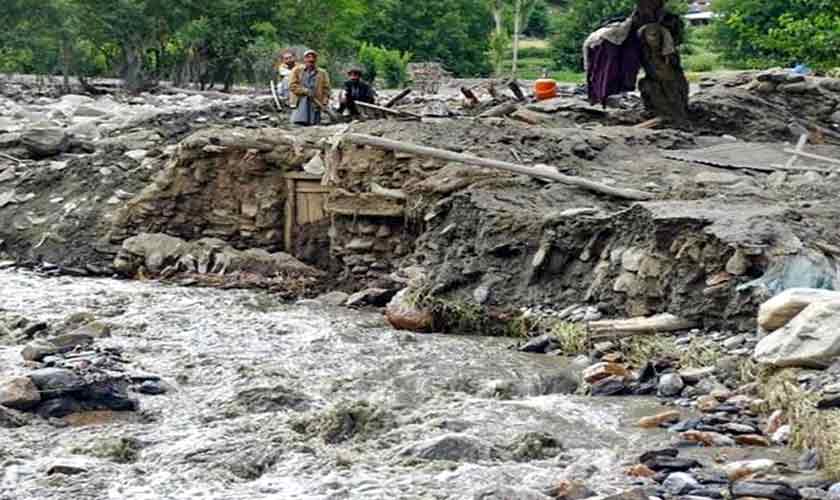
ragedy struck again in the Swat valley on June 27 and 28. The once verdant slopes of Fizagat and Khwaza Khela saw catastrophic devastation as a massive flash-flood, triggered by torrential monsoon shower, washed away tourists, families and livestock along the Swat River.
Videos circulating on the social media showed over a dozen of people, including children, clinging to a piece of land surrounded by water on all sides. By the time a rescue operation could be initiated, eleven people had lost their lives.
According to the initial report of the Provincial Disaster Management Authority, there were four children and three women among the eleven killed. The reports said that three people were still missing. Elsewhere, 59 people were rescued in frantic operations carried out by Rescue 1122. Local sources reported damage to 56 houses, out of which six were completely destroyed. Flash floods also killed 13 people in the Punjab.
Although the National Disaster Management Authority had already issued warnings, riverbanks remained accessible to the tourists. Several hotels and restaurants that stood in illegal proximity to the riverbank operated despite similar losses in 2010, 2020 and 2022. In 2022, the valley had witnessed unprecedented destruction due to massive flooding on the same Swat River. The government had then marked ‘red zones’ and promised strict enforcement.
The recurrence of tragedy due to massive flash-floods is emblematic of a larger crisis that unfolds every monsoon. Every year, the authorities respond to monsoons as if they were a surprise. Every year, the rescue operations are late. Every year, some officials are suspended from service and long-duration inquiries ordered apparently to cover up the failure of governance, the absence of planning and a dangerous cultural tendency to forget.
When the rains return
Every year, the plains, hills and valleys of Khyber Pakhtunkhwa witness widespread devastation as floodwaters sweep away everything in their path - schools, homes, roads and people. These cataclysmic events repeat every year with tragic predictability. This begs the question: What has the Khyber Pakhtunkhwa learnt from its long history of monsoon devastations? While some steps have been taken to strengthen reactive systems, proactive measures to mitigate monsoon risks are largely absent.
According to the Provincial Disaster Management Authority, over 100,000 homes were completely destroyed and more than 289 people died in the 2022 floods. With thousands of acres of farmland wiped out in Swat, Tank, Charsadda and Dera Ismail Khan districts the NDMA damage assessment marked 2022 as one of the most catastrophic years in the KP’s history. Much of the promised reconstruction, reforms and regulations have remained on paper.
Rescue 1122’s capacity has improved in parts of Swat and Peshawar. Public awareness campaigns, specifically through local mosques and radios have educated the local people in evacuation procedures. However, such campaigns lack long-term benefits because they are dependent on donor funding. This limits their reach and sustainability.
After the 2010 floods, the Planning Commission had recommended relocating communities living within 100 metres of active riverbanks of Swat and Kohistan. However, many of the same villages were washed away in 2022. Despite warnings issued in the aftermath of the 2022 floods, effective anti-encroachment drives did not follow. Satellite-based floodplain assessments by the Swiss Humanitarian Aid Unit (SHA/SDC) in 2022 showed that many of the destroyed commercial buildings and homes built in river buffer zones were in violation to environmental safety standards. This violation continued in 2024 and again in 2025. The local authorities often blame landowners and absence of political support. The reasons are painfully evident. The residents are often poor farmers and labourers who build their houses on the same shaky spots due to unavailability of alternative lands for houses and security. To date, no meaningful relocation policy has been implemented.
Prevention falls silent
One of the few areas where the KP has shown progress is the early warning systems. In collaboration with the NDMA, the PDMA and the Pakistan Meteorological Department, a robust flood alert system has been developed. In 2023, text message alerts were sent to the people living in flood-prone districts of Swat and Kohistan. Provincial Disaster Response Forces were on high alert and boats and tents were pre-positioned in seven districts. However, prevention rather than response, remained weak.
The KP lacks river monitoring systems. The authorities rely on rainfall forecasts. The Punjab, by comparison, has real-time telemetry on the Indus tributaries. The KP’s flash-prone rivers like Panjkora and Swat still lack advanced river gauges. As a result, when the mudslides of the mid-July 2023 washed away 30 houses, the NDMA repeatedly warned that the hydrological sensors were needed in these areas.
Tragedies like these will continue to recur until the policymakers in Peshawar prioritise the development of proper drainage networks, resilient schools and flood-proof infrastructure.
A significant challenge is the ongoing encroachment on riverbanks and floodplains. NDMA’s Monsoon Contingency Plan 2023 had identified the northern KP districts - Swat, Kohistan, Mansehra and Dir - as flood-prone. Despite court orders and government regulations, forbidden construction on the bank of the Swat River continues. This narrows the river channel, magnifying the force and destructiveness of the floodwater. In the 2022 deluge, the homes and hotels located in Bahrain and Kalam were completely washed away by the high-speed flood. The Urban Unit reported that about 40 percent of the homes destroyed in upper Swat had been built within 50 metres of the river, in violation of safety guidelines.
Infrastructure weaknesses are another problem. The bridges in Swart and Dir built after the 2022 floods were again damaged in 2023, revealing poor engineering. Temporary embankments constructed in 2023 were washed away by flash floods in 2024. Locals often accuse the contractors of using substandard materials and leaving the projects incomplete. The contractors blame lack of timely funding.
Urban drainage is also another issue. Even moderate rains leave parts of Peshawar submerged for days. The city’s storm-water drains (nullahs) are frequently choked with plastic waste. Despite budgetary allocations, many storm-water drainage projects in Faqirabad, Tehkal and Hayatabad remain uncompleted.
The road to recovery
Community-based flood preparedness, a success story in Nepal and Bangladesh, has been nearly absent. In remote districts like Upper Dir, elders rely on traditional knowledge and signs like river noise, animal behaviour and sudden shifts in temperature to forecast floods. The indigenous expertise is often side-lined in favour of advance models that fail to account for the on-the-ground reality.
GLOF hazard
The mountainous districts of the province - Kohistan and Upper Chitral - lack a full-fledged and dedicated GLOF alert system. While the federal government’s GLOF-II project, which primarily focuses on Gilgit-Baltistan, covers some parts of the KP, its reach is minimal.
There has been no dearth of warnings in the KP. In 2018, the NDMA and the SUPARCO warned of glacial melt and intensified GLOFs in the northern areas of the province. The University of Peshawar’s Disaster Risk Management Centre has published researches urging greater investment in afforestation and slope stabilisation.
A lack of climate adaptation planning aggravates the problems. Unlike the Punjab and Sindh, where climate adaptation plans have been drafted, the KP hasn’t formulated a climate adaptation roadmap. A recent research by the Climate Analytics and the International Centre for Integrated Mountain Development says Upper Dir and Chitral districts are amongst the most vulnerable in the Hindukush Himalayan belt. With flash floods and GLOFs expected to become more common in future years, entire communities are at risk.
Schools and hospitals
The Education Department’s report submitted to the National Assembly in 2023 pointed out that a staggering 1,180 schools were completely destroyed in the 2022 floods. As of 2024, only 430 of those had been reconstructed or repaired. According to Alif Ailaan’s Education Infrastructure Audit, Swat and Dera Ismail Khan have the highest proportion of children attending flood-affected schools.
Another report compiled by the Education Department states that 142 schools were damaged in 2024, mainly in Upper Dir, Battagram and Swat. Many of the schools destroyed in 2022 still awaited repairs. In many parts of the province, children continue to study in tents and open-air spaces. Temporary learning centres set-up by the UNICEF and local NGOs have filled the gap, but the unavailability of proper infrastructure affects education quality and safety of the children.
Medical preparedness is also deplorable. In 2024, people in many villages of Kohistan and Swat districts reported skin infections, diarrhoea and snake bites after the floods. Mobile health teams arrived late and basic health units (BHUs) lacked essential medicines. NDMA’s 2024 directives advised pre-positioning of the medical supplies but district health officers often complained of funds arriving very late.
A cycle of inaction
A joint report by the Asian Development Bank and the UNDP in 2023, pointed out that the budget for flood resilience in the KP stands at 0.5 per cent of the Annual Development Plan, which is insufficient to meet basic infrastructural upgrades. Despite the availability of donor funds, international technical support, implementation in the region remains abysmal. A monitoring report from the Asian Development Bank in 2024, says that KP has the second-lowest fund utilisation rate among the provinces for flood-related projects.
Federal agencies have continuously warned that climate change will increase in intensity and monsoon rains will be more extreme in the years ahead. Unfortunately, the KP has yet to learn its lessons.
The cost of this inaction is very disturbing in the long-run. In economic terms, trillions of rupees is lost annually in precious lives, homes, livestock and crops. Psychologically, the trust in the state institutions fades away. Socially, several generations of children have lost out on education. Environmentally, every flood erodes the soil, depletes forest cover and tends to make the future disasters more extreme.
Flood mitigation policies in the KP remain largely unimplemented. Residents also speak of rescue helicopters arriving after distressed people have been washed away. Until the policymakers in Peshawar prioritise the development of proper drainage networks, resilient schools, urban planning policies and flood-proof infrastructure, tragedies like that of the Swat River will continue to recur.
Zeeshan Nasir is a Turbat-based writer currently pursuing an MBBS degree at the Makran Medical Cllege, Turbat. He tweets on X at @zeeshannasir972.