Print Story
X




Punjab government’s much-touted Yellow Line Electric Transit Project draws fierce criticism from environmentalists, conservationists and civil society
| F |
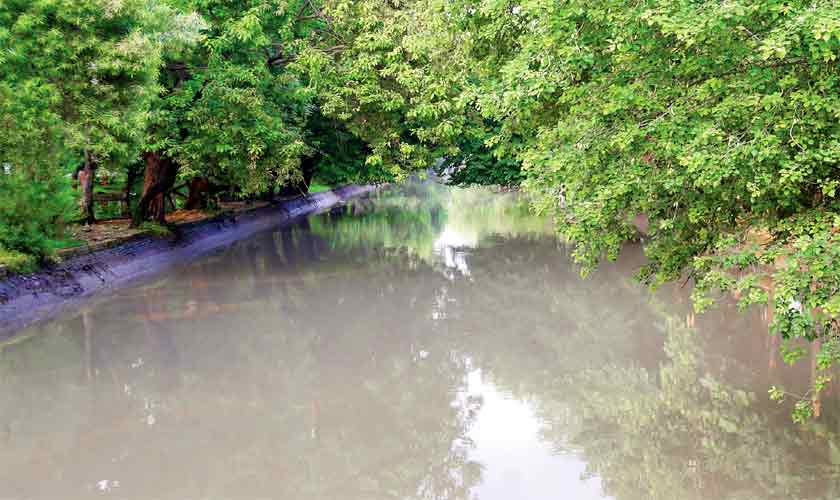
atima Atta routinely takes the Canal Road while commuting from Bahria Town to her workplace on The Mall. It’s a commute she relishes — “because it’s so serene,” she says.
A communications specialist, Atta is upset that the route may change shape for worse if the Punjab government goes ahead with its Yellow Line Electric Transit Project. Said to be a rail-based public transport scheme on the Canal, it will likely involve removing a great deal of foliage along the Canal.
The project was announced recently in the provincial government’s budget for the FY2025-26. According to media reports, the Yellow Line will be run from Thokar Niaz Beg to Harbanspura. It will cover a distance of 24 kilometres one way. It will have 18 stations. The cost projection of the project is Rs 80 billion.
While proponents of Yellow Line are calling it a transformative solution for the city’s congested road traffic, the project has attracted fierce criticism from environmentalists, conservationists and civil society whose main grouse is that it will require felling of approximately 1,400 mature trees along the Canal.
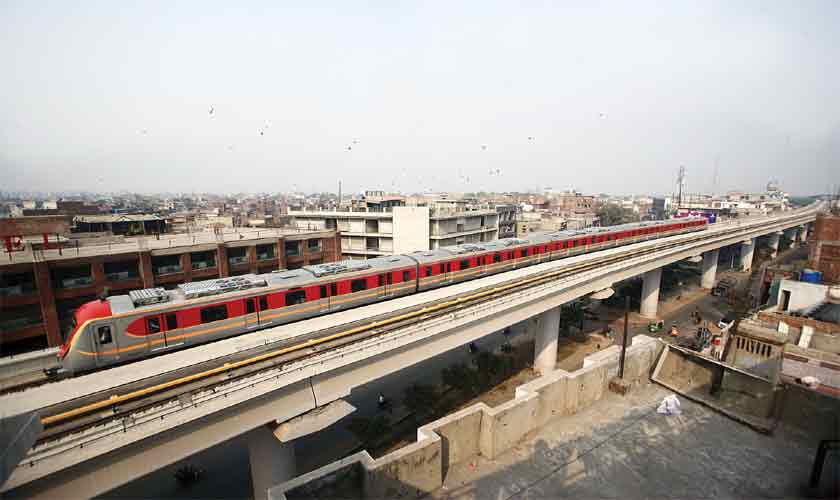
As per the project’s feasibility study, 20-30 electric trains will be imported from China. These will serve an estimated 130,000 passengers daily. Government circles claim the Yellow Line will be an improvement upon the clean, efficient and modern urban mass transit system introduced by the Orange Line Metro Train. Some of the opponents say that no development ought to come at the cost of the city’s ecological assets.
Among the fiercest critics of the project is the Lahore Conservation Society, led by Prof Dr Ajaz Anwar who warns that the large-scale cutting of trees will devastate what he calls “Lahore’s lungs.” The trees lining the Canal — some of which are over a hundred years old — form a canopy that provides shade, add to scenic beauty and supports urban biodiversity by absorbing significant amounts of carbon dioxide, he says.
In a public appeal, shared widely across social media platforms, Dr Anwar said: “We urge the authorities to explore more sustainable alternatives that can both deliver public transport improvements and protect our green legacy.” He also highlighted the lack of transparency in the environmental impact assessment initiated by the Environmental Protection Agency.
In a public appeal, shared widely across social media platforms,Dr Ajaz Anwar said: “We urge the authorities to explore more sustainable alternatives that can both deliver public transport improvements and protect our green legacy.”
While the project awaits approval from the Punjab Cabinet and the ECNEC, concerns are increasingly being raised at various public forums as well as in courtrooms. Last month, the Lahore High Court took strong notice of the situation. During a hearing, Justice Shahid Karim declared that the felling of trees on Canal Road could not be allowed for any development project, including the Yellow Line. He also said that future development projects must show compassion for future generations by preserving Lahore’s green cover.
The judge warned the relevant authorities, including the Parks and Horticulture Authority, against any felling of trees
| M |
Meanwhile, some civil society groups are working to mobilise public opinion on the issue. Legal teams are preparing petitions, and environmentalists are demanding the establishment of a permanent Tree and Heritage Care Authority in the Punjab. Their demands include setting up an urban tree census, a grievance redress mechanism and mandatory public oversight of large-scale infrastructure initiatives.
Many recall the previous legal battles, such as those against the OLMT and the e-Bus depot, where the courts intervened to halt damage to green spaces.
After significant backlash from the public, and following the court orders, the government appears to be amending the project. Chief Minister Maryam Nawaz personally approved its direction in May, alongside an eco-friendly e-Taxi pilot which involves 1,100 electric cabs and solar-powered charging stations. Transport Department officials says that they are now working with NESPAK to revise the feasibility study to better protect the Canal’s environment and comply with the court directives.
Tahir Wattoo, Special Secretary, Transport and Mass-transit Department, tells TNS that a fresh study is under way to find a balanced solution. “We are not blind to public concerns,” he says. “We want to make the Yellow Line as environmentally responsible and technically efficient as possible.”
However, the public is sceptical of the government narrative. “First they plan, then they cut [the trees], and later they offer excuses. This time we must stop them before the damage is done,” says Fatima Atta, echoing popular concerns. “We don’t want to be remembered as the generation that fiddled while the city burnt.”
Ahsan Raza is a newspaper editor. He can be reached at ahsanbudh@hotmail.com