

Print Story
X




Teacher training needs to change on three levels: knowledge, pedagogy and attitudes
| E |
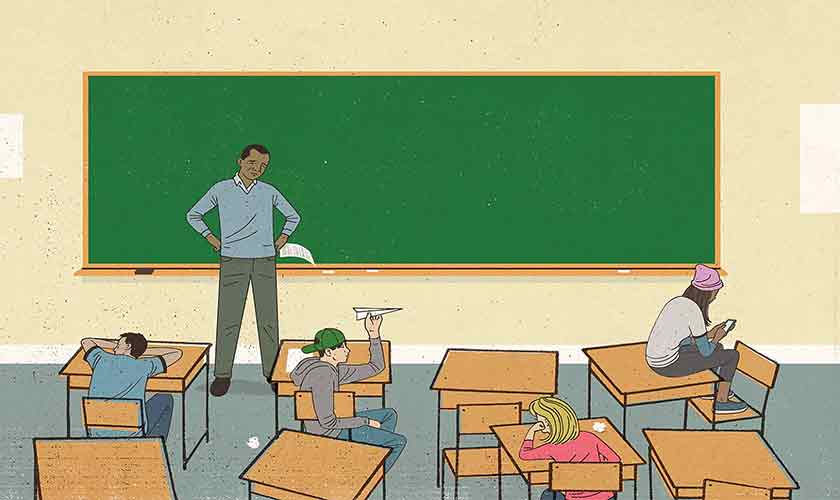
ducation plays a fundamental role in bringing about change in every society. Effective education transforms lives andleaves an indelible mark on the community. Because teachers are pivotal to turning education into an effective social force, any effort to improve an educational system must make adequate provision for their professional preparation.
Pakistan has a long history of teacher‑education programmes, ranging from JV and SV certificates to BT, BEd and MEd degrees. Researchers Warwick and Reimer examined these teacher education programmes and discovered that certificate courses designed to improve teaching showed no relationship with three out of four achievement tests and only a weak link with the fourth. Their findings raised serious doubts about the effectiveness of teacher‑education schemes in Pakistan.
A comprehensive view of teacher preparation recognises that change is required on three levels: knowledge, pedagogy and attitudes. Pakistani programmes concentrate almost exclusively on pedagogy. In traditional courses, lists of the qualities of a good teacher and good teaching are handed out to potential teachers on the assumption that merely having a knowledge ofthese traits will improve practice. This model casts the teacher not as a producer of knowledge but as its passive consumer.
Moreover, many of the social‑change theories imported from other countries bear little resemblance to the realities of our classrooms. When teachers step into their classrooms, they find the prescribed content largely disconnected from thelocal context and are hard‑pressed to make it relevant. Course participants seldom have opportunities to look critically at the overall school environment and to exercise informed choice. Instead, they receive a rigid, pre-determined teaching model that fails to bridge the gap between theoretical ideals and practical realities. Traditional training rarely tries to link teaching with research—an approach that could spur curricular innovation. Training workshops often reinforce the notion that teachers are merecogs in a vast educational machine.
Although school improvement is a complex endeavour, teacher‑education courses give scant attention to that complexity. Core ideas, such as recognising that change is a slow, incremental process, are rarely explored. One factor that jeopardises reform is the failure to understand change as a holistic undertaking. Training institutes need courses that bring together principals, teachers, administrators and other stakeholders. Effective change also requires a robust follow‑up mechanism. Instead, teachers are usually left on isolated islands; follow‑up, which could offer supervision and support, is missing. Sustainable change hinges on the principal’s role. When school heads are involved from the start, the chances of success increase, yet their perspectives are seldom included in training. Consequently, principals often view classroom innovations and the teachers who champion them with indifference, if not hostility. Many promising initiatives thus languish because the head was never consulted. Strikingly, there are few courses for principals themselves—courses that might equip them in delegation, leadership issues and other competencies essential for lasting reform.
Teacher‑education programmes must strive for a balance between theory and practice. School visits, classroom observation, team teaching, solo teaching, and pre- and post-lesson conferences are practical ways to turn theory into action.
Curriculum is another powerful lever of change. In Pakistan, it is designed at the national level. The teachers merely implement it. Textbooks dominate most schools. Both teachers and administrators focus on finishing the syllabus within the allotted time. Even teachers who understand the need for innovation find themselves constrained. School heads are assessed by examination results, so they prioritise scores. The same holds true for teachers, whose performance is judged by class outcomes. Parents’ expectations reinforce this pressure. Students, parents, principals and colleagues together create a climate that discourages pedagogical experimentation, however enthusiastic a teacher may be.
Shulman, in his seminal paper (1986), came up with a very important concept, called pedagogical content knowledge (PCK), which plays a pivotal role in teaching and teacher education. According to him, PCK is a blending of content and pedagogy that helps us understand how particular topics are organised, represented and adapted to learners’ diverse interests and abilities. In most of our teacher education programmes, we see an obvious disconnect between content knowledge and pedagogy.
Teacher‑education programmesmust strive for a balance between theory and practice. School visits, classroom observation, team teaching, solo teaching, and pre‑ and post-lesson conferences are practical ways to turn theory into action. Teaching practice must cease to be a token exercise and become a reflective activity. Before formal teaching begins, the participants should familiarise themselves with the school, classroom, students and staff; such groundwork can prove invaluable.
Another important component that needs to be integrated with teacher education programmes is the use of artificial intelligence. This means preparing teachers to integrate emerging technologies with their teaching to meet the demands of 21st-Century classrooms. It is, however, important to note that the emerging technologies can’t replace the role of the teacher, but its appropriate use can enhance interactive learning, personalised instruction and real-time feedback.
Encouraging critical thinking is another vital dimension. Throughout their training, teachers should have opportunities to critique methods and curricula and to propose alternatives, thereby fostering a culture of continuous learning. Critical reflection can catalyse change not only in personal outlook but also in school life. Ultimately, we must redefine the teacher’s role. Conceived as reflective practitioners who think as well as act, teachers can help improve the system itself while raising their classroom performance.
The writer is an educationist and applied linguist. He is the author of multiple books on education, language, and gender, including Education Policies in Pakistan: Politics, Projections, and Practices. E-mail: shahidksiddiqui@gmail.com