

Print Story
X




This year’s International Booker Prize shortlist depicts the myriad faces of struggle in different parts of the world
| A |
decade ago, I read a tweet by a woman in England who was planning to read the entire Booker Prize shortlist with her book club. This seemed a massive undertaking even for an individual, let alone with a group of people, especially when book clubs are usually teeming with people who will not even finish the one book under discussion. Fast forward to the present and the announcement of the International Booker Prize nominees. With the rise and rise of social media, everybody has a platform to express their opinion and this year, many readers decided to read the International Booker Prize shortlist and predict the winner. This was a very interesting exercise to behold, made even more interesting in retrospect when the one novel several people had left out happened to win the Prize.
I, too, decided to read the shortlist, albeit after the Prize had already been announced, so mine was not an exercise in predictive accuracy. What struck me before I even opened any of the books was the fact that most of the shortlisted books were by European authors, the only exceptions being the winner, Indian author Banu Mushtaq’s Heart Lamp and Japanese author Hiromi Kawakami’s Under the Eye of the Big Bird. The shortlist is, of course, not a deliberate sociological cross-section, complicated as it is by its own particular rules of nomination, as well as the fact that the judges change each year, making it agreeably difficult for the Prize to form any sort of pattern. The Booker committee does not select the books for nomination itself, publishers submit one book “of long form fiction” each year, which is one book per imprint if it is a large conglomerate; imprints that have had a book long-listed in the previous five years can submit extra titles; and then there is a category of “call ins,” a certain reserve amount submitted by each publisher that the committee can ask to be included. It is also useful to remember what Hilary Mantel said of her experience as judge for the 1990 Prize, “I am glad I was a Booker judge relatively early in my career. It stopped me thinking that literary prizes are about literary value.” By which, given the details that emerge about the process, she surely meant the politics and varied considerations and personalities involved in the decision.
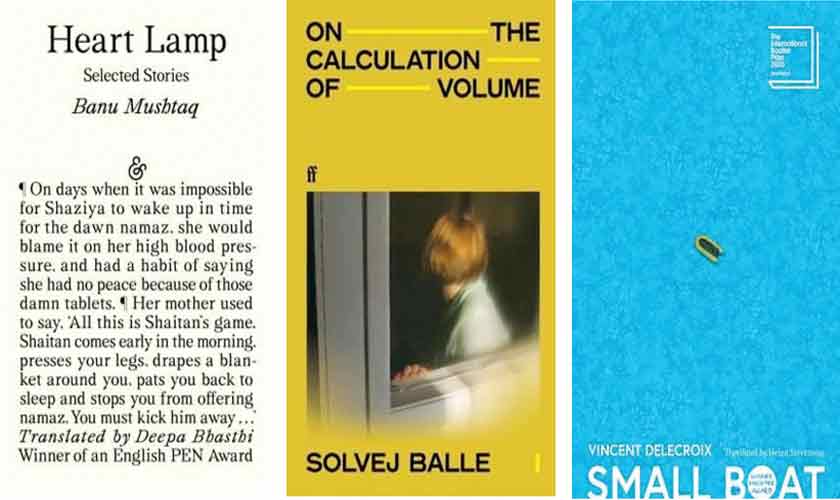
The International Booker Prize differs in its criteria by allowing each imprint to submit six books; there is no limit on the amount submitted for call-ins; and, most significantly, the judges may themselves include any book published during the eligible time period even if it has not been submitted. A common thread running through most of the books shortlisted for the 2025 International Booker Prize is that they have been published by small independent presses in the UK, with the notable exception of A Leopard-Skin Hat by Anne Serre which has been published by Penguin. The rest are published by And Other Stories (Heart Lamp), Granta (Under the Eye of the Big Bird), Small Axes (Small Boat), Fitzcarraldo Editions (Perfection) and Faber and Faber (On the Calculation of Volume 1). This serendipitous cross-section of the UK’s literary landscape reveals something of its literary choices and publication of literature in translation.
Perfection by Vincenzo Latronico opens with a description, spanning several pages, of the Berlin apartment that is the backdrop to its protagonists’ lives. A seemingly objective, but in fact excoriating, account of millennials’ lives and priorities, the novel features no dialogue and treats the couple at its heart as one entity, whose professions, personalities and choices are inextricably joined. The protagonists are transplants to Berlin whose remote graphic design jobs did not require them to move, but they are seemingly influenced by a vision of what their life should look like, a vision drawn from all the images they are bombarded with via social media. They have decided to make this choice, which the narrative makes clear is not fundamentally financially sound. The reality is that they have to rent out their apartment (on another app, which sounds like Airbnb but is not named) multiple times a year when they go somewhere cheaper for a holiday or return to their home country, in order to break even. The narrative voice in this slim novel may be its most interesting feature — it may easily belong to somebody from an older generation, who judges them for moving to an expensive city for its “culture” when there is no professional need to. It is an illuminating look at contemporary life, which seems hollow in the absence of ready-made social and life milestones like marriage, children and a mortgage. But since all these milestones now seem out of reach to most millennials, who will, according to reports, have to keep working their whole lives to sustain themselves, what exactly are the correct decisions?
The calculation of Volume 1 is the first in a septology. In contrast to Latronico’s omniscient narrative, it is written in the first person. A woman wakes up on the 18th of November for more than a year in this first volume, and the book follows her as she tries to make sense of the logic behind this. An antiquarian bookseller from rural France, the first of these 18th Novembers starts in Paris, when she wakes up to the same sequence of events repeating themselves, like a man dropping a piece of bread at breakfast and the disappearance of the books she bought the previous day. The one thing that remains constant throughout these repetitive days is the burn on her hand that she received on the original 18th of the month and that goes through its natural stages of healing, although it is doubtful that this was the catalyst for her unique predicament. Another slim book, it packs a lot of existential angst in its pages as it convinces us to question, along with its narrator, the limits of sustainability of resources and the amount of emotional burden we can, in all conscience, place on the people closest to us.
Also set in France, this time entirely in Paris, Anne Serre’s A Leopard-Skin Hat plays with the narrative voice. Though ostensibly told by an omniscient narrator, the protagonist of the novel, Fanny, is accompanied by her own narrator, a lifelong friend and an entity whose physical outline is blurred. It is revealed early in the novel that Fanny died young, by suicide, and the Narrator is trying to understand if there was any point in time where he could have prevented this act. What follows is an intimate account of her state of mind and personality as she tried to grapple with the demands of normal life. The novel deliciously calls into question the rules of narrative, which are already ephemeral by the end of this first quarter of the Twenty-first Century. By thrusting the narrator into the book itself, Serre destabilises the reader’s expectations of what or who a narrator really is.
Vincent Delecroix’s Small Boat, is divided into three parts, each one playing with tone and voice. The book is a fictionalised account of a real life incident, where a boat filled with refugees tried to cross the Channel and sank, killing everyone on board because neither the British nor French coastguards could reach them in time. The first and third parts of the novel focus on the character of a woman being interrogated for her role in not notifying the coastal authorities of the direness of the refugees’ plight and sending rescue teams quickly enough to avert the tragedy. It soon becomes clear that the focus has shifted almost entirely to the woman’s tone and seeming lack of remorse. The woman emphasises, throughout the stream of consciousness narrative, that she has been trained to treat everybody in need equally, whether it is a billionaire or a refugee, while she reiterates to herself that it is not her fault that they drowned since she had not asked them to migrate to France or to set out across the Channel in a small boat looking for refuge in Britain. On the surface, the narrative calls into question the role of moral responsibility, but, on a deeper level, it is also a call to the reader to deal with the unlikeable female character and the bureaucratic practice of finding one person to blame when the forces at play are much larger and structural.
These contemporary writers’ treatment of issues of identity, responsibility and literary style converge and expand in the pages of the Prize-winner, Banu Mushtaq’s Heart Lamp. A collection of short stories, it is unprecedented in its win, not just as the first short-story collection to do so, but also as the first book translated from Kannada to win the Prize. Banu Mushtaq has been an activist and lawyer. The twelve stories collected here were written between 1990 and 2023, thus accounting for the differences in style amongst them. The first story, Stone slabs for Shaista Mahal, is written in the first person and addresses the reader directly, as if recounting an oral story, as it defines the terms the narrator is using to identify their cast of characters. As a woman belonging to the minority Muslim community of Karnataka, Mushtaq has spoken about her unique decision to write about the experiences of Muslim women in her native language, which has previously been used almost exclusively by the Hindu majority to tell stories rooted in their particular religious idiom and cultural concerns. All twelve stories focus on the trials of women being suffocated by the patriarchy, which uses religion; social attitudes towards finance and property; and language to keep women in positions that deprive them of autonomy and dignity. The female protagonists of these stories, however, try to reclaim their autonomy by varied means as they try to fight against the structures oppressing them. At once heart-wrenching and refreshing, this collection is a reassuring breath of fresh air as it shows the hope and resilience that lie underneath harsher realities.
Heart Lamp provides a counterpoint to the individualistic, lone struggles of the protagonists of the other novels that were shortlisted for the Prize. Collectively, the shortlist depicts the myriad faces of struggle in different parts of the world. The characters in Mushtaq’s stories, though, are inextricably tied to their communities. Each story either has multiple protagonists or at least multiple focal points, as they highlight that despite their individual struggles, no woman is alone; what impacts one also impacts others around her. Despite the unexpectedness of its win, Heart Lamp is a winner worthy of being read widely, especially in Pakistan, the neighbour that shares a lot of cultural and social similarities with these stories. It may also be a lesson in how to tell an “issue” story without being maudlin, melodramatic or pessimistic. Our TV serial writers could take notes.
The writerruns a popular Instagram account called @maddyslibrary, where she talks about books, colonisation and women’s rights