

Print Story
X




The idea of a model village is to stimulate economic development by creating meaningful opportunities
| “E |
nding poverty on a livable planet requires all countries to enhance the resilience of their people and economies to the impacts of climate change, while also reducing greenhouse gas emissions and other damage to nature and the environment,” says People in a Changing Climate: From Vulnerability to Action — a 2024 World Bank report.
Pakistan is at the crossroads of climate change, economic challenges and rural underdevelopment. With 62 percent of the population residing in rural areas (the World Bank 2023), 37.4 percent of workforce engaged in agriculture (Food and Agriculture Organisation) and recurrent climate catastrophes in the form of drought, heatwaves and floods, there is an urgent need to rethink support for the communities — not just through relief, but also through long-term measures enabling people to bounce back and recover.
While a large part of our workforce is growing crops and raising livestock, rural areas — home to 80 percent of the country’s poor population (the World Bank, 2023) — cannot develop just by looking at the crops. Development requires building an ecosystem that captures both backward and forward linkages to promote self-reliance, local pride, economic diversification, social cohesion and climate resilience and reduces the carbon footprint. Poverty is a multidimensional phenomenon represented by four key dimensions: health, education, asset ownership and living conditions. Rural areas require investment encompassing people in the form of healthcare, education, water systems and energy for human fruition.
This distills to a long-term transformational approach that poverty alleviation must go hand in hand with economic empowerment, climate adaptation, social services and community ownership. Territorial approaches to local development (TALD) offer a strategic, place-based methodology for empowering rural communities through decentralised participative governance, bottom-up integrated planning and local ownership. By recognising each territory — such as a village cluster, tehsil or district — as a unique socio-economic unit with distinct needs and potential, the TALD enables tailored, multi-sectoral and multi-stakeholder interventions aligned with local realities while celebrating local culture and knowledge systems.
Given its expansive network of partner organisations and deep community engagement model, Pakistan Poverty Alleviation Fund is well-positioned to serve as a national catalyst for implementing TALD in Pakistan. The PPAF can facilitate the formulation and execution of territorially grounded local development plans.
Applied to the model village concept, this would mean building comprehensive local strategies co-created by communities, civil society organisations and local authorities — integrating livelihoods, basic services, renewable energy, climate resilience and local governance into a cohesive territorial plan. Such an approach can also help align provincial and federal investments with grassroots priorities, ensuring long-term impact, local accountability and inclusive economic growth.
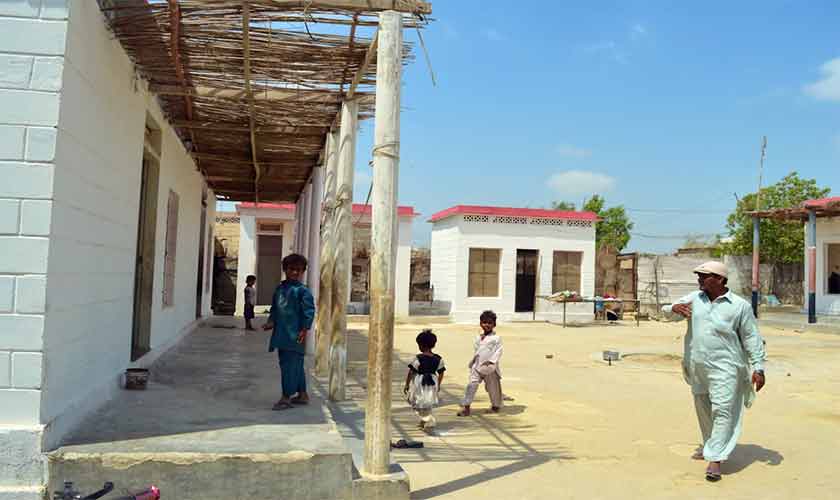
Anchored in institutional experience and social capitaland informed by over two decades of experience in poverty alleviation, including developing model villages of Goth Noor Muhammad near Karachi and Ehsan Pur near Muzaffargarh, supported by Shell Pakistan and Engro Foundation, respectively, the PPAF proposes model village development for resilient local economic development. The concept, aligning with national priorities on poverty reduction and climate action, has the potential to uplift the most vulnerable districts across the country.
The model village concept suggests promoting public-private partnerships to facilitate access to digital tools, clean energy solutions and market linkages to enable rural producers, especially women and the youth.
The five key pillars of this model are: 1) enhancing value in local products and produce, enabling communities to access markets and tap into private sector and government opportunities; 2) leveraging natural assets and traditional knowledge for sustainable economic growth; 3) improving employability by equipping individuals with relevant skills and training; 4) using digital tools — from e-commerce platforms to mobile wallets — to connect especially women entrepreneurs to wider markets and financial services; and 5) bridging the social services delivery gap.
As we navigate the 21st Century, the global development discourse is increasingly centred on two converging shifts: climate change and technological transformation. The 2019 Human Development Report warns that our ability to adapt and respond to these will define the future of human development. The 2020 Human Development Report asserts that local, nature-based solutions can drive global change.
In this context, PPAF’s model village concept emerges as a localised rural development intervention led through community-driven, climate-resilientand digitally enabled transformation. Social capital is developed by organising households at community, village and Union Council levels and building up local institutions and capacities of the local government.
The model addresses multi-dimensional poverty by simultaneously investing in livelihoods; basic infrastructure and services; and environmental sustainability. Economic empowerment is to be brought about at both individual household and community levels through asset transfers, skills training and business development support.
Households receive vocational and technical training aligned with market demand, along with start-up capital and tools to initiate small enterprises. Special emphasis is to be placed on green and nature-based industries, such as organic product development, eco-tourism and climate-smart agriculture, to promote environmental sustainability and inclusive growth.
The concept suggests improving essential infrastructure and social services to enhance the quality of life in rural communities. Improving connectivity, reducing transaction costs and ensuring access to markets, education, healthcare and clean water creates an enabling environment for economic activity to thrive. The concept envisions green infrastructure development paired with relevant green construction skills, anticipatory action while integrating environmental conservation with livelihoods and social protection to build long-term community resilience.
The World Bank’s 2023 report, Development, Climate, and Nature Crisis: Solutions to End Poverty on a Livable Planet, emphasises the critical role of the private sector, not only in financing low-emission, resilient infrastructure but also in offering green technology, innovative business models and market solutions.
The model village concept suggests promoting public-private partnerships to facilitate access to digital tools, clean energy solutions and market linkages to enable rural producers, especially women and youth, scale up their enterprises and connect with wider consumer bases. An integral feature of the concept is linking with existing government programmes, such as the Prime Minister’s Interest-free Loan Scheme, to expand financial inclusion and catalyse economic growth.
The idea of the model village is to stimulate local economic development by creating meaningful opportunities within rural regions and ensuring that every rupee circulates multiple times within the local community before exiting. PPAF’s model village development approach is more than just a development project — it is a blueprint for climate-resilient and self-reliant communities.
While infrastructure and basic services help unlock the potential, anchoring economic activity locally through enterprise development, value addition and market linkages, the approach builds self-reliant economies where wealth is generated, retained and reinvested within the community.
This approach speaks to the global imperative of building a livable planet where communities are not only protected from crises but are also empowered to thrive through inclusive, green and future-oriented development. Imagine the cumulative effect as we scale up the model village to tehsil level and create a model tehsil in each of he 169 districts of the country!
The writer, an architect and urban planner, works with Pakistan Poverty Alleviation Fund