Print Story
X

| A |
s Pakistan begins another fiscal year amidst economic constraints and pressing development priorities, the education budgets of Khyber Pakhtunkhwa and Balochistan offer important insights into how provincial governments are responding to entrenched access and learning gaps.
KP is home to 13.1 million children aged 5-16 years; 4.9 million of them are out of school. In Balochistan, of the 5.4 million children in this age group, an estimated 3.8 million remain outside the formal education system. These figures underscore both the urgency and opportunity to expand access, improve quality and close regional disparities through provincial budgetary choices. With both provinces committing substantial resources to education in FY 2025-26, the real test will be how effectively these are targeted and how they translated into equitable, measurable outcomes.
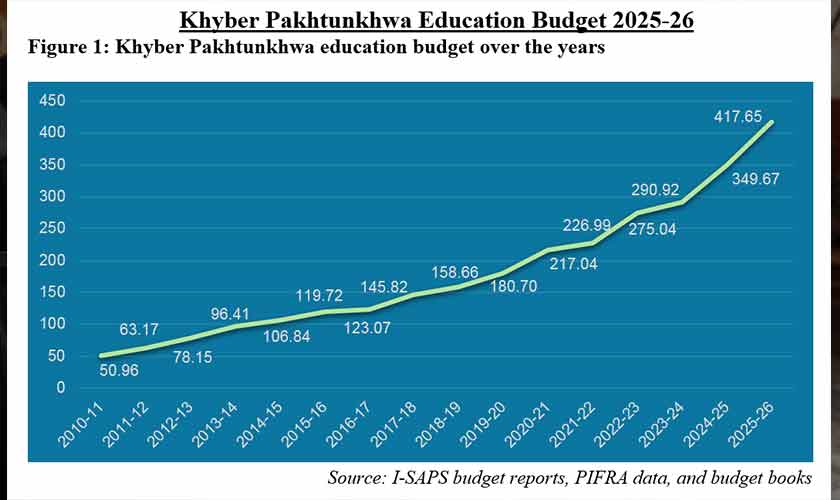
Khyber Pakhtunkhwa has allocated Rs 418 billion to education in its 2025-26 budget, the largest in the province’s history and a notable affirmation of its prioritisation of the sector. This marks a 19 percent increase over the previous year and demonstrates a consistent upward trajectory, more than doubling over the past seven years. Education now accounts for 21 percent of the provincial budget, up from 17 percent in 2016-17, reflecting sustained progress. The province’s allocation has grown from Rs 172 billion in FY 2017-18 to over Rs 400 billion, reflecting not only the available fiscal space but, more importantly, a commendable political commitment to invest in education as a strategic priority.
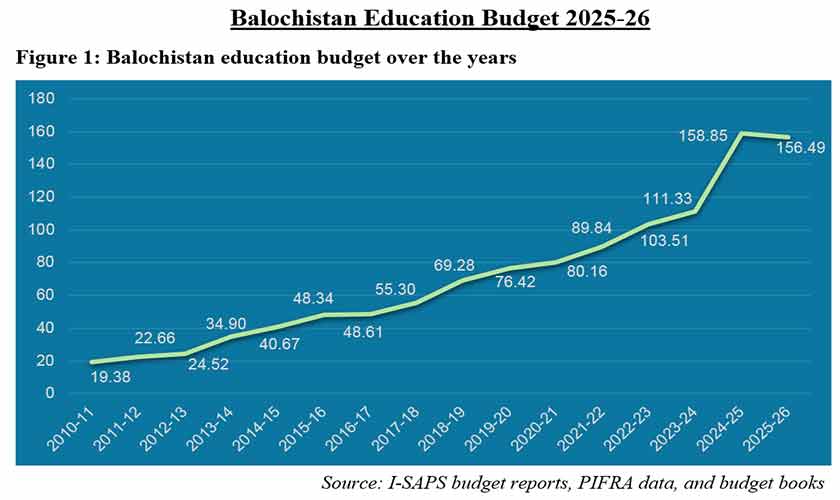
While Khyber Pakhtunkhwa’s allocation has increased significantly, Balochistan’s education budget for FY 2025-26 stands at Rs 156 billion, slightly lower than last year’s Rs 159 billion. Although the reduction is marginal, its symbolic weight is significant, especially given the province’s pressing educational needs. As a share of the total provincial budget, the allocation for education has declined from 17 percent to 16 percent, highlighting the challenge of balancing limited resources against competing development priorities. Nonetheless, the trajectory over the past decade has been one of substantial growth, from just Rs 30 billion in 2015-16, the education budget has expanded more than fivefold, demonstrating a growing recognition of education’s role in development and the need to sustain this momentum despite resource constraints.
The balance between recurrent and development spending highlights how provinces sustain existing systems while investing in future improvements. In KP, 94 percent of the FY 2025-26 education budget is for recurrent expenditures, leaving just 6 percent for development. This allocation pattern has persisted over the past decade, with development shares oscillating between 4 percent in FY 2017-18 and 9 percent in FY 2019-20. Even during years of overall budget growth, capital investments in infrastructure, innovation and learning quality have remained modest. The current distribution continues this trend, reflecting a cautious approach that prioritises sustenance over expansion.
Khyber Pakhtunkhwa and Balochistan stand at the frontlines of Pakistan’s education reform, grappling not only with access and learning challenges but also with rising insecurity that threatens hard-won gains.
Balochistan, while allocating a relatively higher 12 percent to development, has witnessed a 41 percent reduction in development allocations compared to the previous year. This marks a sharp reversal from FY 2024-25, when development spending constituted nearly 19 percent of the education budget, and is notably lower than the 23 percent recorded in FY 2021-22. The implications are significant: reduced fiscal space for new school construction, classroom practices and support for learning improvements, especially in underserved rural and peri-urban areas. The trend in Balochistan’s development financing trajectory reflects both fiscal volatility and the need for a robust medium-term expenditure framework to protect key investments.
The functional breakdown of budgets and stated priorities sheds light on where provincial education systems intend to focus resources and reforms. In KP, 88 percent of recurrent spending is dedicated to school education, 11 percent to higher education and 1 percent to technical and vocational streams. Development allocations follow a similar pattern, with 75 percent directed toward elementary and secondary education. Notably, Rs 5 billion has been allocated to an Education Emergency Programme to re-enrol out of school children (OOSC), alongside Rs 5.9 billion for upgrading facilities in over 32,000 schools, underscoring a renewed focus on retention and infrastructure. However, investments in early childhood education and post-primary transitions remain limited despite their recognised importance for equity and learning outcomes.
In Balochistan, recurrent spending allocates 34 percent to secondary, 27 percent to primary and 23 percent to higher education. Development funds are distributed similarly, with 40 percent allocated for primary, 35 percent for secondary and 25 percent for higher education. Key initiatives include Rs 28 billion for early years and primary education, 431 new toilet blocks and a pilot school meals programme in Quetta. Dedicated allocations for girls’ education, inclusive education and learning recovery remain underdeveloped, leaving critical gaps unaddressed.
Despite higher allocations, critical system-level challenges persist in both provinces. The KP still has 4.9 million out-of-school children, concentrated in merged districts and among adolescent girls. Over 40 percent of KP schools remain without boundary walls and 26 percent lack a water supply. While recruitment plans are under way, multi-grade teaching continues in 33 percent of primary schools. Balochistan faces even starker deficits: more than 60 percent of schools operate without electricity, toilets or safe drinking water. With over 60 percent of students concentrated at the primary level, post-primary transitions remain limited. The province also suffers from high student–teacher ratios in secondary grades and a persistently low female enrolment rate. Without targeted investments and delivery reforms, budgetary increases risk entrenching existing inequities rather than transforming outcomes.
Turning budgets into outcomes in the KP and Balochistan requires a sharper focus on how allocations are structured, prioritised and implemented to address persistent gaps in access, infrastructure and learning. To make education spending truly transformative in these provinces, five strategic shifts are imperative.
First, development allocations must be ring-fenced from mid-year cuts and strategically channelled into girls’ education, infrastructure improvement and underserved geographies, particularly the merged districts in the KP and remote southern Balochistan. Second, the balance of spending must shift from inputs to outcomes by embedding structured pedagogy, foundational skills and readiness programmes into the recurrent budget, not left to ad hoc projects. Third, budget execution must improve through timely releases, streamlined planning and utilisation targets tied to district needs and capacities.
Fourth, delivery models should be localised and flexible, expanding initiatives such as community and afternoon schools to reach children in scattered, low-density areas. Fifth, financing must be aligned with measurable results, supported by adaptive tools: targeted subsidies, school-based management and robust assessments. This agenda demands more than fiscal provision; it calls for efficient resource use, performance-linked budgeting and partnerships to unlock expertise and capital.
The KP and Balochistan stand at the frontlines of Pakistan’s education reform, grappling not only with access and learning challenges but also with rising insecurity that threatens hard-won gains. These budgets carry the potential to protect education from the fallout of conflict and exclusion, but only if they are spent with clarity of purpose and discipline. Success will ultimately be measured by how these investments translate into safe, inclusive and meaningful education for every child, even in the face of adversity.
Ahmad Ali is affiliated with the Institute of Social and Policy Sciences (I-SAPS). He can be reached at ahmadaley@gmail.com