Print Story
X




Because of the complex nature of GLOFs, the prediction of magnitude and timing of their occurrence remain poorly understood
| A |
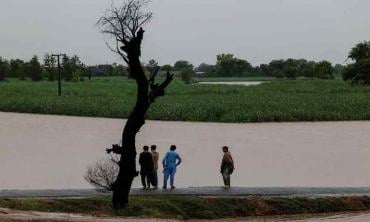
glacial lake outburst flood (GLOF) is caused by the failure of a dam containing a glacial lake. The failure might result from erosion; a buildup of water pressure; an avalanche of rock or heavy snow (moraine); or collapse of an adjacent glacier resulting in a large water influx. GLOFs are one of the most catastrophic geological hazards in high mountain areas and can be highly destructive because of the lack of prior warning. Glacial lake outbursting is characterised by rapid rise to peak discharge and very large flood volumes. A sudden release of a large volume of water results in flash floods and intense erosion along the flow path. This is devastating to infrastructure and communities in the GLOF affected areas. GLOFs are, therefore, ranked among the most striking glacier hazards. Historically, GLOFs have resulted in thousands of deaths and caused extensive damage downstream.
The sudden release of millions of cubic metres of water and debris can lead to substantial damage to infrastructure, property and agriculture; and result in extensive loss of life and livelihoods among remote, often poor, mountainous communities. The GLOFs result in river bank erosion; trigger landslides; and cover valley floors with thick sheets of sediment and wooden debris.
GLOF triggering is a complicated process. The dam breach initiation is caused by mass movement-induced impulse waves, lake overfilling and moraine or ice dam degradation. Because of their complex nature, the prediction of magnitude and timing of their occurrence remain poorly understood. The fact that many changes in the glacier lake system e.g. subglacial tunnel enlargement or mechanical collapse of dams, which contribute towards outbursting of lakes, cannot be monitored by satellites, makes it hard or impossible to predict the GLOF events.
Climate change
The average global temperature is on the rise. Glaciers are particularly sensitive to global warming. Climate warming induces widespread ice retreat and glacier thinning resulting in the rapid expansion of glacial lakes and the frequent occurrence of ice avalanches and GLOFs. This global glacier mass loss has accelerated since the 1960s, mainly as a result of human activities producing more and larger glacial lakes. Over the last three decades, the global glacier mass has substantially decreased. Globally, the number, area and volume of glacial lakes have grown nearly 50 percent. This global trend (warming and loss of ice mass) is predicted to persist through the 21st Century. The continued loss of ice and increase in number of glacial lakes will consequently escalate GLOF events. In view of the rising average global temperatures, millions of people worldwide are potentially at risk from GLOF events. This makes regions with glaciers more vulnerable to flooding risks from GLOFs and threatens livelihoods of communities in high mountains. According to a recent study, 15 million people are at risk from GLOFs, mostly in China, India, Nepal, Pakistan and Peru.
The Third Pole
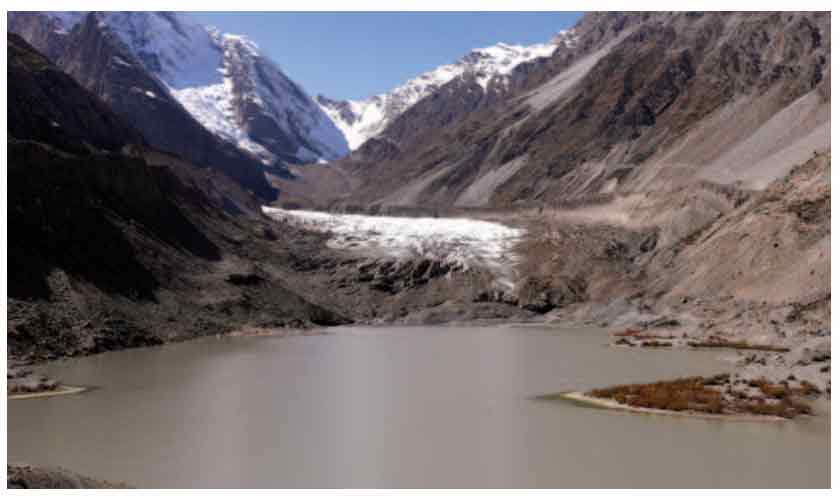
The glaciers and ice fields of the Tibetan Plateau extending to high mountain ranges (including the Himalayas, Hindu Kush and the Karakoram), are sometimes referred to as the Third Pole. It contains the largest amount of freshwater ice outside the Arctic and Antarctic, making it a vital water source for billions of people. The Third Pole has experienced retreat of over 10,000 glaciers over the past three decades. The consequent increased melting has facilitated the formation of a significant number of new and rapidly expanding glacial lakes. The number of glacial lakes reported during 2015-20 ranged from 10,000 to 30,000. Over the period, the glacial lake area increased by 15.2 percent.
The contribution of glacial lakes to sea level rise and their potential for hydroelectric power development is insignificant, but their destructive potential remains a concern. A recent global report on GLOFs has documented over 3,000 events, a majority occurring in the Third Pole.
A 2016 GLOF in the eastern Himalayas with a 40-kilometre runout destroyed a hydro-power plant in Nepal. In 2023, heavy rains caused a landslide into the glacial South Lhonak Lake in Sikkim. This triggered a GLOF. The flood resulted in the collapse of Teesta III Dam causing widespread infrastructure damage.
Since 1900, more than 110 GLOFs originating from such moraine-dammed lakes have been recorded in the Third Pole. Together, these have claimed around 7,000 lives.
Pakistan
Pakistan has more than 7,000 glaciers—the highest outside polar regions. Due to global warming, glaciers in the northern mountain ranges are melting. This has resulted in more than 3,000 lakes in Gilgit-Baltistan and Khyber Pakhtunkhwa. Of these, 33 have been identified as imminent GLOF threat. Hunza Valley in the Karakorum region is home to thousands of glaciers. Batura, Khurdopin, Passu, Verzjerav, Shishper and Yazghil are some of the glaciers that have been associated with GLOF events in the past. Passu is one of the fastest-receding, highly vulnerable glaciers. In May 2022, a massive discharge from the glacier threatened houses and critical infrastructure on the main Karakorum Highway.
In the context of global warming and extreme heat events in the country, GLOFs are a serious concern in Gilgit-Baltistan and the mountainous regions of Khyber Pakhtunkhwa. The National Disaster Management Authority has issued alerts for potential GLOFs in both the regions, warning of increased water levels in rivers, landslides and flash floods.
The Ministry of Climate Change in collaboration with the UNDP is working on a project on reducing GLOF risks and vulnerabilities. The objective of the project is to manage risks associated with GLOFs and improve community preparedness and disaster response.
The knowledge of glacial lake dynamics and management of GLOF risks is still developing in the Third Pole, including in Pakistan. There is a dire need to update our knowledge on recent developments in managing GLOFs. Research on local trends of factors contributing to glacier melting will help us better cope with a growing natural threat.
An integrated, globally coordinated GLOF-watch approach involving continuous monitoring and fully automated early warning systems for glacial lake with high risk levels is of primary and foremost importance. This should be supplemented by artificial drainage and dam reinforcement measures that have been tried in other parts of the world and found useful.
The writer teaches at SZABIST, Islamabad. He can be reached at thepirsahib@yahoo.com