

Print Story
X




Heavy vehicles and Karachi’s chaotic traffic make for a lethal blend
| A |
deadly combination of poorly designed roads, lackadaisical enforcement resulting in a pervasive disregard for traffic rules have created a perfect storm of chaos on Karachi’s bustling roads.
Reckless driving, inadequate infrastructure and apathy towards traffic regulations combine every day to ensure a lethal environment for motorcyclists and pedestrians.
DIG Pir Mohammad Ali Shah, the Traffic Police chief, identifies the factors contributing to this situation. In his book, drivers’ lack of understanding of traffic laws is the leading cause of lethal accidents.
Motorists, he says, are often ignorant of lane discipline and pedestrians’ rights. Driven often by a sense of urgency and lacking adequate awareness of their surroundings, the motorcyclists, truckers and distracted car drivers (busy on cell phones) tend to speed on, with aggressive lane changes, says the DIG. “At night we see many cars and motorcycles operating without lights.”
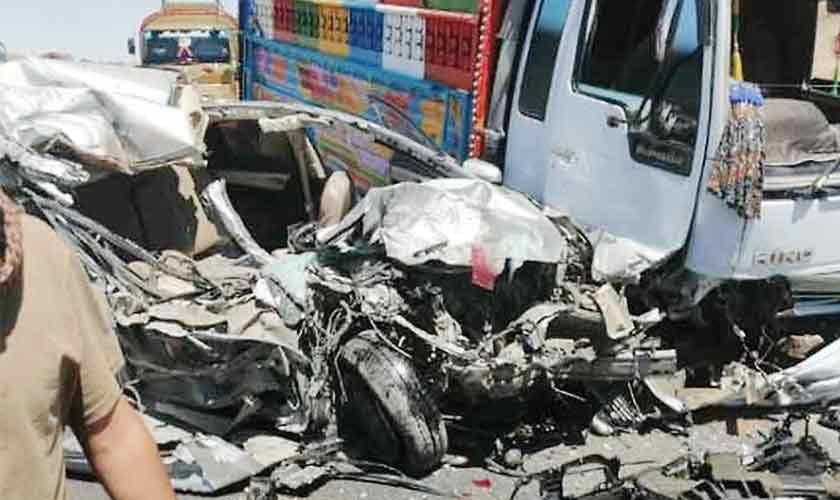
Last week, there was a harrowing accident on Shahra-i-Faisal when a speeding car crashed into an ambulance with such force that the ambulance veered off course, past the road median and collided with a truck rushing in the opposite direction. Miraculously, no lives were lost. However, the incident should be a stark reminder of the dangers of speeding.
According to Karachi Traffic Police statistics, from January to May 14, 2025, 374 people died in road accidents. Of these 199 deceased carried no licence; 195 of the drivers causing such accidents lacked valid permission for driving.
“To break the cycle, Pakistan needs a more rigorous system that tests drivers’ skills and knowledge of traffic laws, says Faraz Khan, a senior journalist with The News.
There should be proper training centres for heavy vehicle drivers. Anticipating potential hazards, such as other drivers, pedestrians and road conditions, and reacting accordingly is crucial for road safety.”
Enforcement remains dangerously lax. Traffic fines fail to deter reckless driving. In 2024, police issued 1.6 million challans and collected Rs 1.3 billion. However, the number road accidents was a record high. Globally, the practice of suspending drivers’ licenses after repeat violations has been found effective. However, Karachi does not have such rules. The city also missed the chance to implement faceless e-ticketing using the the Safe City Camera Regime as the cameras currently in use cannot read the licence plates to track stolen or speeding vehicles. However, DIG Shah remains optimistic. He says, “the NRTC and the Traffic Police are developing software to detect 16 common violations via Safe City cameras. AI improvements are planned for the future.”
But traffic enforcement technology alone cannot contain the threat from the poorly trained drivers and their overloaded trucks
Driven by the desire to meet deadlines and save trips, many carry 75-80 tonnes against a legal limit of 35 tonnes, says DIG Traffic. “Excessive vehicle weight results in longer stopping distances, accelerated brake wear and potential brake failures, all compromising vehicle control.”
The unreasonably long drivers’ shift test human endurance and impair reaction times, decision-making and awareness leading to tragic encounters. From January to May 14, 2025, 118 deaths out of 374 were caused by trailer trucks, trucks, dumpers, water tankers and oil tankers. According to a Traffic Police statistical breakup, the trailers caused 36 fatalities, trucks 46, water tankers 23, dumpers 13 and oil tankers four. In the same period, 184 motorcyclists lost their lives, so did 131 pedestrians. In 2023, heavy transport was the main cause of 61 fatal accidents; in 2024 the number was 265.
According to Karachi Traffic Police statistics, from January to May 14, 2025, 374 people died in road accidents. Of these 199 deceased carried no licence; 195 drivers causing the accidents lacked valid permission for driving.
A young couple riding home on a motorbike following a visit to the gynecologist was recently hit by a truck. The baby was delivered after the death of its mother and did not survive long. According to Rai Akmal of the Karachi Road Accident Analysis Team, the driver initially claimed brake failure. However, the police investigation revealed otherwise. “The driver later confessed that he had been driving for 24 hours without rest. He lost focus, and mistakenly pressed the accelerator pedal instead of applying the brakes.”
In most cases other motorists are not aware of the heavy trucks’ blind spot and get mowed down by them, says DIG Traffic. Trucks, tankers and trailers have blind spots where the drivers do not see smaller vehicles or motorcyclists trying to overtake them from parallel lanes. “They [blind spots] are located directly behind the truck’s trailer, in front and near the driver and the passenger doors. They are on both sides: the driver’s side (one lane) and the passenger’s side (two lanes).”
Motorcyclists have always been the largest class of victims in fatal accidents. Most result from poor manoeuvring, inadequate control and lack of hazard awareness, officials of the Traffic Police say. “Risky weaving or performing stunts also contributes to accidents.” Head injuries are a leading cause of motorcycle accident fatalities but many young riders disregard helmets. Many operate without side mirrors. This blinds them to traffic behind them.
A police officer told TNS that many motorcyclists face a higher risk due to poor-quality helmets and missing side mirrors. The Sindh Police has asked bike manufacturers to make unremovable mirrors, but the companies said they needed approval from their foreign principals—no decision yet. Meanwhile, a bill to improve helmet safety standards has been lying with the Parliament for years, with no clear reason for the delay.
Poor road design in West and Malir towns has created accident-prone “black spots” requiring either design adjustments or stricter enforcement to prevent frequent accidents, says Dr Muhammad Ahmed, Director of NED’s Centre for Environment and Social Sustainability. “Mauripur Road, Korangi Road and the the 30km urban stretch of the National Highway from Star Gate to Ghaggar Phatak are virtual death traps.” The road near Gulbai requires redesigning. A grave site in the middle of the road causes deadly confusion and frequent deadly accidents.
Pedestrians are the second most frequent victims of lethal accidents. Karachi lacks proper sidewalks and in many places, shopkeepers have taken over the existing walkways. This forces people to walk in the first lane, weaving through pushcart markets, where speeding vehicles end up hitting them. The Traffic Police accident report says that 139 pedestrians were killed in 2024. 131 pedestrian deaths have already been recorded from Jan to May 2025, “Thesey occurred mostly in West, Malir and Korangi towns.” Rai Akmal says “Pedestrian fatalities dropped from 139 in 2024 to 70 in 2025, but the numbers remain alarming. The Western and Korangi traffic districts, particularly along the high-speed Northern Bypass, Hub River Road and National Highway in Malir district are the hotspots.
The mixing of heavy vehicles with cars, bikes and jeeps on our roads is a recipe for disaster. Meanwhile, multi-billion-rupee freight corridors, designed to seamlessly link ports to industrial zones and highways, remain woefully underutilised. Dr Muhammad Ahmad suggests “The Northern Bypass specially built for goods carriers must be used irrespective of the longer distance.” Many heavy vehicles avoid the Northern Bypass citing concern for fuel economy. This is not a valid excuse.
Dr Ahmed proposes that all heavy traffic entering from the National Highway be directed through the Eastern Bypass and Northern Bypass to access the Karachi Port or the SITE/North Karachi industrial areas. Similarly, traffic bound for Bin Qasim Port must also be routed through the same bypass. “No heavy vehicle should be allowed on the M5 Motorway beyond the Northern Bypass interchange.” For traffic serving the Korangi Industrial Area, the designated route should be the Mehran Highway, with a restriction on using the N5 after Bin Qasim Mor. “Light traffic must never be allowed on Northern Bypass,” Dr Ahmad says.
Dedicated freight corridors for heavy vehicles and restricting their movement in populated areas can significantly reduce the number of fatal accidents. It’s time for Karachi to adopt a multi-faceted approach to tackle its traffic woes and make its roads safer for all users.
The writer is a senior The News staffer in Karachi