

Print Story
X




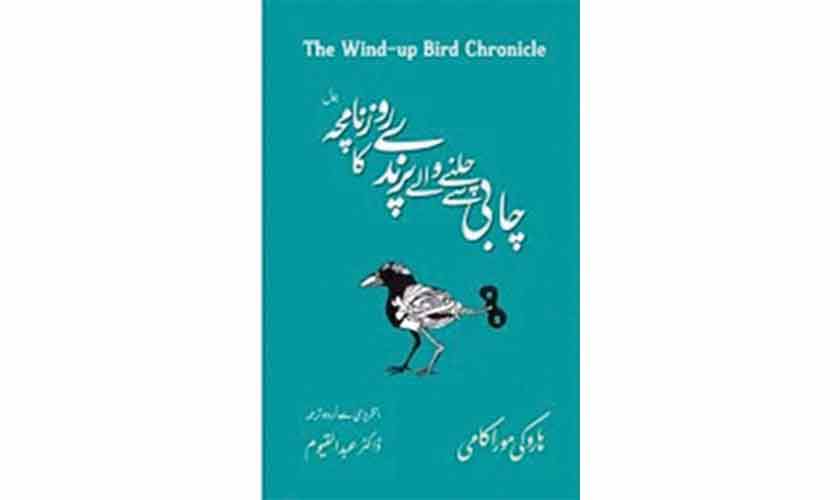
Dr Abdul Quyyum’s Urdu version of The Wind-Up Bird Chronicle resonates with a generation facing uncertainty
| H |
aruki Murakami’s The Wind-Up Bird Chronicle is a profound exploration of identity, memory and isolation, intricately weaving the mundane intricacies of everyday life with surreal, dream-like experiences. At its core, the novel follows the protagonist, Toru Okada, as he navigates the mysterious disappearance of his wife, plunging him into a world filled with enigmatic characters and bizarre occurrences. Murakami masterfully blends historical references, particularly Japan’s turbulent war-time past, with metaphysical elements, creating a narrative that resonates deeply on both personal and universal levels. The themes of isolation and self-discovery are particularly relevant in today’s digital age, where younger generations grapple intensely with issues of identity, connection and purpose in an increasingly fragmented world.
Bringing this literary masterpiece into Urdu required the skilled and thoughtful hand of Dr Abdul Quyyum, a seasoned translator whose previous work includes the acclaimed Urdu translation of Murakami’s Norwegian Wood. He is currently working on a translation of Francis Fukuyama’s Liberalism and Its Discontents. Dr Quyyum, who holds a PhD in education, possesses a unique sensitivity toward linguistic nuance and cultural context. He currently runs the Education High School, an institution that aims to provide quality education to the economically impoverished in Sialkot. His extensive academic and literary background equips him to navigate the delicate intricacies of Murakami’s prose, ensuring both fidelity to the original and accessibility for Urdu-speaking readers.
Dr Quyyum has described translating Murakami’s distinctive blend of surrealism and realism as “a set of unique and intricate challenges.” He explains that in Urdu literary tradition, realism and surrealism usually exist separately, thus “blending them required careful navigation of tone and vocabulary.” Moreover, Murakami’s minimalist prose poses a unique difficulty because “Urdu, being an ornate and expressive language, might naturally incline towards embellishment,” risking the loss of Murakami’s characteristic understated emotional tension. To address this, Dr Quyyum consciously avoided dramatisation: “For example, translating a simple line like ‘I sat by the well and waited,’ the temptation might be to expand it with emotion, but its power lies in the restraint,” he noted.
Particularly for Urdu readers in Pakistan, the novel’s exploration of existential anxieties, societal alienation and the search for authentic connections offers a compelling reflection of contemporary struggles and aspirations. Dr Quyyum emphasises this relevance by stating, “Toru Okada’s quiet, introspective withdrawal from society will connect with anyone who has felt alienated from the noisy, chaotic world around them, especially in urban centres like Karachi or Lahore.” He also points out how the Pakistani youth’s anxiety about their uncertain futures, concerning career stability, identity formation and societal pressures, echoes profoundly in Murakami’s narrative.
Murakami’s portrayal of urban isolation mirrors the paradoxical experience of digital connectivity and emotional alienation familiar to many young Pakistanis. Dr Quyyum elaborates, “Murakami poignantly portrays isolation in modern urban settings, something increasingly familiar to Pakistani youth as digital connectivity paradoxically fosters closeness and profound alienation.” He says that translating the internal, stream-of-consciousness reflections, a hallmark of Murakami’s style, required careful handling to avoid sounding either melodramatic or disconnected from local sensibilities.
Another challenge, according to Dr Quyyum, was the novel’s strong grounding in Japanese history and cultural symbolism, elements that might initially seem distant or inaccessible to an Urdu readership. Yet, he says, he consciously resisted over-explanation, preferring to retain the novel’s inherent foreignness. “Sometimes the best way to honour a work like Murakami’s is to retain its sense of otherness,” Dr Quyyum says, emphasising that the reader’s encounter with unfamiliar references, such as Japan’s imperial violence in Manchuria or Shinto-inspired motifs, actually reinforces the novel’s central themes of alienation and disconnection. At critical junctures, however, he has provided brief footnotes “sparingly, so the flow of reading isn’t broken,” providing essential context without intruding on the narrative’s poetic ambiguity.
Dr Quyyum also highlights the resonance of Murakami’s female characters, such as Kumiko and May Kasahara, in Pakistani society. He notes, “Pakistani readers may find these characters surprisingly resonant, especially in a society where women’s inner worlds are often hidden, yet powerful.” Characters like Kumiko, caught between duty and emotional isolation, and May Kasahara, whose youthful rebellion defies societal expectations, reflect complex gender dynamics familiar to many Pakistani readers.
On a personal level, says Dr Quyyum, his experience of translating this novel deeply impacted his appreciation of its themes. Initially attracted by Murakami’s unique narrative silence and stillness, he discovered deeper emotional layers in the process of translation. “When you translate, you have to live inside the sentences,” he reflects, revealing how he began to understand Murakami’s subtle exploration of “ordinary human loneliness” more intimately. The journey led him to see the novel not just as a surreal narrative but also as “a deeply human story of grief, alienation and the search for meaning, things that resonate as much in an Urdu-speaking world as in a Japanese one.”
Dr Abdul Quyyum’s translation of The Wind-Up Bird Chronicle into Urdu does more than merely bridge linguistic divides. It allows Pakistani readers to explore Murakami’s literary world, uncovering universal truths about the quiet ways in which individuals endure and seek authenticity amidst chaos. His translation is a sensitive, nuanced meditation, beautifully capturing the emotional complexity and existential subtlety of Murakami’s original, while bringing to life a resonant narrative of introspection and isolation uniquely suited to contemporary Pakistan.
Chabi Say
Chalnay Walay Parinday Ka
Roznamcha
Translated by
Dr Abdul Quyyum
Price: Rs 3,000
Pages: 578
The reviewer is a researcher and counsellor at the Trinity School and co-founder of Cicero Counselling, specialising in guiding students through their academic and career journeys. He can be contacted at sarangaamir405 @gmail.com