Print Story
X




The death toll has been rising even with a peace agreement in place
| A |
s local peace agreements in Kurram’s flashpoint villages raise hopes for stability, two deadly incidents in recent days have reignited fears of extremist violence aimed at derailing fragile reconciliation efforts. The attacks claimed eight lives and injured several people, casting a shadow over the region’s tenuous calm.
In the most recent incident, artillery shells struck the Tor Ghar area of Central Kurram, killing four children. According to local social activist Abdul Khaliq Pathan, at least ten shells were fired. One of those directly hit the children.
“Their bodies were so badly mutilated, they were barely recognisable,” he told The News on Sunday. Another shell landed in a mosque but fortunately caused no casualties. The rest fell in open areas.
The attack sparked outrage across the district. Grief-stricken families and tribal elders brought the children’s remains to Parachinar, the district headquarters, to demand justice.
The protesters held placards with the Urdu slogan, “Raising your voice is better than lifting coffins,” and called for an impartial investigation into the incident. “What was their crime?” asked Pathan. “Tell us so we can protect the rest of our children.”
This was not a unique incident. Just weeks earlier, shelling in the same tehsil had claimed the life of a woman. The attacks have occurred despite the terms of the Kohat Agreement, which mandated the surrender of illegal weapons by May 30 in an effort to ensure long-term peace.
In a separate incident, four men collecting firewood in Pewar Shermakhel, a Shia-majority border village in Upper Kurram, were killed in landmine explosions and four others sustained injuries. Treated initially at a hospital in Parachinar, the injured were later transferred to a medical facility in Peshawar.
“This is a deliberate attempt to sabotage the peace,” said a tribal elder. Survivor Hasan Ghulam, speaking from his hospital bed, recounted the horror: “We were approaching the mountains when we heard loud explosions. Four of my companions were martyred. Two horses were killed on the spot too.”
Tribal elders have strongly condemned the attacks, demanding immediate investigation and the arrest of those responsible. “Such incidents must not be allowed to go unpunished,” said one elder. “The perpetrators must be brought to justice.”
Back-to-back violations have fueled anxiety in Kurram, particularly in Pewar, an already sensitive area that witnessed sectarian clashes in 2021 over a forest ownership dispute between Sunni and Shia communities.
According to Kurram police data, 257 imambargahs have been identified across the district, 37 of which are classified as highly sensitive, 14 as sensitive and 206 as normal.
In a separate incident, four men collecting firewood in Pewar Shermakhel, a Shia-majority border village in Upper Kurram, were killed in landmine explosions and four others sustained injuries. In the most recent incident, artillery shells struck the Tor Ghar area of Central Kurram, killing four children.
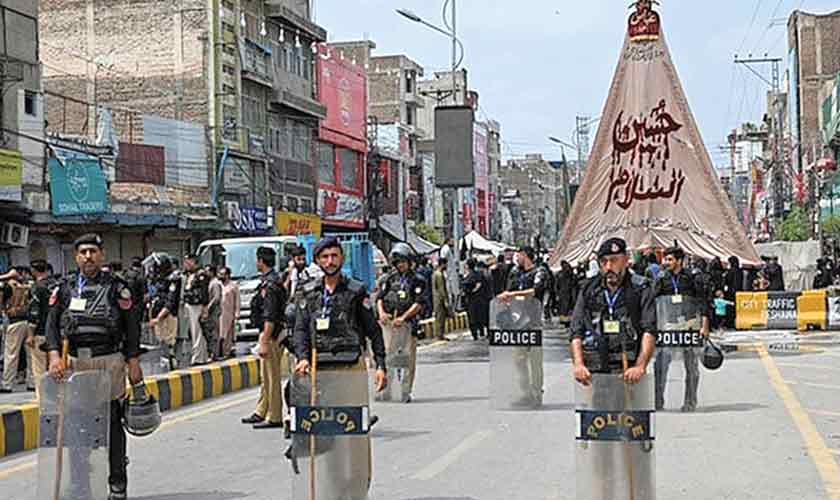
A total of 429 Muharram processions are scheduled, including 71 marked as highly sensitive and 24 as sensitive. At least 1,724 police personnel have been deployed to ensure security during Muharram.
To assess security arrangements during Muharram, Kohat’s Regional Police Officer Abbas Majeed Marwat and Kohat Division Commissioner Muata’sim Billah visited Kurram. They were accompanied by District Police Officer Kurram Malik Habib Khan and Deputy Commissioner Ashfaq Khan.
The officials held separate consultations with Shia elders in Upper Kurram’s Parachinar and Sunni leaders in Lower Kurram’s Sadda. The meetings focused on multi-level coordination, inter-sectarian harmony and security measures in Muharram.
Officials said that Muharram was a sacred month and ensuring peace during it was a “collective responsibility.” Community leaders pledged full cooperation to maintain law and order during the period.
To reinforce these efforts, Khyber Pakhtunkhwa Chief Secretary Shahab Ali Shah addressed a Grand Divisional Peace Jirga at the Kohat Police Club earlier this week. Calling for sincerity, unity and hard work, Shah urged all stakeholders to engage in inclusive dialogue and build trust.
The jirga, convened in preparation for Muharram, brought together a wide range of stakeholders, including Provincial Law Minister Aftab Alam; MNAs Shehryar Afridi, Hameed Hussain and Yousaf Khan; MPAs Shafi Jan, Aurangzeb Orakzai and Ali Hadi; Inspector General of Police Zulfiqar Hameed and senior civil and military officials from Kohat, Kurram, Orakzai and Hangu. Prominent religious leaders also participated in the jirga.
Praising the unity demonstrated by elected representatives and community leaders, Shah emphasised the need to instill patriotic values in the younger generation. “We are all Muslims and brothers. There is no room for division among us,” he said.
Cautioning against internal destabilisation, the chief secretary said that Pakistan’s enemies were attempting to create chaos from within the country. “They know they cannot defeat us militarily, so they try to weaken us internally,” he said.
He condemned the exploitation of religion to justify violence, stating, “When we all share the same faith, there is no justification for taking up arms against one another.”
Speaking specifically on the situation in Kurram, Shah expressed cautious optimism. He noted that peace was gradually returning to the district and expressed hope that the region’s main highway would soon be reopened. He urged residents to surrender illegal arms voluntarily, warning that otherwise the state would take necessary action.
“God willing, not only Muharram but every coming month will pass in peace, and our enemies will not succeed in their malicious designs,” he added.
The writer is a multimedia producer. He tweets @daudpasaney