


Print Story
X




Over 900 Christian farmers and their families are being threatened by a land mafia and evicted from their villages
| B |
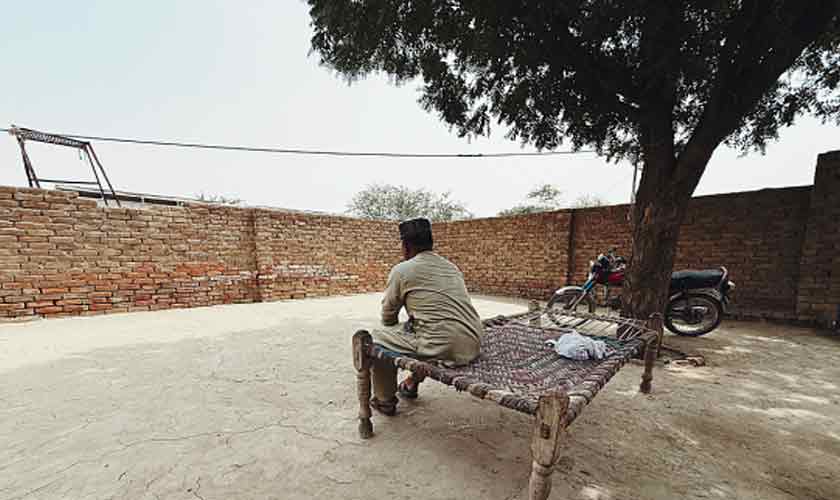
y the time Louisa Michael finishes speaking, her voice is barely a whisper. The sadness in it is deafening. “Should I save my land? Or should I save my children?” she asks. “They threaten me all the time, ‘You have daughters,’ they say.”
For Louisa, life now unfolds within the walls of a small church room. Her story stretches across three generations, 30 acres of land and nearly two decades of fighting for it. It is a story of labour, legacy and loss; a life pried away, piece by piece and a woman who refuses to let silence be its last chapter.
Over 900 Christian farming families in Derek Abad, in the Thal desert of south Punjab, are currently enduring forced evictions by a land mafia, which is exploiting blatant bureaucratic neglect. For over 40 years, these families have poured their hearts and souls into transforming barren land into thriving farms. They now face harassment from land mafias and are unjustly denied legal ownership rights.
There was a time when a single bus that passed by. Back then, Louisa’s family was quietly transforming the earth beneath their feet. “We brought this land to life,” she says. “My mother, father, two uncles, my in-laws; all of us worked under the scorching sun. We turned this barren land into something that could grow food. Today we are not allowed to eat what the land produces,“ Louisa says.
The fight for ownership and possession of the land in Derek Abad has not only taken their fields and their home. It has also claimed lives. “Five of our elders died in grief,” Louisa says. “They could not bear to see everything they had built, stolen,“ she says.
Louisa’s family once lived in a haveli, a five-room house they no longer live in. Yet, every day, Louisa finds herself staring at it, holding on to the memory of a home that now exists only in her heart.
Today, she lives in a small church room with her small family; the same church where she was once married.
“I never thought I would end up here, living like this,” she says. “We did not even have a washroom. So I set up one, using just a curtain. This too, I had to do in stealth,” she says. “Sometimes, the men [from the land mafia] turn up at the church.”
Louisa and her husband, like many other Christian families in Derek Abad, have spent nearly two decades fighting a legal battle to reclaim their land. Everything they have earned and saved was poured into the battle: court fees, documents, endless hearings, leaving behind nothing. “Justice,” she says, “was never on their side.”
Despite clear court orders in their favour, government officials have failed to acknowledge the affected community’s rightful claim to the land. There is a 1983 directive issued by the Board of Revenue and a 1995 notification by the deputy commissioner of Muzaffargarh that recognise the Christian community’s possession of land in nine villages: Chaks 547, 548, 552 and 584 to 589.
“‘He’s in the city these days,’ they say,” she whispers. “And that only deepens our fear.”
Even those who lend them an ear become a liability as she and her family are later interrogated by their torturers. “Who was that?” they are asked, “Why were they here?”
Rafi is one of many from the community with a similar story. “Since 2003, the problem has only gotten worse. We planted the trees here and now that the land has become valuable, they have taken it over, illegally,” he says.
Rafi says his family was among the earliest settlers in Thal, during Zulfikar Ali Bhutto’s government, which promised to turn the desert dunes into cultivable fields. His father was allotted 25 acres. For five decades, Rafi, his elder brother and their late father farmed that land.
But despite the work, his family and over 900 other Christian families like theirs have no legal title. Fearing mafia violence, entire families have abandoned their homes and are living in the open. “Our people are sleeping under the sky,” Rafi says. “Some have suffered snake bites.” If we as much as cut a tree we ourselves planted for firewood, they file a police case against us,” Rafi adds.
Several applications have been submitted to the Revenue Department in Kot Addu. While the harassment faced by the community has subsided slightly, the core issue of title to the land remains unresolved. “There is not just one or two of us,” Rafi says. “An entire community is being told to disappear. All we ask for is what already belongs to us. Let us stay. Let us farm. Let us live.” he says.
The pastor of the Church in Derek Abad, Maqsood Nazeer, has been a voice for the Christian community facing land-grab and forced evictions. Since his transfer to the area in 2021, he has remained an advocate for the displaced families. “Our demand is simple; those who made this land livable must be given the right to live on it,“ he says.
Pastor Maqsood credits civil society, including the Human Rights Commission of Pakistan, with helping them highlight the issue.
A Human Rights Commission of Pakistan team from Multan, led by Advocate High Court, Lubna Nadeem, has visited on a fact finding mission. She says that the HRCP has taken several steps to resolve the situation including writing a letter to the government. The letter was specifically about stopping the harassment, illegal land grab and threats to the farmers. Agents of the land mafia have harassed the farmers and illegally harvested their crops.
“We made sure that none of that happens again. No such incident has been reported since the fact finding mission visited the area. After the letter was written and the subsequent press release issued by the HRCP, the local administration called these Christian farmers and assured them of their assistance. We have not met any judicial officer but we intend to file a case against the land mafia,“ she says.
“Once we get a stay order from the High Court, it is imperative on the concerned government officer/ department, private official/ organization and police officials to implement it. If anyone disobeys the lawful order, it is not just illegal but also amounts to contempt of court and is punishable under law.”
“As a lawyer I will initiate contempt of court proceedings against those who ignore court orders. Under Article 204 of Pakistan’s constitution and Contempt of Court Ordinance, 2003, the court has the power to punish those who disobey its orders. The court may ask the defendants to appear before it and fine or imprison them.”
“If local authorities do not act on the orders, the aggrieved party may file a writ petition under Article 199, to get justice,“ she says.
The writer is a freelance multimedia journalist in Multan