Print Story
X

| I |
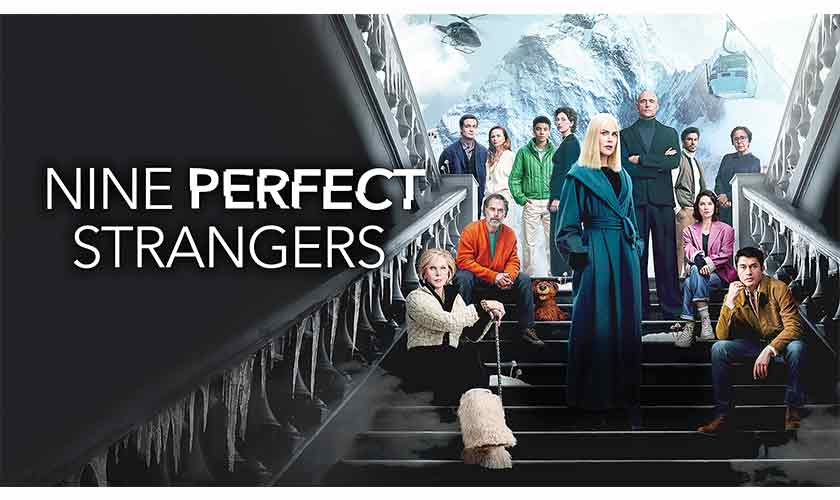
It opens in the Alps, not with a whisper but a hallucination. A bear may or may not be talking and Nicole Kidman’s Masha, ghostlike and glowing, returns to orchestrate yet another spiritual odyssey for a new crop of damaged strangers. But the real question haunting Season 2 of Nine Perfect Strangers is not whether these people can heal. It is whether the show itself can. The answer? Not quite.
After a divisive but compelling first season set in California, Hulu’s sophomore season reboots the retreat with a new cast, new traumas and new drugs, literally and thematically. The result is a visually rich, thematically ambitious, but often narratively hollow experiment in what happens when self-help becomes spectacle.
At its core, Nine Perfect Strangers is still about broken people and the illusion of fixing them. The guests, ranging from a billionaire tech mogul (Mark Strong) and his estranged son (Henry Golding), to grieving women, addicted artists and burnt-out healers, arrive at a luxurious Alpine retreat in search of transformation. What they get instead is curated chaos.
Thematically, Season 2 wants to interrogate the entire culture of commodified healing. “Healing should not feel like a luxury experience,” one character whispers after her third guided trip. Masha’s methods, equal parts spiritual guru and pharmaceutical dealer, test the limits of ethical therapy. But this time, her control is slipping. As she micro-doses her guests into emotional oblivion, one is left wondering if this is a therapeutic process or a metaphysical circus.
What begins with intention soon unravels into absurdity, which is not always a flaw. A bear speaks; people hallucinate and see their dead loved ones; the mountains seem to bend around grief. “When reality breaks down, absurdity sneaks in. Maybe that is the only honest thing left,” Masha muses—one of many lines that feel like they belong in a college philosophy class… or a fever dream.
Yet, while the show gestures toward deep psychological work, its approach often feels superficial. Key themes, like the intersection of wealth and healing, are introduced but never fully explored. “You think trauma looks the same on a private jet as it does on a bus?” asks retreat staffer Yao in one particularly sharp moment. “Try grieving when the world does not give you time off.” It’s a brilliant observation, but the show does not dig into the systemic implications. Instead, it shifts gears to another hallucinogenic montage or emotional outburst.
After a divisive but compelling first season set in California, Hulu’s sophomore season reboots the retreat with a new cast, new traumas and new drugs, literally and thematically. The result is a visually rich, thematically ambitious, but often narratively hollow experiment in what happens when self-help becomes spectacle.
Still, the performances are strong. Nicole Kidman slips back into Masha’s enigmatic presence with ease, radiating both ethereal calm and quiet menace. Murray Bartlett, fresh off The White Lotus, is the season’s emotional anchor, bringing gravitas and depth to a character caught between surrender and self-control. Christine Baranski adds icy bite to an otherwise uneven script.
The standout? Henry Golding, who gives a surprisingly vulnerable performance as a man trying to reconnect with a father who buys intimacy but cannot feel it. His arc, however rushed, reflects one of the show’s more sincere explorations: that connection, not catharsis, may be what the soul actually craves. “Why does being vulnerable feel lonelier than being alone?” a guest asks. It’s a devastating line in a show filled with them.
Visually, Nine Perfect Strangers is still a feast. Director Jonathan Levine makes the Alps feel both serene and sinister. The retreat becomes a dreamscape—bathed in whites, greens and uncanny stillness—mirroring the characters’ inner confusion. Flashbacks are woven with hypnotic visuals, set to meditative soundscapes that toe the line between soothing and suffocating.
But stunning aesthetics can only go so far when narrative cohesion is lacking. Critics have already described the season as “bloated,” “fragmented” and “more style than soul.” They are not wrong. Some character arcs get resolved too neatly; others vanish without explanation. Even the emotional climax—meant to be the retreat’s final cathartic ceremony—feels more like a melodramatic reset button than a meaningful reckoning.
That said, the series is not without emotional power. When it hits, it hits. A particularly poignant group therapy scene ends with the quiet confession: “We came here to fix ourselves, but maybe we’re not broken. Maybe we’re just… grieving.” In these moments, Nine Perfect Strangers sheds its surrealist skin and touches something raw and real.
But those moments are few. The rest is metaphorical glitter. Masha’s monologues are poetic but hollow. “Pain is not something you escape. It is something you carry differently,” she tells a guest. But the series seems unsure about how to carry its weight, oscillating between philosophical ambition and shallow spectacle.
In the end, Nine Perfect Strangers: Season 2 feels like an extended psychedelic trip: vivid, disorienting, intermittently insightful, but ultimately exhausting. It wants to say something about trauma, privilege, control and the absurdity of healing, but ends up muttering rather than declaring. You will come away entertained, perhaps even stirred. But healed? Not quite.
The writer has a degree in psychology with a minor in mass communication. She can be reached at ukmaryam2@gmail.com