

Print Story
X




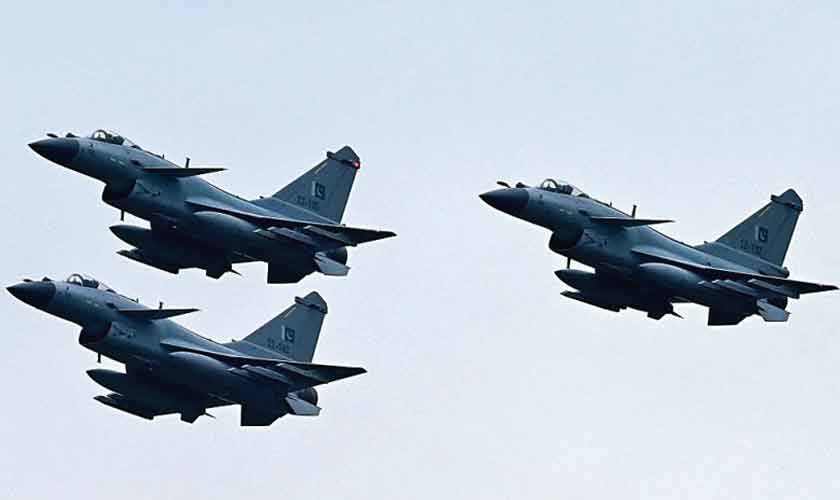
On May 7, the PAF Falcons ambushed and stunned aggressor Indian jets
| O |
On June 1, India’s chief of defence staff, admitted that his country had lost more than one aircraft during the May 7 encounter with the Pakistan Air Force.
When askedby a reporter about claims that six Indian jets had been downed, Gen Anil Chauhan went on to say: “What is important is … not the jets being downed but why they were downed.” Earlier on May 11, India’s director general of air operations had acknowledged the losses. “Losses are a part of combat,” Air Marshal AK Bharti said at a news conference.
There have been several independent verifications of Indian losses. Let us focus instead on how the PAF was able to stun a numerically superior adversary.
In today’s fast-evolving battlefields, wars are no longer fought with boots on the ground alone. Satellites in space, cyber units behind computer screens and fighter jets in the sky work in tandem to shape modern warfare.
As digital echo system reshapes the rules of engagement, air forces around the world are at the forefront of this transformation—combining action in land, air, cyber, space and electronic warfare domains. These are called multiple domain operations. Air force commanders now rely on data from all these domains for battle management and execution.
“The space technology improves communication, navigationand ISR awareness (intelligence, surveillance and reconnaissance). The cyber tools help disrupt enemy systems and protect the friendly ones; the electronic warfare targets enemy radars and communications to gain control of the electromagnetic space,” says Air Commodore Khalid Chishti (retired).
“In the multi-domain operations, the entire workforce acts as one. As one platform silently detects an incoming threat, another tracks it and a third launches the intercepting missile.”
We first saw some of this unfolding during the Operation Swift Retort in 2019 where IAF pilots’ communications were jammed before two of them were brought down in dog fight. Last month the PAF employed full-spectrum operations to neutralise the IAF attack.
“Over the years the PAF’s commanders have realised that the air battles of the future will be shaped by beyond visual range (BVRs) and the net-centric warfare. Successive commanders have rehearsed the doctrines in Indus Shield exercises, fine tuning tactics and strategies,” says former Vice Chief of Air Staff Air Marshal Arshad Malik (retired). “Visualising the future, the PAF established a critical component of integrated air defence, the National ISR and Integrated Air Operations Centre (NIAOC) at its headquarters.”
“The NIAOC operates a real-time “indigenised” networked system for detection, tracking, hostile target identification and ultimate interception/ neutralisation,” says Air Marshal Malik.
“Using an indigenously developed secure Data Link 17, the seamless fusion of space-based assets, cyber capabilities and electronic warfare systems, combined with the strategic deployment of air defence and disruptive technologies creates a synergistic war theatre picture for commanders at the NIAOC. The NIAOC also analyses the air operations of army, navy and the civil aviation for joint operations coordination and national security even during peace.”
“One of the J-10Cs fired its BVR PL-15. The best part was that the Indian pilots remained clueless about the impending threat. They received no missile lock alerts—no eerie beeping in their cockpit, no flashing symbols—until the final moments,” says Air Marshal Arshad Malik.
“During the May 6-7 air engagements, all combat missions were commanded and synchronised through the NIAOC’s unified battle management system to achieve enhanced air dominance,” says Air Marshal alik.
“On the night of May 6-7, the PAF kill chain came into focus when a ground-based air defence system—possibly a surface-to-air missile battery or a specialised surveillance radar—first illuminated the Indian targets, i.e. locking onto its signals. The crucial first step painted the enemy aircraft within the larger sensor picture, alerting airborne units,” says Air Commodore Chishti.
Serving as a command-and-control hub, the sweeping radar beams of the airborne SAAB 2000 Erieye Airborne Early Warning and Control (AEW&C) monitored the targets and planned the engagement. At the same time, it relayed target positioning to the forward-positioned jets.
“In the heat of battle, every part of the kill chain was turbocharged by a vast network of ISR assets, humming with satellite links siphoning off crucial intelligence. The electronic warfare (EW) assets crackled with electromagnetic pulses, jamming enemy radars and disrupting command links. The cyber command units played havoc with the enemy command centres and their back and forth communication with the frontline pilots. Even the communication between pilots in the same formation was jammed,” says Air Marshal Malik.
“This created an opportunity. One of the J-10Cs fired its BVR PL-15. The best part was that the Indian pilots remained clueless about the impending threat. They received no missile lock alerts—no eerie beeping in their cockpit, no flashing symbols—until the final moments,” says Air Marshal Malik.
The warning came only a heartbeat before the warhead tore through the fuselage. One second, it was a jet; the next, a screaming comet of shrapnel and flames that nosedived across the horizon until the earth claimed it in a mushroom of fire.
The layered attack strategy turned into a high-speed game of cat and mouse, stretching across hundreds of kilometers. Every move was carefully directed by airborne controllers and live data from radar and support systems.
Falling like dominoes, six (or seven) Indian aircraft were destroyed within their airspace. These included three Rafale fighters and an Su-30MKI, a Mirage 2000 and a MiG-29. Not a single PAF jet crossed the border—or was lost.
During the two-hour battle, the electronic warfare proved decisive. The jamming severed enemy communication at critical moments. The ISPR later released a cockpit intercept: a Rafale pilot’s transmission crackled through—amidst staccato bursts of terse, coded chatter laced with static and system alarms.
Using the call sign GODZILA 4, an IAF group leader was asking for the whereabouts of one of the formation’s jets. After a brief silence, the reply came: “explosion in air.”
Air combat has evolved from WWI/ II dogfights (P-51s vs Messerschmitts) to Vietnam’s missile duels (F-4s vs MiG-21s) and Desert Storm’s stealth/ EW revolution (F-117s). The 2020 Armenia-Azerbaijan war introduced loitering munitions (Harop) and UAVs (Bayraktar). Ukraine perfected the drone swarms.
The May 2025 Pak-India clash showcased PAF’s latest doctrine. It prioritises short, decisive battles—delivering crippling blows through rapid, overwhelming force rather than protracted engagements. The strategy aims to quickly inflict maximum damage, leveraging precision strikes and shock tactics to compel early capitulation.
The writer is a senior The News staffer in Karachi