


Print Story
X




In her debut collection, Daima Hussain distils joy, grief and memory into her poems
| I |
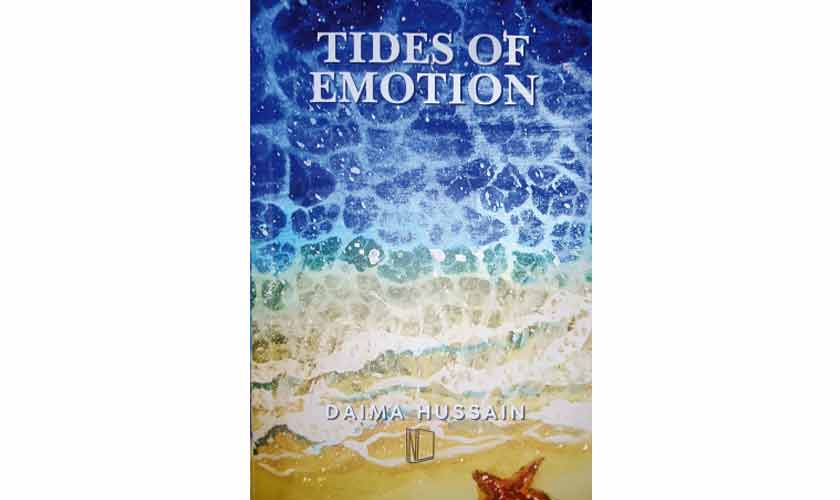
In The Tides of Emotion, Daima Hussain charts a poetic journey through faith, fear, love and identity, a tide that carries both the scent of matar chawal (rice cooked with sweat peas) and the shadow of a crow’s wing. The debut collection is divided into six thematic sections. Each pulls the reader deeper into the emotional undertow of human experience. From the mythic melancholy of Karasu to the reverent quiet of Hamd and the warmth of A Poem for Him, Hussain’s voice is at once tender and sharp, steeped in personal reflection yet alive with universal resonance. Her poems do not merely describe emotions; they distil them, dissect them and hold them up to the light like the many facets of a gem - imperfect and brilliant.
Divided into six distinct sections, Hamd; Emotional Currents; Reflections on Life; The Language of Hearts; Visceral Sensations; and Verses That Speak, The Tides of Emotion mirrors the unpredictable flow of feeling itself. “When you write poems,” Hussain explains, “even when you try to stick to a theme, your emotions, the time of day; even the flutter of a bird’s wing - can distract you.” What began as a focused exploration of emotional states evolves organically into a broader reflection on what stirs the human soul. Each section expands the emotional terrain: from meditative praise to pure emotion, to experience and memory, to love in its many forms, to the beauty of sensory life; and finally, to the power of storytelling.
One of the collection’s most haunting poems, Karasu, is a testament to Hussain’s ability to translate internal unrest into visceral imagery. Named after the mythological crow-like creature of Japanese folklore, the poem evokes a creeping, shape-shifting anxiety that moves “up my spine,/ in a shiver of cold.” The image of the crow becomes a metaphor for depression and fear: persistent, unsettling and strange in its beauty. “The image of that black crow would not leave my mind,” Hussain explains, adding that her understanding of the Karasu-tengu emerged more from anime than from historical sources. The authenticity of emotion shines through: the crow is not just a cultural nod, but a lived presence, “riveting and flowing” through her senses, “fogging… defenses,” and leaving in its wake a “sigh of relief.” This interplay between personal pain and mythological imagery gives Karasu a layered, transnational voice, deeply rooted in emotion, yet unbound by geographical borders.
In Gratitude, from the section Emotional Currents, Hussain takes a more lyrical, almost incantatory approach. The poem loops through rhymes and internal rhythms, grappling with the paradox of a feeling so foundational yet often absent. “The thing to make or break / A life is a simple thing,” she writes, grounding the poem in the quiet enormity of gratefulness. There’s a moral parable threaded through which feels both timeless and cautionary, like something half-remembered from a fable. The language leans archaic in parts, almost Biblical. Yet the message is contemporary: the absence of gratitude corrodes. Of all the emotions, gratitude is perhaps the least glamorous. Still, Hussain elevates it to something essential, a spiritual discipline; a “thing to make or break.”
In The Language of Hearts, Hussain turns her gaze toward love - romantic and otherwise - with a warmth that is both expansive and deeply personal. In A Poem for Him, the beloved becomes a collage of sensations, places and metaphors: “fragrant matar chawwal,” “a cosy four-bedroom home,” “a green, verdant field studded with strawberries.” These aren’t just romanticised images, they’re tactile, specific, and rooted in cultural and domestic familiarity. In our interview, Hussain said that the emotion of love was simply too vast to be contained in a single poem: “The language of hearts contains my musings on love, romantic and otherwise.” She also noted that writing about joy was surprisingly difficult. She explained that “joy is often fleeting and so powerful that we are always chasing it.” That tension, between the tenderness of love and the elusiveness of happiness, suffuses the poem with a kind of aching clarity. The beloved is not just a person, but also a landscape, a shelter, a presence so luminous that “he is sunshine impossible to miss.”
Hussain’s poems often arise from what she calls “the things in life that stir strong emotions in me,” a guiding principle behind the Visceral Sensations section. In Patterns, she surrenders to the mesmerising geometry of nature: “Fractal patterns mesmerise and beguile / wizard, devil, angel, man alike.” There’s a near-spiritual reverence in her descriptions, as if the poem itself is spiralling inward, tracing the hypnotic logic of beauty. These sensory encounters, she says, were actually the last to be gathered into the book, yet they are some of the most emotionally potent. The final section, Verses That Speak, takes a slightly different turn. “I strongly believe that stories are the things that evoke the sincerest emotions within us,” Hussain said. “Stories connect people and let them empathise with one another, essentially feel each other’s emotions.” That belief is the beating heart of the collection: that poetry, like storytelling, is a bridge. Whether shaped by mythology, love or the structure of a leaf, Hussain’s verse insists on feeling as a shared human act.
The Tides of Emotion is more than a collection of poetry. It is a map of inner weather, a lyrical archive of moments too fleeting or too sharp to hold onto in prose. Through myth and memory, rhythm and raw honesty, Daima Hussain invites the reader into an emotional topography that feels both intensely personal and strikingly familiar. Her poems do not preach or pretend to offer answers. Instead, they extend an open hand, asking us to pause, to feel and to remember. In an age of distraction and emotional suppression, this book dares to be vulnerable. It reminds us, as Hussain herself does, that storytelling, whether through verse or voice, is one of the last remaining ways we truly connect. In that connection, emotion doesn’t just rise, it returns home.
The Tides of Emotion
Author: Daima Hussain
Publisher: New Line Publishers
Pages: 124
Price: Rs 1,000
The reviewer is a researcher and counsellor at the Trinity School and co-founder of Cicero Counselling, specialising in guiding students through their academic and career journeys. He can be contacted at sarangaamir405 @gmail.com