Print Story
X




An ensemble of young musicians from Gilgit-Baltistan brings melodies to enchant a Lahori audience
| T |
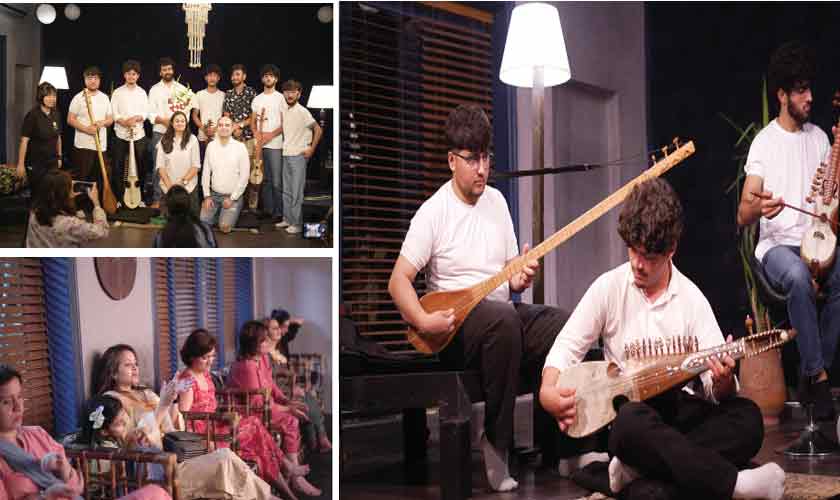
he mellifluous sounds of Gilgit Baltistan’s traditional music captivated a packed audience at Lahore’s Olomopolo on a balmy summer evening. A talented ensemble of young musicians trained in Hunza’s Leif Larson Music Centre played a selection of folk music through a blend of local instruments such as the rabab, Chitrali sitar and dadang.
One of the vibrant musical pieces called Bazam had a celebratory quality to it and appeared to dial up the energy levels of the musicians who sang along with smiles as they strummed their instruments with vigour. The lead musician, Mujib Ruzik, explained that during harsh winters, people of his area gather at home to play instruments and sing together. This activity is called a Bazm.
The audience was also treated to an interpretation of popular music woven together by the lilting melodies of Hunza.
The LLMC was established by Aga Khan Cultural Service Pakistan in collaboration with Aga Khan Music Programme and the Royal Norwegian Embassy in 2016. Built in the heart of Hunza, in the idyllic Royal Garden of the Altit Fort, the centre aims to conserve Gilgit Baltistan’s indigenous music.
Its students have gone on to study music at Pakistan’s leading art colleges such as the National College of Arts, Lahore. They also get the opportunity to attend residencies such as a recent training on raga by veteran composer Arshad Mehmood and iconic sitar player, Ustaad Nafees. LLMC’s troupe of musicians have participated in prestigious musical initiatives such as the Pakistan government’s National Anthem Project. They frequently travel to major urban centres of the country to perform at high-profile events such as this year’s Faiz Festival, the Lahore Biennale and events hosted by international organisations such as the United Nations.
Aga Khan Cultural Service-Pakistan’s CEO, Tausif Khawaja, described the conservation of historical heritage as one of the key goals of his organisation. “The Leif Larson Music Centre is a passion project that aims to preserve the rich musical tradition of Gilgit Baltistan. We are working hard to revive local instruments, which, despite their stirring sound, have been going into redundancy. Music truly speaks a universal language. I am happy to see our indigenous mountain melodies being appreciated by the people of Lahore.”
The centre has served to inspire many young musicians to keep their musical tradition alive. Asiya Shah, Hunza’s first Xiginee player and a student at the NCA, was previously trained at LLMC. She aims to go back to her hometown to teach music to other girls. “The LLMC has had a profound impact on my life, transforming me as a musician,” she said, “Once I graduate from the NCA, I want to return to Hunza and teach girls different musical instruments and inspire them to explore the captivating world of Hunza’s folk music, which is steeped in our vibrant cultural traditions.”
Olomopolo Media’s executive director Kanwal Khoosat said the musical evening reminded her of how powerful cultural expression can be in bringing people together and keeping shared stories alive.
“We were truly honored to welcome the musicians from the Leif Larsen Music Centre to Olomopolo. Their music carried the soul of the mountains, rich with history, emotion and a deep connection to the land and its people. We are excited to keep building heartfelt collaborations like this one, that give voice to traditions, communities and identities that deserve to be seen, heard and celebrated,” she said.
The writer is a freelance contributor