Print Story
X




Central Asia can choose between remaining fragmented and building a more connected and prosperous future
| T |
he Central Asia Regional Economic Cooperation region includes Pakistan, China, Afghanistan and several Central Asian countries. This region was once defined by the ancient Silk Road. It still holds the potential to become a major corridor for trade, transport and economic growth.
CAREC is not just a geographic area; it is also a development platform led by the Asian Development Bank. Launched in 2001, the CAREC Programme helps its 11 member countries work together to improve connectivity, promote trade and support sustainable development. Its aim is to reduce poverty and promote prosperity by making it easier for people, goods and ideas to move across borders.
The programme focuses on practical areas like building better roads and railways, simplifying customs procedures, improving access to energy and encouraging regional cooperation in fields like agriculture, education and climate resilience. It works through cooperation among governments, research institutions and development partners. The ADB is playing a central role in funding and coordination.
Despite this effort, the CAREC remains one of the least connected regions in the world. Trade among its member countries, excluding China, is just around 7 percent of their total trade, compared to 22 percent within ASEAN. This gap highlights the serious challenges that still exist, including weak infrastructure, fragmented policies, political tensions and a lack of trust among neighbours.
These issues were clearly visible recently when tensions between Pakistan and India led to border closures and the suspension of air travel. This not only affected direct trade between the two countries but also disrupted regional trade routes that connect South and Central Asia.
There has been some positive news as well. China helped restart talks between Pakistan and Afghanistan, leading the two countries to restore full diplomatic relations and appoint ambassadors. This is an important development, since Afghanistan is a key bridge between Central and South Asia.
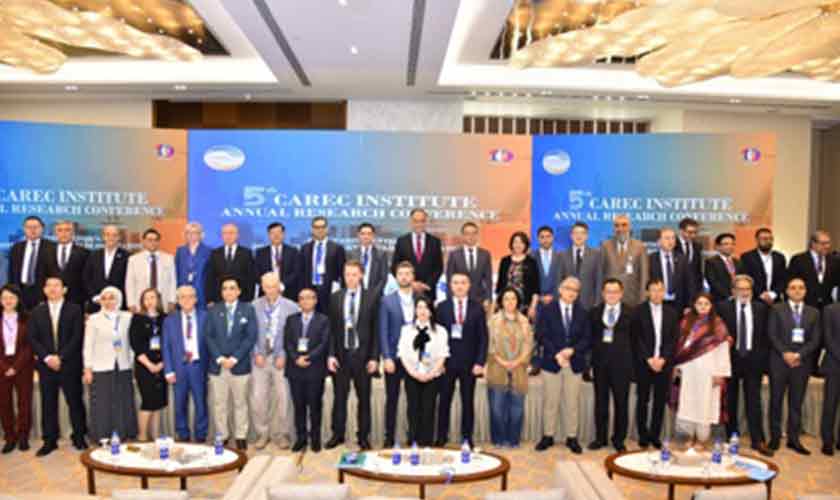
It was in this complex regional environment that the 5th Annual Research Conference of the CAREC Institute was held in Islamabad on May 29-30. The conference brought together over 200 participants from across the region. They included researchers, government officials, business leaders and development professionals. The theme of the conference was: CAREC Connectivity: Promoting Trade and Trade Facilitation.
The event was made possible in large part through the efforts of Dr Ghulam Samad, a Pakistani economist who is a Senior Research Specialist at the CAREC Institute. He played a central role in organising the conference and ensuring strong regional participation. “We wanted to bring everyone together to have a serious conversation about the future of this region. Islamabad was the right place for that,” says Dr Samad.
Minister for Planning and Development Ahsan Iqbal also spoke at the conference. He stressed that geographic proximity could be a major advantage but only if the member countries were willing to work together. He noted that the biggest barriers to trade were not physical borders or roads, but slow procedures, red tape and a lack of coordination. These problems, he said, could be solved as long as there was political will.
More than 30 research papers were presented by scholars from China, Pakistan, Kazakhstan, Turkey, Azerbaijan, Kyrgyzstan and Tajikistan. The topics included green transport, trade reforms, energy transition and inclusive development. A clear message came through: building roads is not enough. Real regional cooperation requires common rules, smooth customs processes and stable political relationships.
There are real opportunities. CAREC countries have large young populations and natural resources. They are attracting investment in transport and energy. New strategies, such as the CAREC Transport Strategy 2030, aim to build better roads.
A key area of discussion was the China-Pakistan Economic Corridor. Although it is often referred to as a bilateral project, experts at the conference said the CPEC could benefit the entire region. Its roads, railways and pipelines could give landlocked countries like Uzbekistan and Tajikistan access to seaports and global markets. In today’s uncertain world, where traditional trade routes are getting destabilised, projects like the CPEC offer new hope.
Another positive example was Pakistan’s implementation of the TIR (Transports Internation aux Routiers) system that helps trucks move goods across borders more easily and safely. Pakistan is also working on digitising its customs system and building logistics hubs to support regional trade. These efforts, supported by partners like the ADB and the CAREC Institute, are steps toward a more modern and efficient trade network.
The biggest obstacle remains political mistrust. India’s absence from most regional trade efforts, including both the CPEC and the CAREC, is a major gap. Its limited trade with neighbours and tense relations with both China and Pakistan, have held back progress. The recent border closures between India and Pakistan are a reminder of how fragile cooperation in the region still is.
Still, institutions like the CAREC Institute offer a path forward. Based in Urumqi, China, the Institute supports its member countries through research, training and policy dialogue. It focuses on five key areas: economic stability; trade and transport corridors; infrastructure; agriculture and water; and human development.
A highlight of the Islamabad conference was the signing of a memorandum of understanding between the CAREC Institute and the University of Sargodha. This agreement aims to promote academic cooperation and encourage research that supports better policymaking. This kind of partnerships help build the trust and knowledge needed for long-term cooperation.
The CAREC region still faces many challenges. Infrastructure in several countries is underdeveloped. The region is also highly vulnerable to climate change, with growing risks of floods, droughts and extreme weather. Many of its economies depend heavily on only a few export items. This makes their economies less stable. Global political and economic uncertainties further complicate matters.
At the same time, there are real opportunities. The CAREC countries have large young populations and vast natural resources. They are attracting investment in transport and energy. New strategies, such as the CAREC Transport Strategy 2030, aim to build better roads, ports and railways. There is a growing focus on greener, more sustainable development.
The Islamabad conference showed that, despite tensions, there is growing momentum for cooperation. The CAREC is at a crossroads: the region can choose between remaining fragmented and moving forward to build a more connected and prosperous future. The discussions in Islamabad were a step in the right direction but much more needs to be done. If the member countries focus on practical actions like aligning trade rules, investing in infrastructure and easing border procedures then they can make real progress. As one delegate wisely put it, “You can build a road in five years, but building trust may take much longer.”
The writer is an Islamabad-based journalist, researcher and media trainer. A former Daniel Pearl/AFPP fellow, he shared in The LA Times’ 2016 Pulitzer Prize for breaking news. He tweets @AounSahi