


Print Story
X




Matthew Goode redeems Netflix’s overstuffed whodunnit thriller series
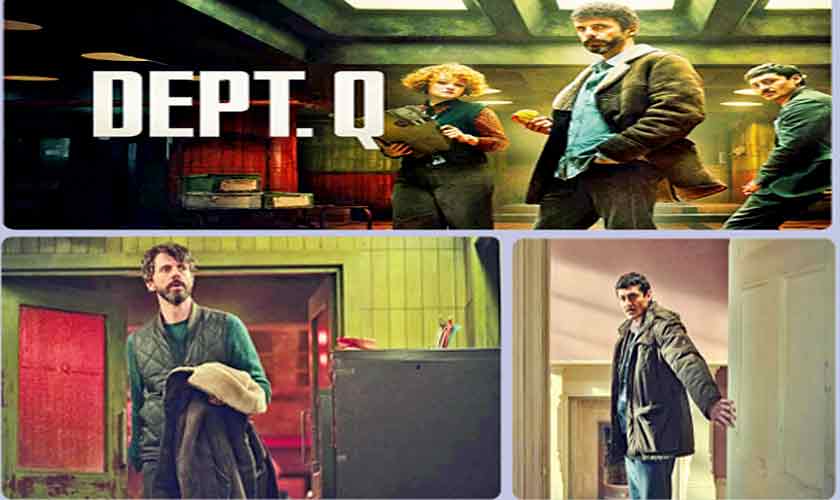
Dept. Q***
*ing: Matthew Goode, Chloe
Pirrie, Jamie Sives, Alexej
Manvelov, Leah Byrne, Aaron McVeigh, and Kelly Macdonald
Created by: Scott Frank and Chandni Lakhani
| C |
reated by Scott Frank and based on the long-running Danish book series by Jussi Adler-Olsen, Netflix’s new British whodunnit series Dept. Q is a dark, often darkly comedic police procedural with promise. Matthew Goode (best known to international audiences for his work in The Crown and Downton Abbey) is terrific as an archetypal no-nonsense cop, and the best part of a series that is fleetingly brilliant and consistently entertaining. While the season boasts some rough edges, overall Dept. Q has more than enough potential to continue if it’s renewed for a second season.
Dept. Q opens with quite a literal bang. Via flashback, an improvised investigation goes horribly, tragically wrong. Virtuoso Edinburgh detective Carl Morck, played by Goode, is rather arrogantly sloppy in securing a homicide site, and the incident leaves his partner paralyzed and a younger cop murdered. Morck suffers from layers of survivor’s guilt and PTSD following the incident, and his lack of a warm welcome once he’s back at work—his colleagues mostly can’t stand him—sometime later only exacerbates this.
Morck is relegated to the grungy basement of the police station by his superiors, and the old rusting former shower facility is repurposed to become a new department dedicated to cold cases. Somewhat indirectly, he’s also paired with ambitious cadet Rose (Leah Byrne) and Syrian refugee Akram (Alexej Manvelov), and the trio investigates the years-old disappearance of notorious local prosecutor Merritt Lingard (Chloe Pirrie).
Meanwhile, Morck struggles with his own broken family life, as well as his intensely adversarial, mandated therapy sessions with police counsellor Dr. Rachel Irving (Kelly Macdonald).
There’s a way to do a whodunnit that’s constantly one step ahead of the audience in the right way—which is, perhaps, the absolute best kind of whodunnit. That said, it’s hard not to often feel a step behind Dept. Q’s story, and not in a complimentary sense. As the investigation into Merritt’s disappearance gains traction, there’s a gruelling number of leads, contacts, and interrogations over nine episodes that likely would have benefited more from being seven or eight. The series never missteps in any substantial way, but the narrative and sprawling cast of characters are bloated to a degree that takes some urgency away from the central mystery, and threatens to overshadow Dept. Q’s stronger assets.
Fortunately, Goode has never been better. The gruff, salty investigator is a character archetype that’s been done to oblivion elsewhere, but Goode nimbly defies any cemented expectation with dark humour and no shortage of surprises. Goode is mesmerising in Dept. Q, no less so in the bits dealing with his messy personal life, especially his interactions and complex relationship with stepson Jasper Stewart (Aaron McVeigh). Their scenes together are really well-acted in that indirect, intermittently stifled way in which men often communicate.
The other real standout in Dept. Q is Macdonald. From her breakout in Trainspotting to roles in films like No Country for Old Men and Goodbye Christopher Robin, Macdonald has consistently remained one of the most underappreciated and effortlessly appealing actors around. The psychological exchanges between Carl and Rachel are a mixture of empathy and aggression, and are the very best parts of this series for reasons having more to do with the actors than with the writing.
Dept. Q suffers from being too much of too many things at times, but it’s a great show in the scenes that play out between Goode and Macdonald. The performances in general are strong, though it’s worth mentioning one clear aspect of missed potential. Manvelov is certainly game, but the script never gives his character Akram much shading; he’s generally just quietly helpful, with bursts of aggression. Surely some of the screen time dedicated to investigating lead after lead would have been better spent giving Akram more depth and backstory. It’s rather representative of a thriller show that attempts to do more than it should, rather than focusing intently on what it needs to do.
Dept. Q will likely grip fans of whodunnit fare well enough, but with some crucial tweaks, it’s not hard to imagine it becoming a better show if further seasons are to follow. Adler-Olsen has written ten novels and counting (the Danish setting of the books has been moved to Scotland for Netflix’s series), so if Dept. Q finds an audience, there should be plenty of material to work with moving forward. If that happens, hopefully, future instalments of the series will be as good as its acting.
- Courtesy: Collider.com