

Print Story
X




The main business hub of the city is chaotic and unwalkable because of illegal parking, encroachments and administrative neglect
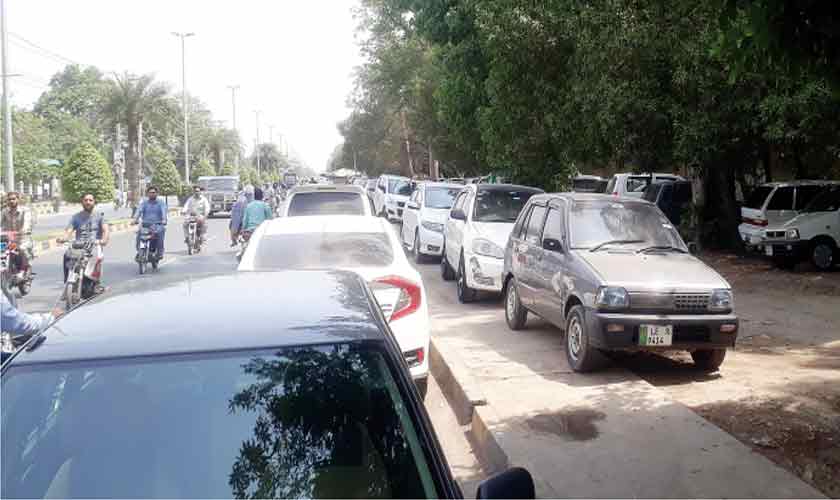
A few days ago, Muhammad Sajid, an employee at a private firm, parked his car near Allama Iqbal Library, a short distance from the Clock Tower. He was approached by a man in plain clothes who demanded Rs 200 as a parking fee and warned that an additional Rs 100 would be charged for every hour the car remained parked beyond the first hour.
When Sajid challenged the demand, pointing out that the official parking fee, set by Faisalabad Parking Company, is Rs 40, he was told that this lot was operated under the District Bar Association, Faisalabad, and not the Parking Company and that the rates were determined by a contractor working for the Bar Association.
This parking area, which spans the surroundings of the District Courts, District Council Road, Kutchery Road, Circular Road and some adjacent roads, accommodates hundreds of cars and motorcycles. The number has surged since Clock Tower’s eight bazaars were declared vehicle-free, further worsening the traffic situation in the surrounding areas.
Earlier this year, at the direction of Chief Minister Maryam Nawaz Sharif, an initiative was launched to make the eight bazaars around the Clock Tower vehicle-free. Barriers were then erected to restrict access. However, even after four months, the area has not been fully cleared of vehicles, nor has the parking issue been resolved.
According to Muhammad Tayyab, an old resident of Rail Bazaar, the root cause of the issue lies in the collusion between the Municipal Corporation and some other government departments. He says that most commercial plazas in Faisalabad’s major business centres, including the eight bazaars, were constructed without any parking facilities.
“Where parking areas once existed, they have been converted into shops. This forces both shopkeepers and customers to park their vehicles on nearby roads and alleyways, resulting in traffic congestion and making it difficult for pedestrians to walk.”
As per the Municipal Corporation’s building by-laws, 35 per cent of any commercial construction area must be left open. Multi-story buildings must provide a parking space for every 1,000 square feet of covered area. However, during recent anti-encroachment operations, no action was taken against violations of these regulations.
Tayyab says that the municipal staff is complicit in protecting illegal encroachments. “Despite ongoing anti-encroachment drives, the seized goods are often returned within hours. This is allegedly because the municipal staff receive monthly bribes from vendors,” he says.
The situation around Faisalabad’s iconic Clock Tower has worsened significantly, particularly on Railway Road, Circular Road, Kotwali Road, Regal Road and Rajbah Road. These areas, packed with shops, are plagued by severe encroachments. The shopkeepers frequently occupy sidewalks and roads, leaving pedestrians with no space and creating bottlenecks for vehicular traffic.
In addition, rows of loader rickshaws park side by side waiting for customers. Many vendors selling fruits, vegetables and snacks also set up stalls on the road, causing persistent traffic jams.
Despite the ongoing anti-encroachment operation by the Municipal Corporation, including the demolition of illegal structures and confiscation of merchandise displayed on roadsides, a major issue remains unaddressed: the illegally operated parking stands run under the District Bar Association Faisalabad. These stands occupy critical road space around the court complex and the historic bazaars, yet no government department has taken action against this.
Traffic police regularly fine and lift vehicles parked in ‘no-parking’ zones around Clock Tower, but vehicles parked at the District Bar-run stands in the same zones remain untouched. Inquiries made, under the Right to Information Act, from the deputy commissioner, assistant commissioner (City), traffic police, Faisalabad Parking Company and the Municipal Corporation confirmed that these parking stands are illegal. Asked who is responsible for shutting these down, each department deflected the responsibility to another.
It is worth noting that similar efforts were made last year when the district administration launched a special drive to remove encroachments and unregulated parking around Clock Tower. The campaign began at the Kutchery Bazaar with a joint operation involving the parking company, city traffic police and the municipal corporation. The shopkeepers were instructed to park their vehicles either near Zail Ghar or in a partially constructed parking plaza next to Chiniot Bazaar. The plan included issuing parking cards to shopkeepers and granting them designated parking privileges. The customers were to be allowed timed parking.
However, the initiative was rolled back soon after. The parking company never issued the promised parking cards and shopkeepers failed to comply with the instruction to stop parking in front of their stores. The result was a return to the chaotic conditions that the campaign had aimed to resolve.
A troubling aspect of Faisalabad’s ongoing urban challenges is the lack of organised parking facilities and accessible pedestrian walkways. This problem is not limited to the eight bazaars surrounding Clock Tower. As a result, streets and sidewalks are increasingly turning into makeshift parking lots, causing traffic congestion and making pedestrian movement difficult.
The situation on major roads like Satyana Road (from Jhal Chowk to Machli Farm Chowk) and Jaranwala Road (from Abdullahpur Chowk to Bijli Ghar Stop) reflects similar chaos. Jhang Road, Sargodha Road and Sheikhupura Road also experience severe traffic bottlenecks during peak hours due to inadequate parking facilities.
To address this growing problem, the Faisalabad Parking Company was established in 2014 with plans to build a parking plaza each on Kotwali Road, Katchery Bazaar and Aminpur Bazaar and two on Rajbah Road. However, only one of these five plazas was partially built near Chiniot Bazaar on Kotwali Road at the site of the former mayor’s house. Following a Rs 300 million spending, the construction was halted eight years ago.
The primary reason for the delay was a lack of clarity over funding responsibilities. Initially, the Faisalabad Parking Company was tasked with financing the project. After changes in the local government system, the responsibility was transferred to the Municipal Corporation. Disagreement over revenue-sharing between the two entities caused further delays. Later, during the PTI-led government in the Punjab, the provincial authorities advised the district government to complete the project under a public-private partnership model. More than a year into the current government’s term, there has been no meaningful progress.
Urban development and infrastructure experts suggest that resolving Faisalabad’s parking and traffic issues will require strict enforcement of building bylaws, expedited construction of parking plazas and the removal of illegal encroachments and unauthorised parking stands.
The persistent mismanagement of Faisalabad’s central commercial zones, particularly around the Clock Tower, highlights a chronic failure of coordination and governance. Despite repeated campaigns and promises by various administrations, the city remains gridlocked by haphazard parking, unchecked encroachments and regulatory inaction. The lack of will to implement building bylaws, complete long-pending infrastructure projects and dismantle unauthorised parking operations continues to erode the urban fabric of Faisalabad.
Lacking a clear strategy, interdepartmental accountability and a roadmap for sustainable urban development, these problems will not only persist but worsen. It’s time for the authorities to move beyond rhetoric and take decisive, transparent action to reclaim Faisalabad’s city centre and make it accessible, efficient and livable.
An out-of-the-box solution could be to designate the Clock Tower bazaar area as a cultural heritage site. Relocating the wholesale markets and businesses to other designated zones on the city’s outskirts could transform the area into a food street and a tourist attraction, ending the congestion while preserving the city’s historic charm.
The writer has been associated with journalism for the past decade. He tweets @naeemahmad876