Print Story
X




A thick blanket of unhealthy fumes envelopes the city, making its residents sick and weighing down on their conscience
| L |
iving in a settlement adjacent to the Lyari River, seven-year-old Kausar is a bright-eyed girl who once loved playing outside her home, but now games that involve any form of physical activity are a nightmare for her. When she frolics about or runs, she finds it difficult to breathe. Her asthma, diagnosed two years ago, is a direct consequence of inhaling emissions released by the illegal dyeing factories that have been operating unchecked near her home for years.
Her mother Fatima says that, every winter, when the city is covered in smog, Kausar’s condition worsens. She frequently wakes up at night gasping for air because she feels suffocated. Fatima interjects, in a trembling voice, “Doctors say my lungs are damaged.”
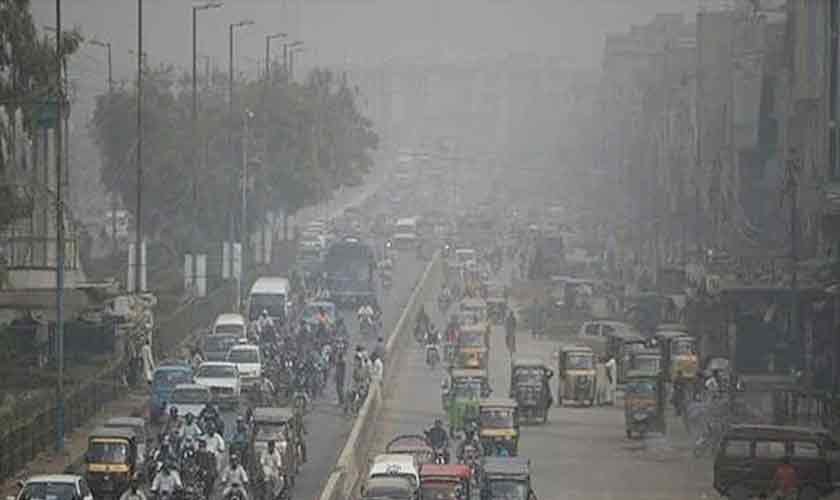
Karachi, home to nearly 30 million people, is struggling for clean air under a thick blanket of pollution. Air pollution has turned the simple act of breathing into a dangerous activity for its residents.
Known once as the City of Lights, Karachi is now often ranked among the most polluted urban centres in the world. Dense air, with dust particles and toxic gases, has become a tangible threat, affecting daily life. Unlike most natural disasters, this threat is silent and invisible. With a flood or an earthquake, the impact is immediately apparent, but air pollution is a silent killer.
Air quality metrics
The metrics used to monitor air quality in Karachi have consistently pointed to extreme danger. A recent Report revealed that, Air Quality Index levels frequently soar to ‘unhealthy’ and sometimes to ‘hazardous’, indicating severe pollution that poses significant risks to human health. These rankings, often placing Karachi alongside and occasionally above the notoriously polluted cities like Lahore and Delhi, These are not isolated incidents but rather a pattern of deteriorating air quality.
An Aga Khan University study (2024) found that air pollution in the city is causing a surge in respiratory disorders. The concentration of fine particulate matter, known as PM2.5, which poses the greatest threat to human health due to its ability to penetrate deep into the lungs and bloodstream is very high. Latest research by the University (2025) raises concerns of a worsening air pollution crisis as mean PM2.5 levels in the city have often exceeded the World Health Organisation’s guidelines by a significant margin. The data shows that, in many areas of city, the 24-hour average PM2.5 concentration has far exceeded the WHO’s guideline value.
The main sources of air pollution in Karachi are vehicular emissions, industrial activities, waste burning, generators and dust from construction sites and dirt roads. It is estimated that around 70 per cent of the pollution is caused by motor vehicles. The authorities are not the only people to blame for the state of affairs. The citizens too have a responsibility in this regard.
The human toll
Behind these horrific statistics lie painful stories of Karachi’s residents who have lost loved ones due to the toxic air.
In December 2020, a mysterious gas leak in a densely populated neighborhood of Keamari killed more than a dozen people after 22 people were brought to hospitals. All of them had difficulty breathing and reported a strong odour in the air. However, the authorities failed to identify the source of the leak. “We still do not know what killed my brother,” says Ali, whose brother was among the victims.
Two years later, in January 2023, another toxic chemical leak was reported in the same district. The Sindh Health Department confirmed that a toxic industrial chemical had killed 18 people in 16 days. The dead included 12-year-old Ayesha, whose parents could not afford to relocate away from the industrial zone.
‘Betrayed by the air I breathed’
Research has shown that the deteriorating air quality is causing serious harm to public health, especially respiratory and lung diseases. Studies have shown that there is a significant increase in respiratory diseases among Karachi’s residents, especially men, the elderly and those with pre-existing lung diseases.
Samina, a 43-year-old mother of three, moved in with her in-laws in the Korangi Industrial Area after marriage. Living near the industry has left her with a severe dust allergy. Now her skin is constantly inflamed and she suffers from chronic bronchitis. “These factories emit smoke day and night. We are forced to breathe in the poison they are spewing,” she says.
Fine particulate matter (PM2.5) is a major culprit, contributing to chronic bronchitis, respiratory infections and pre-existing lung conditions such as asthma and chronic obstructive pulmonary disease. Due to their microscopic size, these particles accumulate deep in the lungs, causing persistent inflammation and making it difficult for the body to expel them.
Farhan, 48, a former factory worker, lives near the North Karachi Industrial Area. Last year, he was diagnosed with heart disease. The doctor attributed it to long-term exposure to industrial pollutants.
“I worked hard at the factory. In the end, I was betrayed by the air I breathed,” Farhan says.
A call to action
Other than social (including psycological) losses, the economic burden of air pollution in Karachi is significant. It leads to increased healthcare costs due to pollution-related illnesses. It also reduces people’s productivity as they fall sick. International Growth Centre (IGC) Studies have estimated that ‘the air pollution costs Pakistan billions of dollars annually.
Despite the alarming situation, the on-ground interventions by the authorities, especially Sindh Environment al Protection Authority and Department of Health, are inadequate. Experts and citizens’ organisations like Karachi Citizens Forum have urged the government to enforce stricter emission regulations for industries and vehicles; promote cleaner energy sources; invest in public transport; increase green spaces and launch public awareness campaigns. The future of Karachi and the health of its residents depend on effective interventions to combat this growing crisis.
The contributor is a Karachi-based urban planner and geographer.