Print Story
X




The Pakistani markets and financial system remained relatively stable during heightened tension with India
| T |
his month, Pakistan went through yet another episode of regional brinkmanship with India. Peace, apparently, is too boring for primetime. Airspace was closed off, retaliatory strikes were exchanged like passive-aggressive texts and diplomatic warnings flew faster than some planes. The worst lasted only four days—barely long enough for a decent Netflix binge—but it was enough to spook the financial system just enough to make it raise an eyebrow. In that blink of the geopolitical eye, crypto casually moonwalked onto the scene—not as a hero, but as that oddly reliable side character you call when things get awkward.
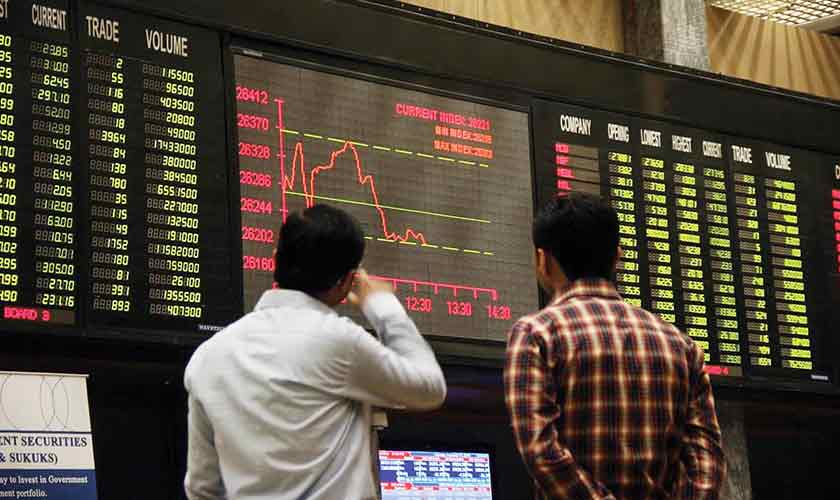
The KSE-100 index dipped 4 percent, a performance best described as “mildly embarrassed” rather than alarmed. The rupee wobbled slightly, but the State Bank didn’t even flinch. Commercial banks, to their credit, acted like they’d seen this soap opera before—stoic and composed. This wasn’t panic. This was an economy doing yoga: uncomfortable but not wounded.
Fin-tech platforms like Sadapay, Nayapay, and Easypaisa noticed a rise in user activity as people rushed to top up their wallets and shuffle money around like they were playing financial musical chairs. Wealth apps quietly reported users tiptoeing out of equities like dinner guests sneaking away before the host brings out the family photo albums. Notably, no major redemptions or capital flight occurred. But the intent behind those minor moves signals something important: a growing demand for agility in financial decision-making.
Perhaps the most telling trend was the modest rise in peer-to-peer (P2P) crypto trading. Activity on platforms like Binance P2P and LocalBitcoins got a modest boost, with premiums on USDT/ PKR rising 2-3 percent. Was it panic? No. It was “just in case” behaviour; you now, the financial equivalent of keeping a bug-out bag in your trunk, next to your gym shoes you never use. People weren’t ditching fiat—they were flirting with optionality. Crypto didn’t overthrow the banks; it just stood there smugly as the Plan B everyone suddenly remembered they had. It was its quiet validation as a contingency layer—a fallback mechanism embraced by a younger, tech-native demographic.
Let’s not forget the diaspora—those long-distance patriots in Dubai and Manchester who love remitting funds and lecturing their cousins about economic responsibility. They too poked around blockchain remittances, adding a little flavour to their otherwise predictable Western Union routine. It wasn’t a revolution. It was curiosity with a side of mild distrust. Was it a signal of disruption? Not yet. But it highlighted crypto’s growing credibility as a second channel—particularly when geopolitical risk threatens physical or banking infrastructure.
More importantly, the conflict gave rise to new questions: how prepared are individuals to navigate moments of financial ambiguity? In private chats and online forums, whispers of how to secure digital wallets and escape fiat purgatory spread like bootleg mixtapes. Nobody was screaming “end of days,” but a few were Googling “how to turn rupees into stablecoins without looking suspicious,” you know, just hypothetically. While the conflict was short, the information shock was real. It’s not difficult to imagine digital communities turning to peer-shared knowledge, private chat groups or online tutorials—hypothetically discussing how to secure digital wallets, protect access credentials or convert small holdings into stablecoins. These aren’t scenes from a speculative future; they represent plausible, quiet actions taken in a moment of perceived fragility.
The conflict gave rise to new questions: how prepared are individuals to navigate moments of financial ambiguity? In private chats and online forums, whispers of how to secure digital wallets and escape fiat purgatory spread like bootleg mixtapes.
Because no modern geopolitical event is complete without a side of digital nonsense, misinformation danced through social media like a drunk uncle at a wedding. Fake airstrike maps, phantom cyberattacks, and Photoshopped exchange rates had a brief moment in the spotlight before reality kicked them offstage. But damage doesn’t need permanence—it just needs virality. Some people saw bad intel and moved money anyway. Because nothing says “financial literacy” like trusting a WhatsApp forward from your uncle named Crypto King92. Even though most of this information was swiftly debunked by official sources, its momentary influence was palpable. In emotionally charged situations, fake news doesn’t need to be credible—it only needs to spread faster than the truth. For some users, the perception of risk—fuelled by unverified content—was enough to provoke financial reactions, from shifting funds to searching for alternative assets.
The impact of misinformation was not uniform across borders. In India, a premature wave of victory posts and celebratory narratives surfaced online even as the situation remained tense. These exaggerated claims—spread rapidly on social media before being challenged by independent and international reporting—briefly lifted market sentiment. The NSE Nifty 50 saw a marginal rebound on May 9, believed to be partially buoyed by optimistic misinformation. But this reaction was short-lived. As accurate assessments of the situation emerged, markets corrected themselves within a day, illustrating how speculative optimism can be just as destabilising as fear.
Pakistani market reaction was more aligned with actual developments on the ground—measured, cautious and pragmatic. The difference underscores how fake news doesn’t only provoke panic—it can also create bubbles of misplaced confidence. Here people reacted more like weary realists than excitable traders. They didn’t buy the rumors; nor did they buy much else. They just quietly moved things around like someone rearranging furniture during a thunderstorm—not panicking, just preparing for the ceiling to maybe fall in.
The response, likely decentralised and peer-driven, illustrates how today’s financial literacy is becoming increasingly platform-agnostic. Even without visible panic, individuals are experimenting with autonomy. They are curious about how money can move—beyond borders, beyond banking hours and beyond conventional rails.
To regulators, this wasn’t a crisis; it was a behavioural field trip; a glimpse into how users behave when the financial system looks slightly wobbly but hasn’t yet keeled over. This was not a regulatory failure nor an institutional breakdown, rather a glimpse into how individuals act when systems, however temporarily, feel exposed. There’s an opportunity here to consider how digital assets might be formally recognised—not as replacements, but as complements to the existing financial ecosystem. Proactive policymaking could help formalise the responsible use of stablecoins or pilot regulatory sandboxes for blockchain-based remittance.
So, what did we learn from this brief chaos cameo? That modern financial resilience isn’t just about strong institutions—it’s also about nimble individuals, quietly hedging their bets while the grown-ups argue. Crypto didn’t conquer anything. It didn’t need to. It just stood by the door with its coat already on, waiting to be invited in.
In 2025, the best financial strategy might not be to bet on the system collapsing, or to pretend it never could. It’s about having options when the power flickers and the Wi-Fi wobbles. When uncertainty comes knocking, it’s not loyalty that keeps you afloat—it’s flexibility; and maybe a little crypto in your digital sock drawer. When uncertainty strikes, the ability to act - to shift, to hedge, to pause or to accelerate - may be the most valuable currency of all.
The writer is an advocate of High Court, a founding partner at Lex Mercatoria and a visiting teacher at Bahria University’s Law Department. She can be reached at minahil.ali12@yahoo.com