

Print Story
X




Mudassar Bashir’s latest Punjabi novel blends history and loss

| G |
oyal, spanning over 550 pages, is Mudassar Bashir’s latest and most expansive novel. With encyclopaedic ambition, it divides its pages between two central characters: Ijaz, a high-ranking officer in the private sector, and Zahid, a professor (and writer of fiction) at a college in Lahore. Both are married. Ijaz enjoys a happy marriage and has three loving children. Zahid, we learn, is stuck in a marriage he cannot leave due to cultural pressure.
Zahid is drawn to a like-minded colleague, who seems to admire – perhaps is love with – him, but refuses to cross a line because of her principles. Zahid spends much of his time, after teaching and marking papers, with a couple of close friends, most notably Painter Babu – a down-to-earth, dervish. Zahid and Painter Babu are committed to unearthing the cultural and political histories of Lahore and, by extension, pre-Partition Punjab. Together, they represent the left-leaning, decolonised intelligentsia of post-colonial South Asia. They are constantly seeking old people who can share the intricacies of lives lived in times past with them.
Ijaz, on the other hand, is plagued by haunted dreams. These are eventually revealed to stem from his betrayal of his first love as a teenager in his village. The reader learns that his guilt arises from never returning to the woman he had once loved, despite heartfelt promises, nor ever finding out what became of her. Ijaz is close to Wasif, whose elderly father suffers from acute depression, the cause of which is the trauma of Partition. Separated from his family, who fled to India, he converted to Islam and became Sheikh Ismail, abandoning his former identity as Ramesh Chand. Sheikh Ismail’s memories of his parents, siblings and early religious rituals torment him deeply.
Encouraged by his daughters to take a break from work to find inner peace, Ijaz agrees to a period of rest. This decision leads him back to his village, where he reconnects with forgotten family members and friends. This part of the novel – arguably the more substantial portion – becomes a journey in reverse, as if seeking to right the wrongs of one’s past.
Mudassar Bashir has a deep interest in local history and in the history of the Punjab. The fiction writer in him is a wounded historian in disguise – wounded by the neglectful attitude of his fellow countrymen and by the collective loss of knowledge about their shared heritage. For him the Islamisation of Pakistan’s history is a sad chapter, as teaching and acknowledgement of the land’s pre- or non-Islamic culture has been minimised or erased from the national consciousness under state directives and poor standards of education. Bashir’s novel is a lament against ignorance born of intolerance.
Despite his good intentions, however, a novel is not a catalogue of missing pages or an archive of historical documents. In fiction, history or historical layers, though important for various reasons, are always subservient to human emotions (rasa) and empathy, which remain the most crucial elements in modern literature.
Despite the burdensome parts of the novel where history throws its weight around a bit too much, I found several parts very enjoyable for their imaginative dare and language.
Mudassar Bashir’s novel struggles to balance the human and the historical and often tilts towards the historical. His cornucopia of historical detail might fascinate the reader but it also weighs the narrative down. The sheer volume of detail burdens the readers’ eyes and ears as they long to witness acts of human transgression, fragility, cruelty, kindness or failure. The rasa of unrequited love between Ijaz and Meenu (his first love) never reaches its full potential, or veer towards an unexpected turn – a tragedy, chaos or sorrowful ending. Too much kindness and goodwill from too many good-hearted characters surrounding Ijaz, in particular, weakens the narrative.
There was early promise of a more complex story in the making between Zahid and his female colleague as Zahid tries to bait her with an open suggestion. Had she taken the bait, the story might have become more human and muddier. Sexual transgression is not always a moral failure. Rafaqat Hayat’s Rolaak and Nain Sukh’s Cheek handle this territory well, exploring the murkiness of human nature through acts of sexual transgression. Both novels are enriched by this, as the characters – male in Rolaak and female in Cheek – acquire a more complex, three-dimensional quality. The reader is thus able to empathise with both, regardless of gender.
Where Goyal does shine is in the flow and register of its language. Mudassar Bashir’s prose never becomes burdensome or convoluted. Even when the dialogue verges on the pedestrian, it almost always manages to remain fresh. His descriptions of landscape are notably visual, at times, even poetic.
I wish the editor had suggested some serious paring down, particularly the sections carrying long poems and monologues. The choice of the title Goyal is worth pondering. The goyal or goyalra appears in several places in classical Punjabi poetry, but in the context of the novel, the closest meaning seems to be the impermanence of life. However, it is not entirely clear to this reviewer what the title’s precise target is.
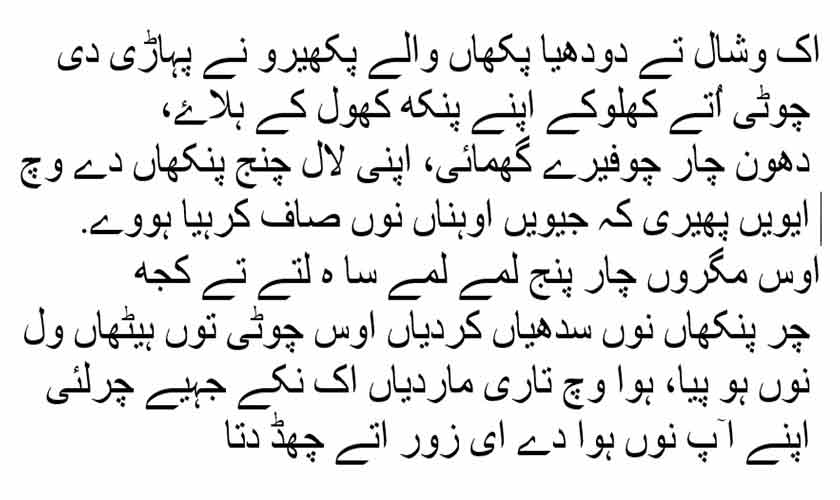
That said, I am glad that Punjabi writers have reached a point where they are unafraid to push the limits of their imagination. I have said before that the modern Punjabi novel – at least in Pakistan – still has some way to go before it can match the calibre of international fiction. Goyal is certainly a step in the right direction. Despite the more burdensome parts of the novel, where history occasionally throws its weight around too much, I found several passages thoroughly enjoyable for their imaginative boldness and linguistic flair. For example:
With prose as fluid and sweet as this, what’s not there to like?
Goyal
Author: Mudassar Bashir
Publisher: Fiction House, Lahore
Pages: 553
Price: Rs 3,000
The reviewer is a librarian and a lecturer in San Francisco. His last book was A Footbridge to Hell Called Love. His novella Unsolaced Faces We Meet In Our Dreams is due soon