Print Story
X




At the 19th Venice Architecture Biennale, the Saudi Pavilion offers a vision of peace and possibility
| I |
nhabitants of the globe have long used fixed signs to determine direction, like the four points on a compass. But in the Twenty-first Century, these demarcations also include political divides, economic disparities and power imbalances. One such boundary today is the division between the Global North and Global South. Yet, within any given region – whether labelled northern or southern – lie numerous ‘norths’ and many ‘souths’.
Europe, for example, is typically considered a northern continent. However, its Mediterranean territories are often viewed as culturally and historically aligned with the Global South – if not part of it. Take Italy, in particular its towns along the Mediterranean and Adriatic Seas, such as Venice. Known by its Arabic name Al-Bunduqiya since the Middle Ages, the city reflects deep-rooted ties to the East, shaped over centuries of trade with the Middle East, India and China.
Today, that exchange is most visible in the flow of cultural goods – especially art and architecture – as Venice continues to draw creative individuals from across the globe to its prestigious alternating art and architecture biennales.
An interesting feature of this year’s architecture biennale in Venice – titled Intelligens: Natural, Artificial, Collective and curated by Carlo Ratti – is the participation of several countries from the Middle East, including Saudi Arabia, the UAE, Qatar, Oman, Bahrain, Lebanon, Egypt, Kuwait and Morocco, as well as Turkey and Pakistan. Each pavilion addresses issues both within and beyond the region, interpreted through distinct cultural and architectural lenses.
For example, Saudi Arabia’s pavilion at the Arsenale venue, The Um Slaim School: An Architecture of Connection, offers a compelling take on collaboration and spatial practice. The project builds on the work of Syn Architects – a Riyadh-based practice founded by Sara Alissa and Nojoud AlSudairi – and the Um Slaim Collective. Curated by Beatrice Leanza and assisted by Sara AlMutlaq, the pavilion stands out for several reasons.
Foremost is its multi-disciplinarity: the pavilion incorporates a woven grid, oral narratives, living archives and architectural documentation of the past. These elements are woven into a network of open walls and meandering lanes, which resist a linear layout and instead invite multiple points of entry. This open structure offers a sense of participation and belonging to the visitor, who may feel, quite literally, at home in the Saudi pavilion after encountering the high-tech displays and futuristic projections elsewhere at the biennale.
Another – and perhaps equally important – aspect is connection, as reflected in the name of the Shamalat project. “Located on the periphery of Diriyah in northern Riyadh, Shamalat is a multi-use cultural hub founded by artist Maha Malluh and designed in collaboration with Syn Architects.” The word Shamalat means “many norths” in Arabic. This presentation of a project on ‘many norths’ from a Global South country at an international biennale hosted in the Global North creates an intriguing conceptual symmetry.
This link can also be observed physically. Walking through the narrow alleys of Venice, one often sees buildings with exposed brickwork peeking through scratched plaster, standing beside newly constructed sections. It is a city where the past and the present coexist – not as a decorative strategy, but as a natural progression of lived history.
It sparks a desire for dialogue: a conversation between Najdi adobe structures and Venetian buildings, between distinct pasts and multiple futures.
A similar sensibility is evident in the restoration of Shamalat, which has been transformed into a complex housing a gallery, library, artist residency and several workshops. In this project, Syn Architects, in collaboration with Malluh, have preserved vernacular mud structures and architectural elements, while adding lime-based walls (the material complements rather than competes with traditional construction) – along with expansive glass windows that invite light and landscape into the space.
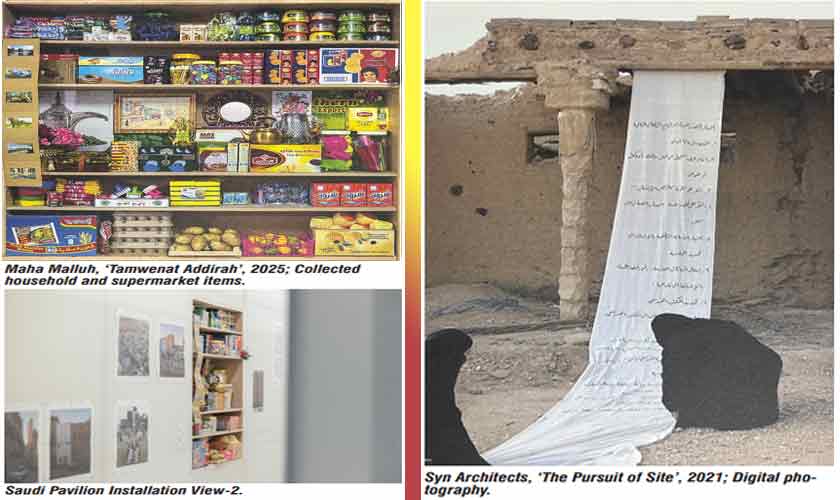
That external world is also part of the Saudi display at the Venice Architecture Biennale – presented through photographic documentation (Present Tense, 2023–2025) by Laurian Ghinitoiu, digital drawings of the site by Syn Architects (2023) and a hand-drawn sketch of building sections (Shamalat, 2014) by Maha Malluh. These sit alongside her mixed-media installation, Tamwenat Addirah (2025), a cabinet filled with everyday household and supermarket items sourced from the Um Slaim neighbourhood.
Inside it, one finds multicoloured plastic combs, washing brushes, biscuit packs, tea bags, table napkins, spice packets, coffee pots and decorative trinkets – all carefully arranged like elements of an orthodox abstract painting. These materials collectively suggest the tastes, social classes, resources and ethnic identities of the neighbourhood’s residents.
Further insight comes from Ghinitoiu’s photographs, which capture men praying, playing or gathering outdoors, as well as the spaces they inhabit. Borrowing a phrase from Italian philosopher Emanuele Coccia, these dwellings “might be a hotel, an apartment, a room just large enough for a single bed or a skyscraper”.
There are always two sides to buildings: the brick-and-mortar forms and the human lives that inhabit them. Materials become residues of memory – touched, desired, enjoyed or transformed by those who came before. The Saudi Pavilion pays homage to this materiality and expands the language of architectural construction. The entire display is enveloped in a fabric that mimics the tint, grain and texture of sand.
It also offers a layered history of Saudi architecture – from the early techniques used in mosque construction, to later multi-storeyed houses and finally the steel-and-glass landmarks of the modern era.
Nations with dense historical legacies are negotiating their heritage in increasingly diverse ways. Often, traces of the past are erased in favour of modern modes of expression. In some cases, the two merge to create hybrid forms, like the global cultural landscape in which a multinational fast-food chain such as McDonald’s now serves the MacArabia. Saudi Arabia, a rapidly expanding economy, is similarly grappling with this tension, as reflected in the Situated Practice section of the Saudi Pavilion.
One of its featured works, The Pursuit of Site (2021), documents a performative intervention that “calls attention to the ephemerality of Najdi adobe architecture and the obstacles to mitigating its deterioration.” Through a series of photographs, the display narrates how, “denied a permit to restore a vacant mud house on an empty plot in old Riyadh, the Um Slaim Collective suspended a fabric banner from the building’s façade.” Inscribed in elegant Arabic script, the banner lists a 12-step process required to obtain official restoration approval.
Other extensions of this intervention are also presented. For instance, The Conservatory (2021) shows how the Um Slaim Collective installed a scaffolding structure clad in fabric over an earthen ruin in old Riyadh – a form typically associated with transitional urban and architectural work. Intriguingly, the structure’s layout, transparency and materiality echo the very form of the Saudi Pavilion itself. As a result, the viewer experiences a dialogue between micro and macro, crossing boundaries of scale, history, purpose and built form.
By incorporating daylight, using natural materials and emphasising inclusivity, the Saudi Pavilion becomes a space of peace, purity, and, with time, a sense of perfection. It also sparks a desire for dialogue: a conversation between Najdi adobe structures and Venetian buildings, between distinct pasts and multiple futures; and between the Arabic name for Venice, Al-Bunduqiya (which in modern Arabic means “firearms”), and Arsenale – the site of the Saudi Pavilion – a word now commonly associated with weapons and military equipment.
19th Architecture Biennale in Venice is being held from May 10 to September 14, 2025.
The writer is visual artist, an art critic, a curator and a professor at the School of Visual Arts and Design, Beaconhouse National University, Lahore. He can be contacted on quddusmirza@gmail.com