Print Story
X

| T |
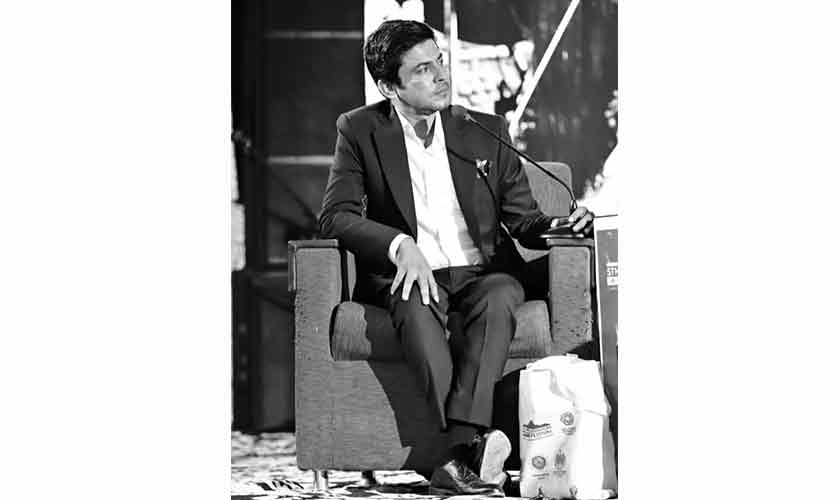
he camera flashes, the crowd murmurs and there he stands—Mazhar Sethar, poised between two Bollywood megastars under the dazzling lights of Dubai. At first glance, it’s just another glamorous event photo. But look closer. The confidence in his stance and the quiet pride in his eyes tell another story. This isn’t just another celebrity snapshot. This is a victory lap twenty years in the making. The saga began not on red carpets, but in the sunbaked streets of Sindh, where a young boy dared to dream bigger than his surroundings would normally permit.
In a small village in Sindh, where most children’s ambitions rarely stretched beyond their immediate horizon, young Mazhar was different. While his peers played cricket in the dusty lanes, he’d find himself mesmerised by the flickering images on the family’s small television set. “I didn’t just watch those shows,” he recalls, running a hand through his hair. “I studied them. The camera angles, the lighting, how the actors delivered their lines—it fascinated me.”
His father, a schoolteacher with modest means, noticed his son’s unusual interest. “Most parents in our village wanted their children to become doctors or engineers,” Mazhar recalls with a chuckle. “My father? He just wanted me to be happy. When I told him I wanted to work in television, he didn’t laugh. He simply asked, ‘How can I help?’”
That simple question became the foundation of everything that followed. With his father’s encouragement, Mazhar began documenting life around him using a borrowed camera. His first “productions” were humble—interviews etc.
Mazhar’s journey took a pivotal turn when he enrolled at Shah Abdul Latif University. While studying sociology, he discovered an unexpected advantage. “Understanding human behaviour is the most powerful tool a storyteller can have,” he says. “My degree taught me why people act the way they do; what moves them; what makes them resist change. These weren’t just academic lessons—they became the backbone of my craft.”
“There were many nights when I thought about quitting,” he says. “The equipment was basic, the budget nonexistent. But then I’d remember that little boy in the village glued to the TV and I’d keep going.”
His breakthrough came with a show at local channel. “It was raw, it was real, and most importantly, it made people feel something,” he recalls. The film caught the attention of local media, leading to his first professional opportunity at KTN, a leading Sindhi television network.
The television studio was both exhilarating and intimidating. “I started as a talk show host, but I wanted to do everything,” Mazhar says, his eyes lighting up at the memory. “I’d pester the cameramen to teach me about lenses, beg the editors to explain their techniques. Some probably found me annoying. I didn’t care. I needed to learn.”
His persistence paid off. Soon, Mazhar was directing music videos that stood out for their cinematic quality. “Most local productions followed the same formula,” he says. “I wanted to break that mould. If we were shooting a love song, I’d insist on locations that told a story. If it was a folk tune, I’d research traditional costumes and customs to ensure that it was authentic.”
“There were many nights when I thought about quitting,” he confesses. “The equipment was basic, the budget nonexistent. But then I’d remember that little boy in the village glued to the TV, and I’d keep going.”
This attention to detail didn’t go unnoticed. His work began attracting attention beyond Sindh, leading to collaborations with artists from across Pakistan. But Mazhar wanted more. “I kept thinking about the international content I’d grown up watching,” he says. “I knew Pakistani stories could resonate globally—they just needed the right presentation.”
The decision to move to Dubai was equal parts terrifying and exhilarating. “I arrived with two suitcases and a portfolio of my work,” Mazhar recalls. “The first month was humbling. I went to countless meetings, showed my reel to anyone who would watch. There were polite nods and vague promises, but no real opportunities.”
Then came the breakthrough—a small commercial for a local brand. “The budget was tiny, but the creative freedom was enormous,” he says. Mazhar poured everything into that project, treating it like a Hollywood production. A spot that looked far more expensive than it was, catching the eye of major advertising agencies.
Soon, Mazhar found himself on sets with Bollywood stars and international models. “The first time I directed a famous actor, my hands were shaking,” he says. “But then I remembered—I’d earned this. My Sindhi roots, my struggle, all those years of working with limited resources—they’d prepared me for this moment.”
Today, Mazhar’s work spans continents. From directing commercials in Dubai to consulting on Hollywood projects, he’s become a bridge between Eastern and Western media. “What I bring to the table is perspective,” he says. “I understand both worlds—the storytelling traditions of South Asia and the production values of global media.”
Success hasn’t weakened his connection to his roots. Mazhar regularly returns to Sindh, conducting workshops for young filmmakers. “Talent is universal,” he insists, “opportunity isn’t. If I can help open doors for even one kid from a background like mine, that’s more meaningful than any award.”
His latest project is about the youth. It is a podcast series highlighting untold stories of the youth role models from rural Pakistan. “These are narratives the world needs to hear,” he says passionately. “Not poverty porn, but real stories of resilience, innovation and hope. That’s the power of media—it can change perceptions, one frame at a time.”
As we wrap up our conversation, Mazhar leans forward, his voice dropping to a confidential tone. “People ask if I’ve ‘made it,’” he says. “But that’s the wrong question. The real question is—what story do I want to tell next?”
With plans for a feature film and a digital platform to showcase South Asian talent in the works, Mazhar shows no signs of slowing down. “Twenty years ago, a village boy dreamed of standing on that stage,” he reflects. “Today, I’m thinking about how to build platforms for others.”
His phone buzzes—another call from Dubai. As he prepares for his next meeting, Mazhar offers one final thought: “They say you can take the boy out of Sindh, but you can’t take Sindh out of the boy. Well, you shouldn’t try to take Sindh out of the boy. That’s where the magic comes from.”
The camera flashes again. This time, it’s not just capturing Mazhar Sethar, the international filmmaker. It’s also capturing the little boy from the village who has not forgotten where he came from.
The writer is a freelance journalist. He tweets @RehmatTunio