

Print Story
X




Parachinar hosts first literary gathering after months of tension
| I |
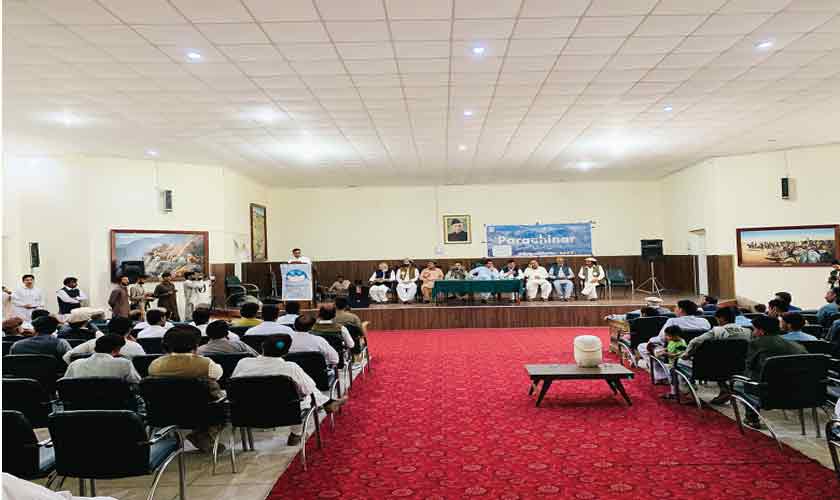
In a powerful gesture of healing and unity, a peace-themed poetry gathering was held in Parachinar after eight months of heightened sectarian tensions in Kurram district. Poets from Sunni and Shia communities across Lower, Central and Upper Kurram came together to recite verses and comment on the present socio-political climate. The aim of the event was to promote peace and envision a shared future.
The event, titled Parachinar Peace Mushaira, was organised at the historic Governor’s Cottage in collaboration with the Department of Culture and Tourism and the literary group SpeenGharAdabi Jirga. The audience included poets, artists, civil society members and residents from all three sub-divisions of the Kurram district.
This was the first time in nearly eight months that poets from Lower and Central Kurram traveled to Parachinar, where they joined their counterparts from Upper Kurram to share their poetry. They were warmly received by the audience.
In addition to poetry, the event featured musical performances by local artists who sang songs celebrating peace and harmony. The sound of traditional Pashto music, after months dominated by the echoes of gunfire, was a welcome change and drew heartfelt applause from the crowd.
Among the performers was Sailab Hussain Sailab from Upper Kurram, a member of SpeenGharAdabi Jirga, who captivated the audience with his poetry. Fellow poets Khurshid Rabbani and Sadiq Hussain Sadiq also shared ghazals. Sadiq poignantly depicted the recent unrest in the valley, likening Kurram, a place of natural beauty, to a prison for its people.
Poet Sabir Bangash used the platform to urge local authorities to make Pashto a mandatory subject in private schools across Kurram, lamenting the fact that many students in government schools can no longer write in their mother tongue. “We must protect and prioritise our linguistic heritage,” he said.
Other poets such as Jamal Miskeen and YousafKhamosh of the Lower Kurram Adabi Tolana and Moeen Marawar from Upper Kurram, delivered deeply resonant poems. Marawar’s verses offered a vivid portrayal of the district’s recent turmoil.
Some poets drew stark comparisons between Kurram and other conflict zones like Gaza. “We are being looted and killed by unknown armed men,” one recited. “There was no medicine, no food. Peace is possible, but where are its advocates?”
Every fifteen minutes, peace anthems were sung, evoking the tranquil beauty of Kurram’s green poplar trees and cool springs. These interludes, rich with cultural references, reminded the participants of what was at stake and what could be restored.
“Such events, held at a time when hatred has been running high, play a crucial role in creating spaces for dialogue and reconciliation.”
In a hopeful turn, several poets addressed women’s rights, condemning forced marriages and highlighting the social injustices woven into daily life. One couplet resonated deeply: “Mena pa talurat luziyatigi, Kala raza kala bazadar zammayana.“ [Frequent meet-ups make the heart fonder, come by sometimes, so I have an excuse to visit you.]
MubashirLuqman shared a moving piece from a mother’s perspective, conveying the pain of violence and division. Raza Bangash emphasised the shared desire for peace among both Sunni and Shia communities.
Nabiullah SpeenGhar, a leading voice in the region’s literary circles, said organising a peace-focused mushaira in a once-volatile environment was a commendable achievement. “Such events, held at a time when hatred has been running high, play a crucial role in creating spaces for dialogue and reconciliation,” he said.
SpeenGharAdabi Jirga president Noor Zaman Khafgani, hailing from Upper Kurram, welcomed all participating poets and delivered his own poetry in melodic tones accompanied by music. “We want peace in our homeland,” he said.
Social activist Abdul Khaliq Pathan from Central Kurram shared a deeply emotional moment: “When I hugged a Shia brother after so long, it felt like the comfort of a mother’s embrace. The solution to our problems lies in coming together.” He urged the administration to help resolve the key issues faced by the community.
Additional Deputy Commissioner Amir Nawaz Khan praised the poets and the participants, saying, “Poets from across Kurram have gathered here today and have made this event unforgettable. Today, instead of hearing the sound of guns, we hear the melody of flutes and rabab. Both sides are calling for peace, love and brotherhood.” He called on all communities to move beyond past differences and work together for a peaceful future for the next generation.
At the end of the recitations, Noor Zaman Khafgani thanked the Culture and Tourism Department for supporting the event. He emphasised the need for such gatherings to continue as a pathway to sustainable peace in Kurram.
Assistant Commissioner Upper Kurram Khalid Imran also took part in the event, surprising the audience by reciting romantic verses and receiving enthusiastic applause. He said all poets shared the poetry with a focus on peace and the situation of Kurram valley, but romance also plays an important part in life.
The event concluded with a traditional Pashtun Attan dance, where participants from both sides formed a circle and danced in unison, symbolising unity and renewed hope. Following the success of the Parachinar Peace Mushaira, a similar event is planned at Sadda in Lower Kurram.
The writer is a multimedia producer. He tweets @daudpasaney