

Print Story
X




Jewanjee’s canvases explore myth, memory and the fragments left behind by history
| I |
n A Short History of Myth, Karen Armstrong writes that gods never die; instead, their stories of death and rebirth are used to explain the rhythm and flow of nature, such as the seasons and harvests. Some myths denote the universal struggle between good and evil, exemplified by cycles of war, conflict, unexpected droughts and floods. Regardless of this pattern of death and regeneration, the central focus is on the conflict and a possible symbolic death. What comes after implies that victory is never complete, that the struggle is ongoing, and a myth must continue to repeat this pattern in order to remain relevant. Only then is the incoherence of senseless death, violence and life justified: through the repetition of destruction and, finally, renewal. Perhaps it is in the magic of the grand canvas of storytelling or the tenacity embedded in these universal struggles; either way, myths have enabled us to live more fully, bravely and intensely.
Visually, many of Zahra Jewanjee’s oil and acrylic paintings are evocative of this longing and the struggle that characterise such archetypal conflict. The desire to capture some kernel of this experience is visible in many of her works, which teeter between abstraction and illusionistic representation. The reckoning of power and truth is represented visually in her series titled Season of the Rainbirds. Jewanjee’s paintings are enigmatic and offer multiple readings; they are animated by the clash and clamour of primordial battles, represented through compositions of shapes such as circles, spheres, orbs, cubes and rectangles that intersect, shift, overlap and lock horns (metaphorically) in the various visual permutations of a timeless confrontation.
Jewanjee’s colour palette is varied. She revels in allowing the languid flow of pigment across the canvas, exploring possibilities and experimenting with clusters of combinations: cobalt blues and hues of alizarin purple bleed through shapes, while in other compositions translucent layers undulate and flicker against neutral surfaces. Certain works resemble the pages of an almanac, ceaselessly weaving together both personal and cosmological tabulations of momentous events.
The gravitas of such a moment is most evident in compositions like Her Revolution and Spiralling Symmetries. It is as if the archetypal shapes that signify eclipses and cosmological shifts contain micro-worlds and the dark matter of the galaxy. Some carry mysterious debris that may unleash foment, while others could subdue conflict; it is a moment of anticipation that is captured by Jewanjee. Movement, not inertia, will determine the outcome.
The sky and lunar imagery, in particular, serve as important leitmotifs in this series. They appear as silent witnesses or a sacred presence in Gossip, Spiralling Symmetries and Articulate Silences. Can the conjunction and alignment of Jewanjee’s eclipses and crescent moons – in synecdochal relation with cerulean skies – be interpreted as harbingers of doom or portents of another destiny?
Some of Jewanjee’s other work grapples more directly with this question, intersecting with the crisis of post-modernity and the erasure of familiar structures. Perhaps this is the hidden caveat in many of her pieces: mystical themes and systems of knowledge caught in the crosshairs of a struggle between nihilism and the loss of identity.
Jewanjee consciously borrows motifs and tropes from Indo-Persianate manuscript painting, but there is a deliberate attempt to empty them of context, just enough to create space for a conflicted reading, full of missing or ambiguous signifiers. In almost every work, there is a visible tendency to siphon off representational meaning and recontextualise birds so they become metaphoric shadows or silhouettes of their former selves. The hoopoe – and perhaps the nightingale – can still be identified, but only symbolically.
Traditionally, the hoopoe has appeared in numerous Mughal and Pahari compositions, but it is most famously rendered in Persian manuscript illustrations of the fabled poem The Conference of the Birds, composed by Farid ud-Din Attar in the 12th Century. Once appropriated from its original context, however, the bird transforms into a more cryptic and trivialised representation.
In Buraq, even the mythical winged creature – a sacred mount – is stripped of its traditional meaning and re-imagined as a silhouette containing the elemental properties of earth, fire and water. As the Buraq attempts to take flight and escape the terrestrial confines of conventional manuscript compositions – defined by their predictable syntax and bordered frames – Jewanjee borrows from a post-modern impulse to visually shatter, fragment and disperse these conventions.
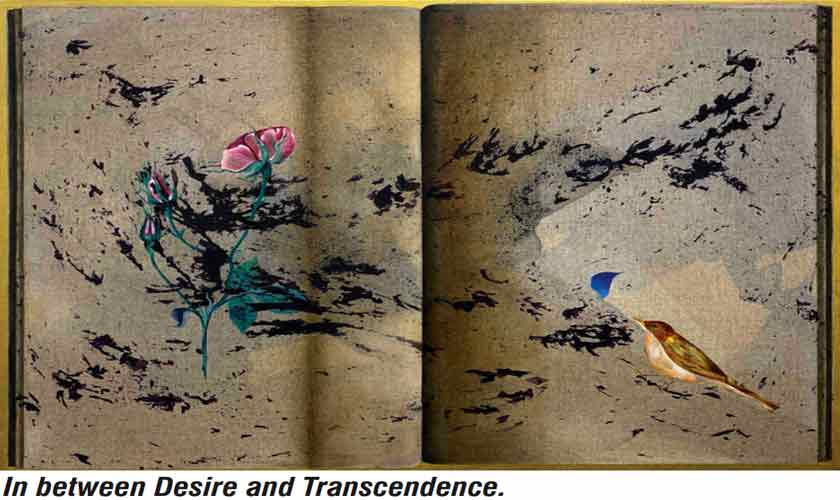
Oddly, the tone of the work remains buoyant. Its psychedelic swirls and eddies of colour radiate positive energy, managing to resurrect familiar themes of union between the soul and the Creator. This resilience vanishes in In Between Desire and Transcendence, where the violence of scatter, entropy, illegibility and erasure is complete.
Spatially, the composition is stripped of historicity and familiarity. The fury of black ink splatters, then congeals, across the surface. Even the familiar gul-o-bulbul (rose and nightingale) – long-standing motifs in Persianate painting and poetry – are forcefully separated and re-imagined as two discrete entities, painted on a surface that resembles a double-page spread. The motifs face each other in solitude and the blank space that surrounds their violent parting takes on new meaning. Transcendence feels like a mirage.
Jewanjee’s visual influences and signifiers oscillate between tradition and innovation. She draws inspiration from earlier masters who ushered in the contemporary impulse by exploring and extrapolating the frame or border as a motif. Yet, there is also restraint in her practice, particularly when she introduces iconography born solely from her own visual language. In many of her compositions, the most dominant leitmotif is that of the wooden chair or stool. Parts and fragments of these pieces of furniture appear across various works. Their visual representation is characterised by neat rows and ordered lines, at times resembling floating patterns.
One manuscript painting displayed in a gallery of the Lahore Museum depicts an awkwardly seated Englishman wearing a solar toupee, seemingly forced into an ill-fitting chair. His limbs appear rigid, as though the chair itself has restrained him. The painting, perhaps unwittingly, reveals the discomfort of the local Indian artist, unfamiliar with how to depict the culture, society and customs of his new colonial master, who, unlike his subjects, preferred sitting on chairs rather than on the ground.
This example, and the broader metaphor of the chair in such a context, may help decode the dynamics of power and behaviour that have historically shaped the region.
In works such as Chair and Sunrise, a scatter of wooden fragments – perhaps the result of a violent explosion – is re-assembled to resemble something entirely new: the syntax of a page containing a mysterious form of pictographic writing. These broken remains appear suspended, yet they do not merely float in mid-air; their aura of death has been replaced by a renewed understanding. They animate the tabula rasa of Jewanjee’s canvases with her own rendition of a personal history of objects.
This state of flux mirrors the disruptions and loss produced by the colonial desire to control, rewrite and “school” its subjects, such as the Indian painter of the chair. Stymied by his inability to comprehend this historical transformation, the painter’s story becomes one of many, ultimately trapped as an obscure cipher encoded in Jewanjee’s visual discourse.
In the Subcontinent, certain migratory birds often appear just before the monsoon. Their presence carries the promise of rain, renewal and hope. In Jewanjee’s paintings, these migratory birds flicker, fade or flee in flocks. Perhaps they are searching for a sacred archetype, or a paradise yet to materialise.
Karen Armstrong writes, “Mythology often springs from profound anxiety about essentially practical problems, which cannot be assuaged by purely logical arguments.” The poetic title, Season of the Rainbirds, expresses a plaintive longing – a yearning for such a myth to present itself after seasons of struggle and drought.
The writer is an art critic, art historian and visual artist currently teaching in the Department of Cultural Studies at NCA, Lahore