

Print Story
X




In a recently concluded group show, artists reimagined ‘garden’ as a site of growth, decay, resistance and renewal
| Y |
ou are never alone in a garden. You are with your family, friends, colleagues; and you’re among other human beings, and sharing the space with animals, birds, insects; and surrounded by trees, plants, flowers, vegetation, mounds and water. A garden is simultaneously a mini version of planet Earth and a micro model of Heaven.
Sehrish Mustafa created (read curated) another kind of garden, which instead of actual flora and fauna, included images of the garden — both created by God and made by mankind. Titled Garden of Times, the group show, held at Articulate Studios, Lahore, expanded the conventional definition of garden as a place of comfort, retreat and pleasure; reimagining it as “a site of growth, decay, resistance and renewal.”
By inviting visual artists of diverse backgrounds, concerns and mediums, Mustafa presented a garden that comprised layers of fractured pasts, presents and futures.
For the curator of any group show, the great (and often unbearable) surprise is the distance between the artists’ selection and the arrival of their works in a physical form at the exhibition venue. In some cases it is an unforgettable pleasure, almost a waltz of two partners — the curator and the producer of artworks.
Garden of Times offered such a cherished and rare occasion that would transform a project into an intelligent and enjoyable text. The works installed at the Articulate Studios, no matter if created specifically for the show or made in the recent past, narrated a relevant and engaging story, of mankind’s interaction with gardens, through their bodies, perceptions, beliefs, desires, dreams and nightmares.
Madyha Leghari’s single-channel video, Hairless, presented a dystopian future, a republic of fear and suppression, where humans would be stripped not only of hair, but of their faces (that is, identity) too. The melancholic tone of this surrealistic sequence seemed real. There could be multiple responses to this condition which exceeded the much-favoured and applied term, Kafkaesque.
Jahanzeb Haroon, a US based Pakistani artist, addressed the alienation caused by the silence of suffocation in his work. Hopelessness of a lone alien in a detached environment seemed to continue in his single channel video, Present is Permanent, a fate faced by every immigrant who is shuttling between two countries and two states of mind. In this black and white video, the ground beneath the protagonist’s feet seems to belong to a specific address, as well as beyond it. Like the demarcation of a particular location, the face, attire and activity of the main figure cannot be connected to a particular context. Documenting the skeleton of the 21st Century which makes everyone a migrant — a minority, a marginalised person — even in their homeland.
Homeland, or home, is also a variable structure or concept, as witnessed in Sameen Agha’s site-specific sculpture, titled A House Once Held. It consisted of broken parts (Nowshera pink marble) of a house-shaped structure. Scattered, embedded and partially buried in the middle of a big garden on the premises of Articulate Studios, the symbol of domestic loss was turned into a societal tragedy; the grief on a national or global level.
The title, Garden of Times, chosen by Mustafa, in its formation suggests that a garden survives the passage of time; it preserves time, and it shifts with/ like time; but the current time is posing a threat to nature. Garden of the Earth, spread from Amazon to Java, from Kilimanjaro to Copenhagen, from Nouakchott to Auckland, is faced with threats from multinational businesses, huge industries, urbanisation sprees and a citizen consuming food packed in plastic wraps.
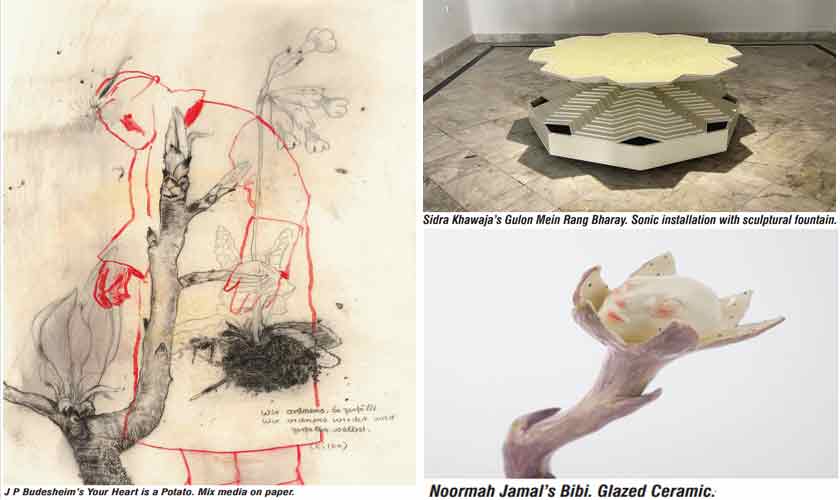
A number of participants indicated this gloomy scenario, particularly JP Budesheim in his mixed media work on paper (two drawings, named Your Heart is A Potato, and the other three called Gardener, with separate numbers).
Sensitively drawn and layered imagery unfolds mankind’s intervention and invasion of nature, either for the sake of pleasure or for the cause of scientific research. Human figures, in a spacesuit and the gear of an agriculturist (or disinfectant worker) next to vegetation, remind one of the ways the mankind is disrupting the ecosystem.
One way forward to get out of this situation would be to revert to nature. Respect it, listen to it and connect with it. For centuries, human beings have been replicating earthly or heavenly gardens in their imagery. In the recently concluded group show, some artists interpreted the idea of garden in personal, ritualistic and social contexts, ranging from Danish Gahlot’s lines of terracotta pots growing plants; to Noormah Jamal’s glazed ceramics depicting familiar characters as a blend of human and plant; to David Alesworth’s mixed media print and collage, titled The Machine in the Garden; and Marjan Baniasadis’s Woven Whispers (oil on canvas); our diverse observations, recollections and comments were recorded and represented.
A few other participants proposed reflection and resistance through the motif of garden, parallel to the forma and aesthetics of poetry, in which traditional diction of beauty, flowers, water, is employed to communicate complex content. Wajeeha Batool’s single channel video, Just Keep Swimming, was an example of this strategy.
A paper boat continued to float (hence, survive) on dark water filled with leaves of varying greens. Sidra Khawaja’s sonic installation with sculptural fountain, titled Gulon Mein Rang Bharay, was composed of levels of white hexagonal sheets, with water jetting from the centre, along with the artist’s voice singing the ghazal.
In Khawaja’s work, a flower becomes a garden, and water is in sync with sound which, using the idiom of poetry, conveys revolutionary content.
Khawaja’s selection of form and poetry was highly imaginative and impressive. What the bard yearns for in the opening line — wishing flowers to bloom with colours, as a means to suggest change in social structure — was transliterated by Khawaja, by keeping her flower blank white and attaching the heart wrenching melody.
Garden of Times, thus, offered multiple views and possibilities of garden, time and the language of art, all interlaced by Mustafa in her pristinely constructed and creatively executed curatorial project.
Quddus Mirza is a senior art academic and critic