Print Story
X




A five-part docu-series compels viewers to reflect on power, narrative formation and ideological warfare
| T |
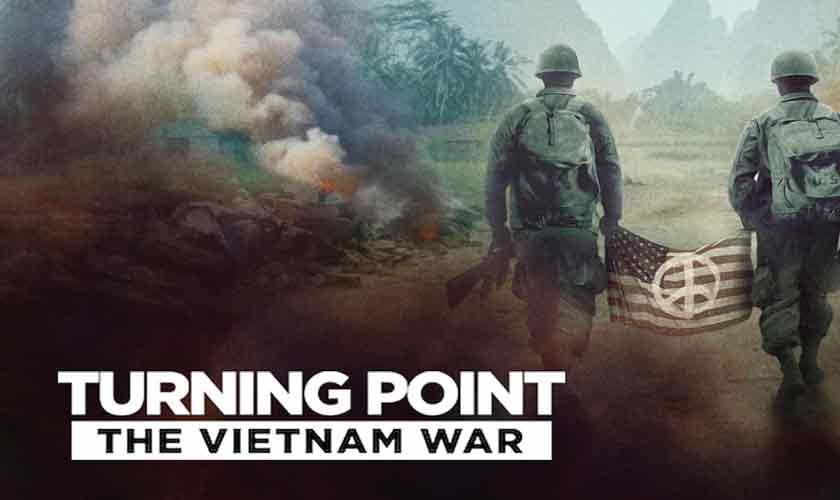
urning Point: The Vietnam War, the latest Netflix docu-series from Brian Knappenberger, arrives at a moment when history feels dangerously cyclical. Released to coincide with the 50th anniversary of the fall of Saigon, the five-part series is not just a chronicle of one of America’s most divisive military entanglements, it is a searing meditation on power, disillusionment and the cost of ideological warfare. Where many documentaries fixate on tactics or battlefield heroics, Turning Point sets its sights on something far more intimate and damning: the machinery of misinformation, the psychological devastation of war and the way truth becomes a casualty long before soldiers ever step on foreign soil.
Knappenberger, known for Turning Point: 9/11 and the War on Terror, returns with a similarly panoramic lens. The Vietnam War, he suggests, was not merely a military failure. It was also a moral and political collapse that reverberated through generations. The series begins with a gripping retelling of the Gulf of Tonkin incident, the murky naval clash that led to a full-scale US commitment to Vietnam. From the outset, archival footage and White House recordings reveal a calculated strategy to manipulate public perception. Lyndon B Johnson’s confident reassurances, paired with images of growing chaos, serve as an early thesis: that the war’s most persistent battle was for the American mind.
The real brilliance of the series lies in its commitment to complexity. This is not a tale of good versus evil. Instead, Knappenberger weaves a narrative through the voices of people on all sides of the conflict: Vietnamese veterans, Viet Cong fighters, US soldiers, South Vietnamese officials and war correspondents. These perspectives are not presented to resolve historical ambiguity, but to deepen it. The result is a documentary that refuses to let the viewer rest in ideological comfort. It demands recognition of contradictions— soldiers can be both perpetrators and victims of crimes; governments can be both strategic and reckless; and the line between propaganda and patriotism is razor-thin.
Where many documentaries fixate on tactics or battlefield heroics, Turning Point sets its sights on something far more intimate and damning: the machinery of misinformation, the psychological devastation of war and the way truth becomes a casualty long before soldiers ever step on foreign soil. …
One of the most harrowing threads in the series is its exploration of the psychological toll on American troops. Far from the glorified portraits of World War II, the soldiers in Vietnam are depicted as fractured and often numb. Interviews and reports detail the grim reality of drug addiction in the ranks, with heroin use reaching staggering levels. In a particularly chilling moment, the series touches on “fragging,” the practice of soldiers attacking their own officers out of disillusionment or anger. Such details are not included for shock value; rather, they speak to the immense psychological strain of fighting a war that increasingly seemed unwinnable and unjustified.
“The wars will end and the leaders will shake hands and that old woman will remain waiting for her martyred son and that girl will wait for her beloved husband and the children will wait for their heroic father, I do not know who sold the homeland but I know who paid the price.” - Mahmoud Darwish

The Vietnamese perspective is given equally thorough treatment, with deeply personal accounts of life under bombing campaigns, re-education camps and the long aftermath of so-called liberation. In one segment, a former Viet Cong fighter speaks not triumphantly but with quiet exhaustion, noting how many of his comrades died believing they were fighting for a better future—only for the survivors to see their country fall into a different kind of oppression. These interviews are devastating not for their anger, but for their sorrow. The war, it becomes clear, did not end with American withdrawal. It simply changed form.
Knappenberger also excels at tracing the war’s reverberations on American soil. Newsreel footage of student protests, Nixon’s crackdowns and the chaos of the 1968 Democratic National Convention remind viewers that the war fractured the US as deeply as Vietnam. The series makes potent use of media clips, anchor voices trembling over live footage, television audiences grappling with the first real-time images of war carnage. It becomes evident how Vietnam redefined public trust. After Tet, after My Lai, after Watergate, the American people would never again believe in the absolute integrity of their leaders. The series doesn’t just show how the war was lost in Vietnam—it also shows how it was lost at home.
a documentary that refuses to let the viewer rest in ideological comfort. It demands recognition of contradictions— soldiers can be both perpetrators and victims of crimes; governments can be both strategic and reckless; and that the line between propaganda and patriotism is razor-thin.
If there is a quiet villain in Turning Point: The Vietnam War, it is not an individual or a government, but ideology itself, particularly the kind that refuses to reckon with reality. The domino theory, once a neat justification for intervention, is exposed as a flimsy pretext that failed to account for Vietnamese nationalism or historical context. Through meticulous research and pointed narration, the series lays bare the consequences of letting fear, not understanding, dictate foreign policy.
By the time the final episode concludes, the war feels less like a historical event than a mirror. Knappenberger does not preach, but the parallels are difficult to miss. America’s ongoing struggles with intervention, disinformation and national trauma echo with eerie familiarity. Like its predecessor focused on 9/11, Turning Point uses the past to ask urgent questions about the present: Who controls the narrative? At what point does the pursuit of influence outweigh the value of human life? And how do nations recover from the lies they tell themselves?
This is not easy viewing, nor is it meant to be. Turning Point: The Vietnam War is a meticulous, gut-wrenching work that forces reflection. It refuses nostalgia, rejects simplicity and insists on empathy. In doing so, it becomes more than a documentary. It becomes a reckoning.
The writer has a degree in psychology with a minor in mass communication. She can be reached at ukmaryam2@gmail.com