Print Story
X




Ever since President Trump announced his tariffs, the US market has lost more than $6.8 trillion
| U |
S President Donald J Trump oversaw and championed the rise of MAGA movement, a populist and nationalist political realignment in contemporary American politics, rooted in the disaffection of several segments of the electorate who perceive themselves as neglected by the bipartisan establishment. Emerging during Obama years, the strong backlash to the rise of globalists in American politics and economy articulates a vision of economic protectionism, immigration restriction and cultural conservatism, all underpinned by a nostalgic appeal to a perceived golden age of American greatness. Americans, who failed to realise their American promise and ream, have joined Donald Trump to lead America to become great again. The MAGA movement sees China as its ideological, political and economic challenger, similar to the USSR of the 20th Century. Therefore, President Trump has declared a trade war on Beijing and several other US trading partners.
In his inaugural address, President Trump pledged to impose tariffs on foreign countries to enrich American citizens. The first such test was Columbia. On January 26, when Columbia refused to allow US military planes carrying illegal Columbian immigrants in the United States to land in the country, Donald Trump did not miss a single moment to threaten to suffocate Columbian economy by imposing an immediate tariff of 25 percent on all Columbian imports into the United States. Columbia succumbed to the pressure.
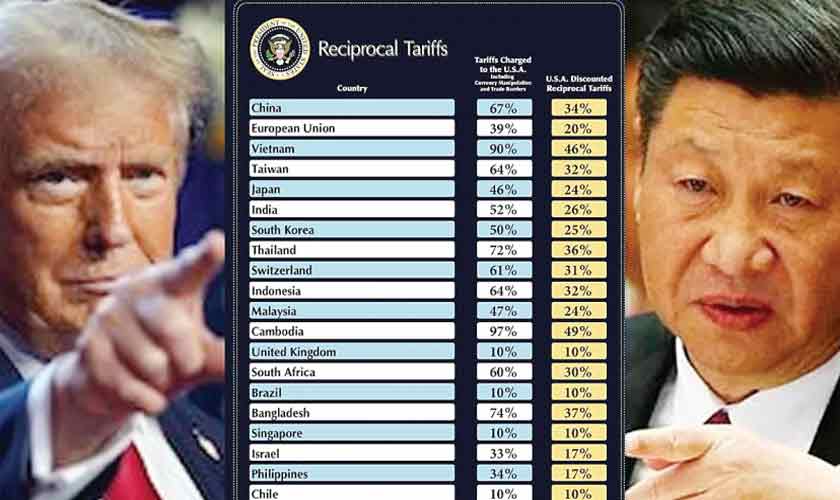
On February 1, President Trump imposed additional tariffs on the three biggest trading partners of the United States; Canada and Mexico were slapped with 25 percent additional tariff and China 10 percent. Canada responded with 25 percent tariffs on American goods and Mexico said it would resist the action whereas China let it go. Between February and March, there were a series of tariffs impositions and pauses, resulting in a total of 145 percent tariff on China, which responded with 125 percent tariffs on imports from the United States. The EU, India, Vietnam, Bangladesh, Pakistan and several other countries have also seen additional tariffs of varying magnitude. President Trump claims that these tariffs are necessary to balance trade between the United States and its trading partners, thus reducing the flow of American wealth to the world and incentivising manufacturing companies to bring manufacturing jobs back to the United States.
Had this plan been executed with more careful planning, it might have spared American and global stock markets some of the chaos they have gone through. Between April 2, when President Trump announced reciprocal tariffs on its trading partners and April 5, more than $6.8 trillion were lost in stock market. The shares of potentially affected companies such as Apple and Nike fell by huge percentages, resulting in panic across the globe and affecting stock markets in Hong Kong, Tokyo, Shanghai and London. Some American economists lamented the move as “worst self-inflicted wound” to American economy. The 25 percent tariffs on auto sector means that already costly cars and trucks will get costlier in the coming months. The immediate impact of this has been the decline in the confidence of American buyer and a looming recession. According to JP Morgan, there is a 60 percent chance of a US recession in 2025. This probability was raised from 40 percent due to concerns about tariffs and their potential impact on global growth.
While recent surveys have shown that American voters are increasingly sceptical of President Trump’s management of the US economy, his approval rating are mostly intact when it comes to other issues such as immigration; deportation of illegal criminals and gangsters; and the promotion of conservative agenda in the United States. It is too early to predict a change in the US political landscape in 2026 mid-term elections. The deportation plans are facing court challenges and, in some cases, courts have ruled in favour of deportees. The ongoing battle in the courts indicates that Democratic Party and civil society organisations are using their professional resources to delay deportations, exhaust judicial options and divest Republican Party and President Trump of the political capital they may have for the mid-term elections in 2026. If the Republican Party loses its razor-thin majority in the House of Representatives, Democratic hawks will sharpen their criticism further and, possibly impeach President Trump yet again. However, given the intense political polarisation, such a move could have unintended consequences.
The global dimension of American tariff war is a byproduct of a new global politico-economic order being shaped by the rise of China and the reassertion of Russia on global stage. While the post-Cold War era was largely defined by unipolarity under American hegemony, recent geopolitical developments signal a decisive shift toward a new bipolarity. China’s rapid economic ascent, technological advancements, military modernisation and assertive foreign policy, especially in the Indo-Pacific region, have positioned it as a credible counterweight to the US dominance. Concurrently, the United States has reinforced its alliances through NATO, AUKUS and the Quad, aiming to contain China’s influence and maintain a liberal international order. This polarisation is further deepened by divergent normative frameworks: the US promotes democratic governance and market capitalism, while China champions state-led development and authoritarian stability. The rise of BRICS – Brazil, Russia, India, China and South Africa – in global economic affairs and the promotion of South-South trade is worrying the United States and its allies whose share in global economy is continuously declining. It is therefore understandable that nations across Asia, Africa, Latin America and the Middle East are recalibrating their foreign policies in response to the changing dynamics of global politico-economic order.
The world is witnessing a structural transition from unipolarity to a multipolarity to a potentially bipolar system, marked by the strategic contest between the United States and China and the assertiveness of regional powers like Russia and India. This redistribution of power has created fertile ground for geopolitical tensions.
The burgeoning national debt of the United States – around $37 trillion now – was exacerbated by the War on Terror and the Covid-19 crisis. During the time when the United States was fighting these challenges, China built its economy, infrastructure and the military power in the region and beyond. Simultaneously, Russia reasserted its role in Eastern Europe and the Middle East. The United States found itself checkmated in great power politics. The realisation of a probable relegation to a lower position in the hierarchical structure of global politics is a painful process. A clash is not inevitable in such adjustments but it does become more probable if trajectories of rivalry, mistrust and zero-sum competition persist. The world is witnessing a structural transition from unipolarity to a multipolarity to a potentially bipolar system, marked by the strategic contest between the United States and China and the assertiveness of regional powers like Russia and India. This redistribution of power, coupled with divergent ideological models – liberal democracy versus authoritarian capitalism – has created fertile ground for geopolitical tensions. Historical patterns suggest that rising powers challenging dominant ones often lead to conflict, though this is a necessary outcome.
In recent weeks, the Trump administration has signaled a potential de-escalation in its ongoing tariff war with China by considering a unilateral rollback of certain tariffs. From a game-theory perspective, this move can be interpreted as a shift in strategy within a repeated non-zero-sum game, where the United States seeks to alter the current payoff matrix in favour of cooperation, or at least mutual restraint. Beijing, however, might interpret this concession not merely as a cooperative gesture but also as an opportunity to recalibrate its strategic posture. Rather than immediately reciprocating with a symmetrical removal of tariffs, China might choose to maintain its retaliatory measures as part of its strategic signaling. By doing so, Beijing could be attempting to alter the future expectations of the game, essentially communicating that unilateral tariff impositions will not go unchallenged and that any return to such coercive trade tactics will carry persistent costs. This strategic choice reflects elements of tit-for-tat within an iterated prisoner’s dilemma framework, where actors condition their responses based on the prior moves of their counterpart. Simultaneously, China may be engaging in deterrence through reputational commitment, attempting to raise the cost of future unilateralism by Washington and shift the equilibrium toward either sustained reciprocity or mutual restraint. President Trump, after having used tariff strategy, may need to use other strategic options to challenge China in its neighborhood. Therefore, a hot war is a possibility.
Any clash between an emerging global power and an established one – whether an escalation of rhetoric or actual violence – is a worrisome development, particularly when it is in one’s neighbourhood. During the last three decades, Pakistan has cultivated deep structural ties with China, ranging from strategic defenxe agreements to structural geoeconomic alignments through China Pakistan Economic Corridor. These ties aim at infrastructure development, defence cooperationand regional connectivity. Pakistan has historically relied on the United States for military aid, economic assistance and diplomatic support at international forums. The dual alignment places Islamabad in an increasingly precarious position as the rivalry between Washington and Beijing intensifies. As Trump administration contemplates the reformulation of a new global order, and as President Xi asserts China’s resolve to retaliate against any American initiative in the trade war, Pakistan could encounter great pressure. An overt alignment with China could risk alienating Western financial institutions, potentially jeopardising access to global capital markets, development aid and trade partnerships. Conversely, distancing itself from Beijing could threaten the flow of Chinese investments, which have become integral to Pakistan’s infrastructure and energy sectors. In the light of Pakistan-China Permanent Friendship Treaty of 2005, it will be difficult for Islamabad to renege from its strategic commitment to Beijing in case of a war in South China Sea. The imperative for strategic hedging is thus paramount. The foreign policy needs to be agile and anchored in principles of non-alignment and regional multilateralism.
In light of the recent escalation in Pakistan-India tensions following the terrorist attack in the Pahalgam area of Indian-occupied Kashmir, it is imperative that Pakistan undertake a comprehensive strategic re-evaluation of its regional and international posture. The rapidly shifting security dynamics in South Asia, marked by persistent hostility, asymmetric threats and an evolving global order, necessitate a recalibrated approach that transcends reactive policymaking. Pakistan must adopt a proactive security doctrine that integrates diplomatic foresight, military preparedness and political coherence to safeguard its national interests in an increasingly volatile geopolitical landscape.
The complexity of contemporary national security challenges requires an unprecedented level of civil-military synergy, particularly at a time when internal political discord threatens to undermine strategic coherence. The ongoing friction between the Pakistan Tehreek-i-Insaf and the establishment has created a political environment fraught with instability. It is important for both the political leadership and the establishment to engage in constructive compromise, aimed at institutionalising a stable framework that ensures civilian supremacy, democratic accountability and constitutional continuity.
Long-term security and prosperity cannot be achieved without earning and sustaining the trust of the citizens. Coercion or elite bargaining alone cannot provide political legitimacy; that requires inclusive governance, transparent decision-making and public confidence in state institutions. The pursuit of national objectives such as safeguarding territorial integrity, sovereignty and socio-economic development is inseparable from the imperative of democratic consolidation.
The writer is a professor of government at Houston Community College, USA. He recently published his book The Rise of the Semi-Core: China, India and Pakistan in the World-System. He can be approached at suklashari@gmail.com